Talk:Uncertainty principle/Archive 5
From Wikipedia, the free encyclopedia
 | This is an archive of past discussions about Uncertainty principle. Do not edit the contents of this page. If you wish to start a new discussion or revive an old one, please do so on the current talk page. |
| Archive 1 | ← | Archive 3 | Archive 4 | Archive 5 | Archive 6 |
machine translation
There doesn't seem to be any English translation available except in an outrageously expensive anthology. The following OCR and machine translation may be good enough so that English speakers can puzzle it out:
http://www.scribd.com/doc/142071642/Heisenberg-Uber-den-anschaulichen-Inhalt-der-quantentheoretischen-Kinematik-und-Mechanik ... German (scans)
http://www.scribd.com/doc/142066606/Heisenberg-Uber-den-anschaulichen-Inhalt-der-quantentheoretischen-Kinematik-und-Mechanik ... German (OCR output)
http://www.scribd.com/doc/142068442/Heisenberg-Uber-den-anschaulichen-Inhalt-der-quantentheoretischen-Kinematik-und-Mechanik ... English (machine translation)
--75.83.76.23 (talk) 16:45, 17 May 2013 (UTC)
To motivate the principle?
In the introduction section of this page, the concluding sentence of the first paragraph uses the phrase "to motivate the pricniple". To the general reader this is meaningless, as a slightly knoweldgeble reader I can only guess that this is in reference to some facts not yet stated. Namely, that there are more than just these two ways to interprate the uncertaity principle and that there is a "motivation" for physists to use these two particular interpretations. But I am only guessing here and even the example I have givien is quite an obtuse use of the word. I have not changed this because I am not quite sure what the origanal author was attempting to say. Even if there is a good reason for using "motivate" here, it needs to be re-written for clarity. Dwightboone (talk) 20:18, 12 August 2013 (UTC)
- The UP is both technical and counterintuitive. Before plunging into the core of the technical argument, the Introduction outlines, as a preamble, the basic motivation of why such a strange principle should be operative at all, and how one could vaguely imagine its necessity and role. As the following paragraphs indicate, in each formulation, the principle has its own logic and function, both quite well motivated, to my mind, and fleshed out technically below. (Of course, in yet other QM formulations, the UP has yet different presentations and motivation! What is covered here are the two best known ones, matrix and wave mechanics. But, then, e.g. in section 4.2, other formulations are covered, as well, which are too technical to be featured earlier in the article.)
- But, of course, you could propose compelling improvements here. It is not clear if you are seeking more content, or if you misconstrued the established use of "motivate" in this context. I suspect you are keen to help the non-technical reader in Introduction_to_quantum_mechanics, not here. Cuzkatzimhut (talk) 21:02, 12 August 2013 (UTC)
- Dwightboone brings the following collection of words into question:
The following attempts to motivate the principle in these two interpretations.
- It took me several attempts before I could construe the quoted material as a sentence, since I grouped two words together, "following attempts." I think it was supposed to be, to paraphrase, "The following discussion is an attempt to..." What the last part is intended to mean escapes me. I can guess, but only with the feeling of standing on the highest rung of a ladder while grasping a branch blowing in the wind. To me, "to motivate" means "to supply psychological pressure on somebody to get him/her to try to do something." "The CEO motivated senior staff members by offering a substantial bonus if certain goals could be met." The idea of "motive" is not one that applies to physics (unless we go back to Aristotle, perhaps). The writer is apparently trying to say that the discussion to follow will express something about the uncertainty principle as it applies to two interpretations of quantum mechanics. Is it like saying that the following discussions will, metaphorically speaking, give life to the uncertainty principle and show how it functions in relation to the two interpretations? I have no idea. I am only guessing. Good writing is, among other things, writing that avoids making readers come up with guesses about the intended meaning of an essay. P0M (talk) 07:41, 16 August 2013 (UTC)
- P.S. Could you, Cuzmatzimhut that is, mean "justification" instead of "motivation"? There are reasons why heat needs to be explained in terms of motion. There are justifications for using the idea of atoms and/or molecules moving around to explain heat. Theories and narratives may have reasons behind them, and they may be justified by evidence and logical reasoning, but humans and other animals have motives for doing things. Sometimes humans are motivated to make certain claims in theory, history, law, etc. and they may be motivated to do so by psychological factors, e.g., the love of truth, the love of money, the desire for revenge or self-justification, etc. P0M (talk) 08:04, 16 August 2013 (UTC)
- I'm against the use of 'motivation'. I can find no definition that would fit the context here, so I suspect it is a misuse of the word. I'm with POM in the use of something like 'justification' - or maybe 'give (good) reason for', or simply 'explain': 'The following attempts to explain the principle under(?) these two interpretations.' Myrvin (talk) 10:34, 16 August 2013 (UTC)
I'm leaving on vacation today, so I cannot be helpful. I supplanted "motivates" by a weak placeholder. I did not introduce that term, but it comports with physics texts, universally, Victorian-sounding as it might be. The OED specifies: "to provide or supply a motive to", as in "Goethe's art was not dramatic [...] he motivates too much for the stage." It is the answer to the question "Why bother with this?". But, indeed, the web is flooded with the meaning you all focus on. The broader meaning that was evidently being used basically amounts to "justify the plausibility of....", and is standard in physics texts: "To motivate the application of the Golden rule in this context, consider...". But if it confuses too many, well, a better substitute might serve. I hope you come up with a better one. Cuzkatzimhut (talk) 11:24, 16 August 2013 (UTC)
- I am going to have to backtrack on this. Digging further, the OED says:
To provide or serve as a rationale for (some action, etc.); to justify.
Chiefly used in academic, esp. scientific, contexts.
1970 Nature 4 Apr. 44/1 The publisher motivates the slim size of these volumes by claiming it makes them more likely to be read.
1973 Physics Bull. Apr. 234/3 The demand for a relativistically acceptable version of momentum conservation is used to motivate the introduction of relativistic concepts of dynamics.
1988 Linguistics & Lang. Behavior Abstr. Dec. 1556/2 Three structural patterns are empirically motivated & theoretically accounted for.
2000 Speech Communication 32 187 The demiphone is motivated and experimentally supported.
- So it's not a misuse of the term, especially in scientific contexts. But it is confusing for some - including me. Myrvin (talk) 13:22, 16 August 2013 (UTC)
- We should be writing so as to minimize the overhead for readers trying to deal with something that is conceptually very difficult to begin with. The whole paragraph is badly written.
The uncertainty principle can be interpreted in either the wave mechanics or matrix mechanics interpretation of quantum mechanics. In wave mechanics the principle is a more visually intuitive interpretation, whereas it was in matrix mechanics where it was first derived and is a more easily generalized interpretation. The following rationalizes the principle in these two interpretations.
- "UP principle interpreted by interpretation," if we reduce the sentence to the bare bones. It suggests that people interpret things by using another interpretation. "UP principle is an interpretation, whereas it is another interpretation." Principles are not interpretations.
- What was the writer of this paragraph really trying to say? A "principle" is something that rests on clear observational evidence. People can give an interpretation of the Uncertainty Principle in terms of what its practical consequence are in one context or another. If we begin with a wave picture of the quantum world, then we can show where the indeterminacy comes from by looking at the consequences of trying to shape a wave so that it has a clear location and also of trying to shape a wave so that it has an unambiguous frequency. If we begin with a matrix picture then the indeterminacy comes right out as a consequence of matrix math. So rather than simply stating the above two ideas dogmatically, the article will next demonstrate how uncertainty manifests itself by looking more closely at a wave description and a matrix description.
- Have I got this right? Or have I made a muddle of my own that doesn't get at what the quoted text is trying to say?P0M (talk) 15:54, 16 August 2013 (UTC)
- I intended the same meaning as "To provide or serve as a rationale for (some action, etc.); to justify. Chiefly used in academic, esp. scientific, contexts." To some, the uncertainty principle appears to be pulled out of thin air, so the introduction helps to motivate (i.e. justify) the principle. If you prefer a different wording, then change it yourself. I see some change has already been made. In any case, I'm pleased to see the discussion has moved away from people linking to their self-published fringe views to more mundane problems like word choice. Teply (talk) 09:49, 17 August 2013 (UTC)
- Thank you. I was definitely out of the loop on the meaning of "to motivate" used in this article. Since that understanding is not reflected in the New World Dictionary of the American Language that I have at hand, I have used Teply's most helpful paraphrase as a basis for understanding and reformulating the paragraph in question. The key need seems to be to allay the impression that the uncertainty principle "appears to be pulled out of thin air," so I have tried to work things around to where the uncertainty principle becomes justified to us because it shows itself and its key role in a couple of contexts that we can more easily understand. I hope this way of doing things is suitable. P0M (talk) 17:21, 17 August 2013 (UTC)
- I intended the same meaning as "To provide or serve as a rationale for (some action, etc.); to justify. Chiefly used in academic, esp. scientific, contexts." To some, the uncertainty principle appears to be pulled out of thin air, so the introduction helps to motivate (i.e. justify) the principle. If you prefer a different wording, then change it yourself. I see some change has already been made. In any case, I'm pleased to see the discussion has moved away from people linking to their self-published fringe views to more mundane problems like word choice. Teply (talk) 09:49, 17 August 2013 (UTC)
IP edit needs looking at
Could someone who understands the relivant equations check if this is legit:
https://en.wikipedia.org/w/index.php?title=Uncertainty_principle&diff=577478786&oldid=577299432
Geni (talk) 21:04, 16 October 2013 (UTC)
- Looks sensible. Aren't the dimensions soundly matched now?Cuzkatzimhut (talk) 21:27, 16 October 2013 (UTC)
Robertson–Schrödinger uncertainty relation
Is self-adjointness really needed resp. where is it needed? Wouldn't it be fine, when the operators A and B are symmetric, i.e. satisfy "<A f, g>=<f, A g>" for f, g in the domain of A (which in general is something different than self-adjointness). -91.63.245.130 (talk) 02:35, 15 November 2013 (UTC)
References to anti-quantum pseudoscience
Could a kind editor please remove all the nonsense that has accumulated throughout this article about Heisenberg's original principle being misleading and the references to the completely wrong recent papers that claimed to circumvent it? The reason why none of this stuff is taught by the credible textbooks is that all this stuff is completely invalid and there is nothing wrong about the uncertainty principle.
As this article completely fails to explain, the principle is the true conceptual pillar of quantum mechanics, the formulation summarizing the key novelty of quantum mechanics relatively to classical physics, and whoever doesn't understand these basic points is lacking the competence that should be required for editors of articles about quantum mechanics. --Lumidek (talk) 10:29, 15 December 2013 (UTC)
- This seems to me to be an overly sweeping statement. Perhaps you are just so convinced of the principle's foundational nature that you are not prepared to consider other things as being more fundamental, with the uncertainty relation as an emergent property? To me, even as a layman, it seems obvious that the wavefunction (from which the uncertainly principle can be derived) is far more fundamental. Indeed, I strongly doubt whether any inequality in quantum mechanics can be truly "fundamental" (i.e. not derivable from a more complete underlying model).
- The lead as it stands seems to present the picture reasonably accurately, showing that care of interpretation is called for, and in particular that an interpretation associating it directly with measurement/observation is flawed. —Quondum 15:42, 15 December 2013 (UTC)
- It's the very purpose of science to acquire and establish insights – sweeping statements are the best ones – and it is indeed the result of the research into these topics. Quantum mechanics works, it is fundamental, and all the proposed alternatives or attempts to make it non-fundamental have been ruled out. So it's just wrong to write texts in encyclopedias that obscure this scientific fact or that even downright contradict it. It is exactly as wrong as writing that the Earth is flat or that the species were created in 6 days. --Lumidek (talk) 17:57, 15 December 2013 (UTC)
QM is about expectations, and so is HUP
This article makes a serious error right up front. The principle does not apply to a single particle. It only applies to an ensemble. The relationship can only be derived by considering the standard deviations of multiple states. This is either multiple particles or the same particle multiple times. It is simple to show that Quantum Mechanics has nothing to say about a single particle. This thought experiment, for instance, is due to de la Pena: prepare a beam of electrons with precise momentum; this can be as precise as you like; then measure the position of one of the electrons as accurately as you like. You can easily beat the HUP relation. Jschlesinger (talk) 15:23, 16 July 2013 (UTC)
- I moved this new discussion of Jschlesinger to the bottom of the page, here, as invited by the section heading. Please, try to stick to the house rules.
- There is no serious error, as far as people with a minimum of physics background are concerned, and it is patently untrue that "Quantum Mechanics has nothing to say about a single particle". It has a lot to say about the probability of features of a single particle, normally probed and verified statistically by a population of similar particles. This is, of course, the point of quantum mechanics, namely that quantitative characterization of a particle's properties ("known" in the article's preamble) involves mere probabilities. The article clearly states right up front that the HUP is a statement on probabilistic expectations. How would you propose to improve the phrasing, in a meaningful way? (I adduced De La Peña's article in the mangled refs of stochastic quantization, but any mumbling in that direction would do this article, HUP, a major dis-service.)
- A lot of good it would do to one to have accurate measurements that could not be predicted or understood. QM takes you all the way to the collapse of the wave-function, but no further, which is where you insinuate it could go (?). You certainly don't learn much new about a particle's QM properties after the collapse of its wavefunction, beyond making sure that the wf contemplated/calculated was, indeed, the correct one—and normally the wf is probed statistically by a population of several particles in a repetitive collapse. Cuzkatzimhut (talk) 18:53, 16 July 2013 (UTC)
- I think the main thing the OP is forgetting is that a "beam" of electrons (or photons, or anything else for that matter) does not have 100% uniformity with regard to all of its constituent particles. So while you would know the average momentum of all the electrons in the beam, you would not know the exact momentum of any single electron in the beam without making a separate measurement. — Preceding unsigned comment added by Hatster301 (talk • contribs) 12:35, 17 July 2013 (UTC)
- You would think that, wouldn't you, forgetting the premise of the discussion, that the probability of momenta outside a range of that beam has already been established to be small. So, with overwhelming probability, the momentum of the individual particle observed (with virtually infinite precision in position) is pretty well known... The UP is a statement of probabilities of a single particle. I might as well quote directly from §3 of Dirac's classic, "The Principles of Quantum Mechanics", p.9:
- I think the main thing the OP is forgetting is that a "beam" of electrons (or photons, or anything else for that matter) does not have 100% uniformity with regard to all of its constituent particles. So while you would know the average momentum of all the electrons in the beam, you would not know the exact momentum of any single electron in the beam without making a separate measurement. — Preceding unsigned comment added by Hatster301 (talk • contribs) 12:35, 17 July 2013 (UTC)
"...the wave function gives information about the probability of one photon being in a particular place and not the probable number of photons in that place. ... The new theory, which connects the wave function with probabilities for one photon, gets over the difficultay by making each photon go partly into each of the two components. Each photon then interferes only with itself. Interference between two different photons never occurs." Cuzkatzimhut (talk) 08:05, 13 November 2013 (UTC)
- This (OP's statement) isn't true, as others have already responded. I think whether the relationship between HUP and other aspects of QM (like wave-particle duality / self-interference) is fundamental or not is still open to argument, as is the role of expectation; but if you think QM has nothing to do with individual particles I'd be very happy to place a large wager at scant odds on a single measurement (free money is as useful to me as it is instructive to the person losing it). TricksterWolf (talk) 22:26, 23 December 2013 (UTC)
"known" vs "measured"
There's a common misconception among laypeople that the uncertainty principle is about human consciousness. The principle prevents humans from "knowing" certain attributes simultaneously. I'd like to suggest something similar to this edit, but I'd like to open the discussion generally just in case there's an even clearer way to avoid this issue.
> certain pairs of physical properties of a particle known as complementary variables, such as position x and momentum p, can be known simultaneously
> certain pairs of physical properties of a particle known as complementary variables, such as position x and momentum p, can be measured simultaneously
I've also seen "known in principle", to distinguish "known by someone" from "potentially knowable by anyone".
Sorenr (talk) 16:30, 1 March 2014 (UTC)
- I suspect your discussion belongs to a physics forum, instead. The third paragraph already explains why "measurement" is deprecated, as it might lead to confusion about ingenuity of technology. "Knowing" in the technical sense has little to do with human consciousness and all this nonsense. In physics parlance, "known" means inferred by experimental means, direct or indirect, by anyone and everyone. This is an article on physics (if not Fourier analysis) and not philosophy. The last thing this article needs here is flakey disquisitions on whether the moon is there when a mouse looks at it and all that. I would very strongly oppose the changes proposed, even though "in principle"s might help. It might be helpful if you took a closer look at the unproductive circular discussions on this , archived in scary voluminousness, raging for years and resulting in repetitive damage. Cuzkatzimhut (talk) 17:31, 1 March 2014 (UTC)
basic probability theory rules that i think should be taking into account
I thought about some anomaly stuff that exists in the basics of probability theory , that could have some implication in QM: Max Born probabilistic interpretation and Uncertainty principle. And it will insert some set theory based math to physics( measure theory which is basis of modern probability is based on set theory) .
QM physics and any statistical theory presume strong law of large number holds all the time ( when n->inf average=mean ) But The strong law of large number holds only when the expected value of probability density function converges surely ( by the mean of Lebesgue integration), there are many probability density function that either the expected value or second moment does not hold this condition( they can converge by other types if integral such as improper reiman or gauge integral ( see here the status on integration definition in math http://www.math.vanderbilt.edu/~schectex/ccc/gauge/ gauge integral also has some connection with QM path integration)
so if some wave function has no first or second moment according to Lebesgue integration then what is the SD and expected value of position for example?
And if there is no such wave functions ( I don’t think it’s true because Cauchy/Lorentzian distribution is in use now) , then such limiting conditions should be taken into account . ( adding to the demand that integral |Psy|^2 dx =1, integral |x|*|Psy|^2 dx < inf and integral x^2*|Psy|^2 dx < inf ) — Preceding unsigned comment added by Itaijj (talk • contribs) 12:56, 19 April 2014 (UTC)
Odd comma
Is the comma in the equation in box in the lead significant? It looks like it does something to the 2. Myrvin (talk) 13:56, 19 April 2014 (UTC)
I see that, later on, it isn't there. I've removed it. Myrvin (talk) 14:10, 19 April 2014 (UTC)
- The comma is not part of the formula, but part of the sentence, and according to MOS:MATH#PUNC, it should be there. I agree that it looks weird with the comma inside the box, but to avoid that I'd rather suggest to drop the box. The formula is outstanding enough as the only displayed formula in a long block of text, so the frame only makes it look a bit like an infobox or image, as if it was not really part of the text flow. — HHHIPPO 22:21, 19 April 2014 (UTC)
- The original comma was too close to the 2, but this has now been fixed. It is not weird. It is only weird to readers who are unused to the formulas-are-text convention, subverted by poor editing. The box is essential. There are only a few truly important formulas in the article, and they should be boxed and otherwise highlighted. Ideally, a reader looks at those first and appreciates what is involved, and decides whether to read anything else at all, or leave. Cuzkatzimhut (talk) 00:38, 20 April 2014 (UTC)
- That works only for readers who can understand the formulae without reading the text, I'm not so sure that's a typical situation. The elements that should give you an overview of what the article is about are the lede and the TOC, not some boxes further down. But never mind, I'm happy to keep the boxes if everybody else likes them. — HHHIPPO 07:27, 20 April 2014 (UTC)
- The original comma was too close to the 2, but this has now been fixed. It is not weird. It is only weird to readers who are unused to the formulas-are-text convention, subverted by poor editing. The box is essential. There are only a few truly important formulas in the article, and they should be boxed and otherwise highlighted. Ideally, a reader looks at those first and appreciates what is involved, and decides whether to read anything else at all, or leave. Cuzkatzimhut (talk) 00:38, 20 April 2014 (UTC)
Masanao Ozawa
Hasn't the uncertainty principle recently been reformulated by Masanao Ozawa? See http://arxiv.org/abs/1402.5601
In which case shouldn't the reformulation be stated at the top of the article very clearly?88.203.90.14 (talk) 21:54, 15 May 2014 (UTC)
- Please see section 4.3. The coverage is appropriate and in a suitable position. It is a technical sideshow for experts and certainly has no conceptual impact on the way one understands quantization. Cuzkatzimhut (talk) 00:17, 16 May 2014 (UTC)
Proof of the Kennard inequality using wave mechanics confusion
The proof part with the integration by parts in confusing because of the the two x's that are used are different, I suggest Chi for one of them. Also, should we include a note that tells the reader that the last step is via Dirac-deltas? Andy Jiang (talk) 04:32, 24 September 2014 (UTC)
- ??? Appears like standard textbook material and standard Fourier analysis. What do you propose, explicitly, to make it better? what two x's are you referring to?Cuzkatzimhut (talk) 14:53, 24 September 2014 (UTC)
- Unless I'm mistaken, one of the x's is for the function g as input and the other is a dummy variable. Otherwise, in the second last step, it would look as if you could cancel terms. I changed it now, tell me if you agree.Andy Jiang (talk) 23:20, 24 September 2014 (UTC)
- I see your point.Agreed. The dummy variable, integrated over, should indeed be something different. The eye slid over the dual use all too easily. Constructive move. Cuzkatzimhut (talk) 23:30, 24 September 2014 (UTC)
Question about your diagram of Heisenberg's microscope: How are the incoming photons directed?
Does your diagram of the Heisenberg microscope have the incoming light coming from the right direction? See
Citations
This is a very poorly cited article. There are large tracts with no citations at all. We need to know where all that stuff comes from. Myrvin (talk) 09:46, 20 January 2015 (UTC)
- Inappropriate complaint. The sections that were defaced by counterproductive citation templates, all in the name of improving the article!, are amply referenced in the main articles linked, to which the reader who does no appreciate the elementary nature of the remarks involved should turn to for help. The formal examples are standard quantum mechanics, and it is egregiously unreasonable to expect a truckload of one's preferred quantum mechanics texts tacked on for "verification"?! The reader unable to recognize these summary examples (not learn about them--this is not a tutorial!) should do due diligence and go inform himself in the main articles. I find the citation templates pointless, distracting, and tendentious. Please remove them. Cuzkatzimhut (talk) 13:28, 20 January 2015 (UTC)
- You are saying that the material in this article doesn't need reliable sources and citations. I find that assertion amazing. Every article should have RSs to verify the statements in the article. You seem to be saying that it is the reader's responsibility to provide verification and not the editor's. This is incorrect and not WP policy. I don't have any favourite textbooks. I am an interested general reader who would like to know where all this uncited material comes from. The article should tell me that. WP links are not the way to verify such statements. I find your comments rude. Myrvin (talk) 14:04, 20 January 2015 (UTC)
- I am saying that evident illustrations of the point in the article do not need "reliable" sources on the spot, given the main articles they provide shorthand summaries and excerpts of. I did not attempt rudeness, I attempted emphasis on the main articles, evidently missed: the entitled reader motivated to seek sources owes due diligence to the main articles. My point was that any QM text would cover that material, just as any elementary geometry book covers the Pythagorean theorem and no ponderous sources are needed to "verify" its reliability. Dozens of editors have been toiling on this for years, in a collective effort and the "uncited material" is not slavish copying off a particular text, but self-evident community knowledge. Trust the physics community. I strongly believe the problem is non-physicists coming to this article and expecting to pick up QM in a couple of paragraphs and cites to somebody's favorite introductory books. Cuzkatzimhut (talk) 15:28, 20 January 2015 (UTC)
- You are saying that the material in this article doesn't need reliable sources and citations. I find that assertion amazing. Every article should have RSs to verify the statements in the article. You seem to be saying that it is the reader's responsibility to provide verification and not the editor's. This is incorrect and not WP policy. I don't have any favourite textbooks. I am an interested general reader who would like to know where all this uncited material comes from. The article should tell me that. WP links are not the way to verify such statements. I find your comments rude. Myrvin (talk) 14:04, 20 January 2015 (UTC)
If you must, cite your L&L, L.D. Landau, E.M. Lifshitz (1977). Quantum Mechanics: Non-Relativistic Theory. Vol. Vol. 3 (3rd ed.). Pergamon Press. ISBN 978-0-08-020940-1. {{cite book}}: |volume= has extra text (help) Online copy, in lieu of the disturbing passive-aggressive templates. Cuzkatzimhut (talk) 15:47, 20 January 2015 (UTC)
- I have done some checking to see if science articles have a special dispensation when it comes to citations. I have been pointed to WP:SCICITE. I'm sure you have read that, being a science article editor. It says about uncontroversial knowledge: "The verifiability criteria require that such statements be sourced so that in principle anyone can verify them". Myrvin (talk) 18:44, 20 January 2015 (UTC)
OK, I'll do it (above) with a heavy heart. "Whose verifiability has been challenged"? Oh dear... Cuzkatzimhut (talk) 18:59, 20 January 2015 (UTC) Done. A perceptive, well-meaning reader can avoid interminable bogus "choices" between L&L and Griffiths... The important point is that these are, and should be, "reminder" paragraphs, not a tutorial. Cuzkatzimhut (talk) 19:14, 20 January 2015 (UTC)
- I think you must be new to this WP:verification and wp:Citing sources lark. The idea is that a reader is able to check the particular material by looking it up in the cited wp:reliable source(RS). Citing a whole textbook does not do the job. For the Examples section, those particular examples must appear in a RS, on a particular page or pages. If the examples do not appear in an RS, then they are WP:Original research, and should not be included. The same goes for the Wave mechanics and Matrix mechanics sections: the material must be on particular pages somewhere. It's called Identifying parts of a source. You can see how it is done in most of the other citations. However, I see there are many missing. By the way, it's not a good idea to put a citation on the section name line - the citation number appears in the Contents. Myrvin (talk) 12:43, 23 January 2015 (UTC)
- I note in WP:SCG the following about examples:
For reasons of notation, clarity, consistency, or simplicity it is often necessary to state things in a slightly different way than they are stated in the references, to provide a different derivation, or to provide an example. This is standard practice in journals, and does not make any claim of novelty.[1] In Wikipedia articles this does not constitute original research and is perfectly permissible – in fact, encouraged – provided that a reader who reads and understands the references can easily see how the material in the Wikipedia article can be inferred.
- Of course, you need to state the references from which the "slightly different way" is derived.Myrvin (talk) 13:24, 23 January 2015 (UTC)
- I am done---and traveling abroad, so therefore unable to help. You try to do it yourself, and hope the hundreds of editors who put that in correct you. I gather you utilized version control to find them, in the first place. Cuzkatzimhut (talk) 15:19, 23 January 2015 (UTC)
This seems to be one of those silly discussions of guidelines, where exactly to apply them, how exactly to apply them, WP:THIS and WP:THAT, etc.
Yes, common sense alone tells that every article needs reliable references, we should know that. Page numbers are important for actually demonstrating the information is in the source in a specific place. But it's not an immediate problem, editors will add them as and when they can, there is no rush or timetable. You (Myrvin) and anyone is free to add "citation needed" templates wherever they are relevant. I disagree with Cuzkatzimhut that they are "distracting" (if in the text, IMO they are not there), but he is not "being rude".
I agree that the citations (and templates) should not be in the section headings themselves, but in the text wherever needed (after a claim). For one thing, they are distracting there (could you imagine four or five cites in a section title?). For another, an entire section (which may include subsections which in turn could include subsubsections etc.) is too much to refer to a source in one go, because there may be a sentence or more in the section which are not in the source, but written as if they are. References for large portions of the article can be listed in the reference section at the end, specific claims need citations. M∧Ŝc2ħεИτlk 19:53, 23 January 2015 (UTC)
- Thanks. I'm not sure I had ever seen a citation in a section heading before. I think there is a larger argument here that I've heard before - maybe in science articles. Some editors seem to think that what they are including is obvious. They think anything obvious needs no citation. Also, some think that what they write is obvious if only the reader were clever enough, or if the reader knew about the subject beforehand. For this material, they consider that it is up to the readers themselves to find out about the material (or become cleverer) because "this is not a tutorial". I've read that phrase more than once. Some also think that a wikilink is as good as a citation. "Go and look at the other articles!" they say. Then, if you do follow the links, you may find that the material is either not there, or is uncited as well. Myrvin (talk) 20:40, 23 January 2015 (UTC)
- Weirdly, the "don't expect a citation, look at the wikilink" argument has just been made to me on Big Bang. Myrvin (talk) 21:12, 23 January 2015 (UTC)
- I thought <ref></ref> syntax was not supposed to be used in headers because of the code it creates. 95.144.169.113 (talk) 17:19, 10 March 2015 (UTC)
The uncertainty principle as a force?
I recently had a discussion at the Science Refdesk about white dwarfs. It seems - as our article on electron degeneracy pressure sort of explains - that since electrons are subject to the Pauli exclusion principle, and measuring the mass of the star means we know it has n electrons, and we know each of those states is distinguishable, which is to say, the difference between them can be measured, it follows that the actual distribution of the electron momenta is forced to have values that differ by the amount of the uncertainty. There are some details that are less clear, like why the math at the link above is based on h whereas here it would seem to be h/4 pi - though there we are speaking of the actual allowed difference between particles and here we're speaking of the standard deviation...
My understanding is incomplete, but it seems amazing that the uncertainty principle can apparently hold up the surface of a star. It would be really nice if someone can go through it here, and if possible list other examples where the principle is doing something more 'active' than just blunting our measurements. Wnt (talk) 02:36, 26 March 2015 (UTC)
- I only causally watch this page, but the "experts" are likely to find that this conversation takes us too far into quantum mechanics proper. Loosely speaking, the uncertainty principle requires a higher uncertainty in the momentum, and hence more kinetic energy if the white dwarf's electrons if the star is too small. You can "guess" a lot of truth from the equation , but such insights might not belong in this Wikipedia article. Someday we will get to this on Wikiversity, but right now I am up to my ears in freshman-level concepts.--Guy vandegrift (talk) 05:01, 26 March 2015 (UTC)

- Indeed, you should not be on this talk page, and I disagree that the article needs any mention of pseudo-forces, or Pauli pressures, which, at the very worst, might belong to de Broglie wavelength, or properly, Exchange force, or even Degenerate matter. I suspect you are misusing the precise term "uncertainty principle" as a loose placeholder term for the inverse linkage between wavelengths and momenta in QM Fourier analysis. Cuzkatzimhut (talk) 10:44, 26 March 2015 (UTC)
- @Cuzkatzimhut: The article on electron degeneracy pressure mentions the Heisenberg uncertainty principle already, and redlinks "Heisenberg speed"... it's just really confusing about it. Can you make that text clearer without introducing any technical inaccuracy that I might? Wnt (talk) 23:49, 27 March 2015 (UTC)
- Indeed, you should not be on this talk page, and I disagree that the article needs any mention of pseudo-forces, or Pauli pressures, which, at the very worst, might belong to de Broglie wavelength, or properly, Exchange force, or even Degenerate matter. I suspect you are misusing the precise term "uncertainty principle" as a loose placeholder term for the inverse linkage between wavelengths and momenta in QM Fourier analysis. Cuzkatzimhut (talk) 10:44, 26 March 2015 (UTC)
- Apologies, I don't have the time to do a half-decent job. As it stands, the paragraph is meaningless, and the bizarre "unfunded mandate" redlink on "Heisenberg velocity" sheer flakey nonsense. Frankly, that stub should not exist, but, instead, be a more organized section of the main article, degenerate matter. The Pauli exclusion principle and the many-body exchange interactions are far more relevant, but of course, as always in Fourier analysis, there are inverse correlations in position and momentum spreads in these statistical multiparticle distributions quite analogous to what is being discussed in this , UP, article for one particle. I can't easy salvage a flawed paragraph, but you might try... Adducing a mainstream reference might help. All I could do is decrimson the hapless "Heisenberg velocity" bluff and link to the main article. Unfortunately, the main article itself is flawed when it comes to the hand-waving poetry of the UP, cf Talk:Degenerate matter/Archive 1#Use of Uncertainty Principle as a means of Explanation, a conversation I would rather not get drawn into.... Of course, I am broadly siding with the critics there... Cuzkatzimhut (talk) 01:27, 28 March 2015 (UTC)
Number of states as 2σxσp/ħ ?
Is the two in the denominator represent the fact that p can be plus or minus? Can I just multiply by the std deviation percentage σ=0.341 squared to count states in a given x*p like this below? If the number of states I always here about is this, then it would be worth mentioning on the page.
number states ?

I was able to derive the entropy equation from using Shannon's H for information, but it required the above to be true so that I could count states in a square box instead of spherical phase space volume of states. Ywaz (talk) 12:45, 28 January 2016 (UTC)
- Hi. I do not think so. The Fourier transform of a wave packet gives
- The factor 2 comes from Kennard. He found that, for a gaussian wave packet,
- Therefore
- Since
- Kennard finally obtained the inequality:


- Stiglich (talk) 13:42, 29 January 2016 (UTC)


![{\displaystyle \epsilon _{A}\eta _{B}+\epsilon _{A}\sigma _{B}+\sigma _{A}\eta _{B}\geq \left|{\frac {1}{2i}}\langle [{\hat {A}},{\hat {B}}]\rangle \right|}](http://wikimedia.org/api/rest_v1/media/math/render/svg/9e212bc97ffe8903683817d62d78b992719951da)


![{\displaystyle \epsilon _{A}\,\eta _{B}+\epsilon _{A}\,\sigma _{B}+\sigma _{A}\,\eta _{B}\,\geq \,{\frac {1}{2}}\,\left|\langle [{\hat {A}},{\hat {B}}]\rangle \right|}](http://wikimedia.org/api/rest_v1/media/math/render/svg/8b3d5d09824d796da94f01b4b5c0d206e1cf8be4)

![{\displaystyle \epsilon _{A}\eta _{B}+\epsilon _{A}\sigma _{B}+\sigma _{A}\eta _{B}+\sigma _{A}\sigma _{B}\geq \left|\langle [{\hat {A}},{\hat {B}}]\rangle \right|.}](http://wikimedia.org/api/rest_v1/media/math/render/svg/0fefac0f8cd140a29cc3041faf1469d786d0c9af)
![{\displaystyle (\epsilon _{A}+\sigma _{A})(\eta _{B}+\sigma _{B})\geq \left|\langle [{\hat {A}},{\hat {B}}]\rangle \right|.}](http://wikimedia.org/api/rest_v1/media/math/render/svg/3f312d8eec3eb44fe7f315653576caa696eedfbf)


![{\displaystyle {\bar {\epsilon }}_{A}{\bar {\eta }}_{B}\geq \left|\langle [{\hat {A}},{\hat {B}}]\rangle \right|}](http://wikimedia.org/api/rest_v1/media/math/render/svg/f8a040ff00036e1db28264132c7b8c8b0becac26)
![{\displaystyle \epsilon _{A}\,\eta _{B}\,\geq \,{\frac {1}{2}}\,\left|\langle [{\hat {A}},{\hat {B}}]\rangle \right|}](http://wikimedia.org/api/rest_v1/media/math/render/svg/4c7a4afa847da5d460f3da5fbd0c4e21b548ede1)


![{\displaystyle \epsilon _{A}\,\epsilon _{B}\,\geq \,{\frac {1}{2}}\,\left|\langle [{\hat {A}},{\hat {B}}]\rangle \right|}](http://wikimedia.org/api/rest_v1/media/math/render/svg/304af0360c130df862f4b0043aec7d8c66f8e8ff)


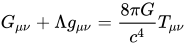 , where ...


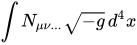


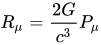
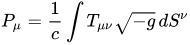







![{\displaystyle [{\hat {R}}_{\mu },{\hat {x}}_{\mu }]=-2i\ell _{P}^{2}}](http://wikimedia.org/api/rest_v1/media/math/render/svg/8d97e0fd3631d9f2a7387a9756d4b652e713056f)





