Maon (city in Judah)
Ancient biblical settlement near Hebron
From Wikipedia, the free encyclopedia
Khirbet Ma'in[1][2] or Tell Máîn (SWP map No. 25), i.e. 'Ma'in Ruins/Tell of Ma'in', or Horvat Maon/H. Ma'on[3][4] (Hebrew for 'Ma'on Ruins'), is an archaeological site in the Hebron Hills, West Bank, rising 863 metres (2,831 ft) above sea level, where the remains of the ancient town of Ma'on (Hebrew: מעון) have been excavated. The town, now a ruin, is mentioned in the Book of Joshua[5] and the Books of Samuel.[6] It still had a Jewish population during the Roman and Byzantine periods, and a synagogue was discovered there. The site was ultimately abandoned around the time of the Muslim conquest.[7]

Horvat Ma'on
| |
|---|---|
Ruin | |
Horvat Ma'on near Hebron (2008) | |
  Horvat Ma'on Location of Horvat Ma'on | |
| Coordinates: 31°24′34″N 35°08′02″E | |
| Grid position | 162/090 PAL |
| Region | West Bank |
| District | Judea and Samaria Area |
| Government | |
| • Council | Har Hevron (Mount Hebron) Regional Council |
| Time zone | UTC+2 (IST) |
| • Summer (DST) | UTC+3 (IDT) |
The site is located about 6 kilometres (3.7 mi) southeast of Yatta. Immediately to the north lies the modern small Arab village of Ma'in.
Etymology
The Hebrew name is variously spelled as Horvat Ma'on,[4] Horvat Maon,[3] or Hurbat Ma'on. Tel Ma'on is sometimes also used.[8]
The Hebrew word ma'on means 'dwelling', 'habitation'.[9]
Horvat, horbat, hurbat, hurvat are transliteration variants of the Hebrew word for 'ruins' and direct equivalents of the Arabic khirbet. Tell is the transliteration of the Arabic word, tel of the Hebrew one, both meaning mound created by accumulation of settlement layers.
In ancient sources
Hebrew Bible
The site is first mentioned as one of the cities of Judah.[10][11] Maon was the place of birth of Nabal the Carmelite.[12] In the Book of Samuel,[13] "the wilderness of Maon" is mentioned as a place of refuge for David when he fled from king Saul.[10] The site is not referred to again in biblical sources.[10]
Late Roman (?) and Early Byzantine period
After the destruction of the Second Temple, there is again a reference to the site, when Rabban Yohanan ben Zakkai is said to have gone up to Maon of Judah.[10][14]
In the early 4th century CE, Maon was mentioned in Eusebius' Onomasticon as being "in the tribe of Judah; in the east of Daroma."[15] During the Late Roman-Early Byzantine period, Darom or Daroma (Hebrew and Aramaic for "South") became a term used for the southern Hebron Hills in rabbinic literature and in Eusebius' Onomasticon.[16][15] At the time, the Hebron Hills were demographically separated into two distinct districts, with only the southern one retaining a Jewish population along with a newer, Christian one.[17] The site was eventually abandoned around the time of the Muslim conquest.[7]
Archaeology
Occupation periods
Archaeologists have discovered at the site potsherds dating back to the Early Bronze Age, the Iron Age (Israelite period) including jar handles bearing the palaeo-Hebrew inscription LMLK, 'for the king', and from the Hellenistic period.[10] Sherds have also been found in situ from the Roman and Byzantine periods, as well as from the Middle Ages.[10] Wine and olive presses from the Roman and Byzantine periods were discovered on the west slope of the tell.[18] The ancient synagogue of Ma'on is dated to the Byzantune period (see below).[18] The absence of material traces from the late 7th-early 8th century are an indication of the abandonement of the village at that time.[18]
Byzantine-period synagogue
A synagogue dating back to the Byzantine/Talmudic period was discovered at Hurvat (Horbat) Ma'on.[19] Two occupation phases were discerned, covering the 4th/5th through the 7th century.[18]
19th-century observations
In 1863, Victor Guérin visited.[12] C.R. Conder of the Palestine Exploration Fund visited the site in 1874,[20] during which time a brief description was written of the site:
Tell Maʻîn –– A mound some 100 feet high. On the west are foundations, caves, and cisterns, and foundations of a tower about 20 feet square. The masonry in this tower is large, with a broad irregular draft and a rustic boss. One stone was 3 feet 8 inches long, 2 feet 9 inches high, the draft about 3 inches wide. There is also a round well-mouth, 5 feet diameter, cut out of a single stone.[21]
20th-21st centuries
Horbat Maon is situated SE of the Arab town of Yatta, on the north side of regional highway 317. By the 1970s, a few Arab families from Yatta had settled on the northern slope of the tell, who work in subsistence farming and graze their flocks of sheep.[22]
In February 2026, reports by the Palestinian news agencies WAFA and Ma'an News Agency described an escalation of Israeli control measures at Tel Maʿin (تل ماعين) in the Masafer Yatta area south of Hebron. According to these reports, Israeli forces issued a military notice of “seizure” (waḍʿ al-yad) over part of the archaeological mound, reportedly for the construction of a military tower, citing security needs and the protection of Israeli settlers who have visited the site for religious purposes.[23][24] Local residents stated that the affected land belongs to the al-Ḥamāmda family and lies approximately 30 metres from their homes, raising concerns of further restrictions on access and movement. Maʿan further reported that, in preceding months, settlers had opened a road approximately 1.5 km long to the summit of the tell and asserted the presence of an “Israeli archaeological site,” while Palestinian residents and activists described visible remains, including stone terraces and architectural features, as dating to the Roman period. The reports also referred to the control of a nearby circular spring structure, around nine metres deep, and to ongoing tensions in the vicinity under Israeli military presence.
Gallery
![The ancient hill of Tel Ma'on,[which?] South Hebron Hills](//upload.wikimedia.org/wikipedia/commons/thumb/7/7f/Tel-Maon-183.jpg/120px-Tel-Maon-183.jpg)
 Tel/Horvat Ma'on near Hebron
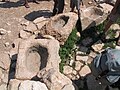 Stone troughs at the well of Ma'on
 Staircase
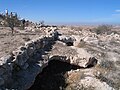 Ancient remains
 Ancient structures
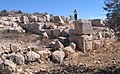 Ancient wall
 Remnants of Byzantine fort at Horvat Ma'on
 Detail
 Ancient stones
![The ancient hill of Tel Ma'on,[which?] South Hebron Hills](#/media/File:Tel-Maon-183.jpg)


See also
- Ancient synagogues in the Palestine region - covers entire Palestine region/Land of Israel
- Ancient synagogues in Israel - covers the modern State of Israel
- Ma'in, Hebron, small village located just north of the site
- Ma'on, Mount Hebron, Israeli settlement, c. 3 km east of the ancient site