Theta representation
From Wikipedia, the free encyclopedia
In mathematics, the theta representation is a particular representation of the Heisenberg group of quantum mechanics. It gains its name from the fact that the Jacobi theta function is invariant under the action of a discrete subgroup of the Heisenberg group. The representation was popularized by David Mumford.
Group generators
The theta representation is a representation of the continuous Heisenberg group over the field of the real numbers. In this representation, the group elements act on a particular Hilbert space. The construction below proceeds first by defining operators that correspond to the Heisenberg group generators. Next, the Hilbert space on which these act is defined, followed by a demonstration of the isomorphism to the usual representations.

Let f(z) be a holomorphic function, let a and b be real numbers, and let be an arbitrary fixed complex number in the upper half-plane; that is, so that the imaginary part of is positive. Define the operators Sa and Tb such that they act on holomorphic functions as and



It can be seen that each operator generates a one-parameter subgroup: and


However, S and T do not commute:

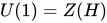
Thus we see that S and T together with a unitary phase form a nilpotent Lie group, the (continuous real) Heisenberg group, parametrizable as where U(1) is the unitary group.

A general group element then acts on a holomorphic function f(z) as where is the center of H, the commutator subgroup . The parameter on serves only to remind that every different value of gives rise to a different representation of the action of the group.



![{\displaystyle [H,H]}](https://wikimedia.org/api/rest_v1/media/math/render/svg/2bac33a1eccfae930f819124126d0d2534ca25dd)

Hilbert space
The action of the group elements is unitary and irreducible on a certain Hilbert space of functions. For a fixed value of τ, define a norm on entire functions of the complex plane as

Here, is the imaginary part of and the domain of integration is the entire complex plane. Let be the set of entire functions f with finite norm. The subscript is used only to indicate that the space depends on the choice of parameter . This forms a Hilbert space. The action of given above is unitary on , that is, preserves the norm on this space. Finally, the action of on is irreducible.


This norm is closely related to that used to define Segal–Bargmann space[citation needed].
Isomorphism
The above theta representation of the Heisenberg group is isomorphic to the canonical Weyl representation of the Heisenberg group. In particular, this implies that and are isomorphic as H-modules. Let stand for a general group element of In the canonical Weyl representation, for every real number h, there is a representation acting on as for and

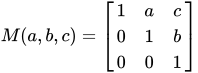





Here, h is the Planck constant. Each such representation is unitarily inequivalent. The corresponding theta representation is:








