Bernstein's theorem on monotone functions
Mathematical theorem
From Wikipedia, the free encyclopedia
In real analysis, a branch of mathematics, Bernstein's theorem, named after Sergei Bernstein, states that every real-valued function on the half-line [0, ∞) that is completely monotone is a mixture of exponential functions or in more abstract language, that it is the Laplace transform of a positive Borel measure on [0, ∞). In one important special case the mixture is a weighted average, or expected value. It is also known as the Bernstein–Widder theorem or Hausdorff–Bernstein–Widder theorem.
History
The result was first proved by Bernstein in 1928,[1] and similar results were discussed by David Widder in 1931[2] who refers to Bernstein but states that "The author had completed the proof of this theorem a few months after the publication of Bernstein's paper without being aware of its existence". The most cited reference is the 1941 book by Widder called The Laplace Transform.[3][4] Later a simpler proof[5][6][7] was given by Boris Korenblum. At around the same time Gustave Choquet studied the much more general concept of monotone functions on semigroups and gave a more abstract proof[8][9][10][11][12] based on the Krein–Milman theorem. Felix Hausdorff had earlier characterised completely monotone sequences. These are the sequences occurring in the Hausdorff moment problem.
Statement of the theorem
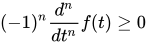
Complete monotonicity of a function f means that f is continuous on [0, ∞), infinitely differentiable on (0, ∞), and satisfiesfor all nonnegative integers n and for all t > 0.
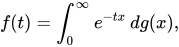
The "weighted average" statement can be characterized thus: there is a non-negative finite Borel measure on [0, ∞) with cumulative distribution function g such thatthe integral being a Riemann–Stieltjes integral.
Bernstein functions
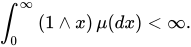
Nonnegative functions whose derivative is completely monotone are called Bernstein functions.[11] Every Bernstein function has the Lévy–Khintchine representation:where and is a measure on the positive real half-line such that



Schoenberg–Williamson theorem
The Schoenberg–Williamson theorem (also called Schoenberg's theorem on multiply monotone functions, Williamson's representation theorem) is the finite-order version of Bernstein's theorem. A k-monotone (or k-times monotone) function satisfiesThe Schoenberg–Williamson theorem says that f is k-monotone on (0, ∞) if and only iffor some positive measure on (0, ∞).


The proof was published by Williamson in 1956[13] but in his paper he mentions that "This formula was discovered by Schoenberg in 1940 but has remained unpublished".
Using the Taylor series of with integral remainder, a more precise formula can be given[14]withwhere and is the indicator function of .


Note then that if is completely monotone then it is k-monotone for all and the Post–Widder inversion formula states that converge in distribution to and converges to as goes to infinity, and we recover Bernstein's theorem.[14]


