Brushtail possum
Genus of marsupials
From Wikipedia, the free encyclopedia
The brushtail possums are the members of the genus Trichosurus in the Phalangeridae, a family of marsupials. They are native to Australia (including Tasmania) and some small nearby islands. Unique among marsupials, they have shifted the hypaxial muscles from the epipubic to the pelvis, much like in placental mammals, meaning that their breathing cycle is more similar to the latter than to that of other non-eutherian mammals.[2] In general, they are more terrestrially oriented than other possums, and in some ways might parallel primates.

| Brushtail possums[1] | |
|---|---|
| |
| Common brushtail possum by John Gould, 1863 | |
Scientific classification  | |
| Kingdom: | Animalia |
| Phylum: | Chordata |
| Class: | Mammalia |
| Infraclass: | Marsupialia |
| Order: | Diprotodontia |
| Family: | Phalangeridae |
| Genus: | Trichosurus Lesson, 1828 |
| Type species | |
| Didelphis vulpecula (Kerr, 1792) | |
| Species | |
|
see text | |
The genus contains these species:
- Northern brushtail possum, T. arnhemensis
- Short-eared possum, T. caninus
- Mountain brushtail possum, T. cunninghami
- Coppery brushtail possum, T. johnstonii
- Common brushtail possum, T. vulpecula
Nest Boxes

Brushtail possums nest in natural tree hollows that occur over many, many years to create a void that animals then find and use. With the loss of more and more large trees in suburban areas, nest boxes act as a hollow tree alternatives to provide an instant space for native animals to call home.
Gallery
 Northern brushtail possum (T. arnhemensis)
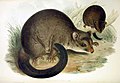 Short-eared possum (T. caninus)
 Coppery brushtail possum (T. johnstonii)
 Common brushtail possum (T. vulpecula)


.jpg)


_white_background.jpg)