User:EthanL13/sandbox
From Wikipedia, the free encyclopedia

- Arabic inscriptions for give way signs, shown on supplementary signs or on the sign itself, vary:
- Bahrain uses "اسمح للمرور"
- Kuwait and the United Arab Emirates use "افسح الطريق"
- Morocco uses "أترك الأسبقية", or alternatively "ليس لكم حق الأسبقية"
- Qatar uses "افسح"
- Tunisia uses "ترك الأولوية", or alternatively "افسح المجال"
History
 | This is not a Wikipedia article: It is an individual user's work-in-progress page, and may be incomplete and/or unreliable. The current/final version of this article may be located at Road signs in Ireland#History now or in the future. |
The early years

Among the first road signs in use on Irish roads were enamelled metal directional signs and cast-iron warning signs, the designs of which where laid out in the 1926 Road Signs and Traffic Signals Regulations.[1] Directional signs featured black text on a yellow background, and were in fingerpost form. Warning signs, for their part, were similar to signs used in the United Kingdom at that time. The signs were cast-iron plates, with raised type painted red on white. A square pictogram illustrated the hazard, and the type of hazard was written beneath. A hollow red triangle normally surmounted the pole to which the sign was attached.
Both types of signs displayed text in Irish, with traditional typeface, and English.
Mid-twentieth century
An overhaul of the system occurred in 1956.[2] Directional signs were now white with black text, warning signs were now in the form of yellow diamonds and a new category of road sign—regulatory signs—was introduced. This new system was based on recommendations by the United Nations,[3] based on an eventually unrealised draft convention for international uniformity of road signs which had been in development beforehand.[4]
1961 - yield signs
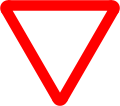 1956–1961
 1961–1997
 English-language version (1997 – present)
 Irish-language version (1962 – present)
.svg)
.svg)


1962 - further updates
Foundations of the current system

In 1977, a new directional sign system was introduced. Irish text was made the same height as English text and was rendered in mixed case, while English text remained in uppercase, and distances were now displayed in kilometres. Additionally, a green background colour was introduced for signs erected on the newly-classified national roads.[5]
1988 - introduction of brown-coloured tourist signs. In November, an amendment to the regulations saw that Irish text be rendered in italics from 1 January 1989.[6]
1996 & 1997 - TSM & new regulations. Introduction of white-on-blue mandatory signs
21st century
2005 - On 20 January 2005, imperial speed limits on signs were replaced with metric speed limits. Around 35,000 existing signs were modified or replaced and a further 23,000 new signs were erected bearing the speed limit in kilometres per hour. To avoid confusion with the old signs, all speed limit signs include the symbol "km/h" beneath the numerals.[7] Due to the two speed limits possible on non-urban roads after 2005 metrication, the "end of speed limit" sign in Ireland (a white circle with black diagonal line as used in the UK) is no longer used – the end of an urban speed restriction is signalled by the sign displaying the limit for the following section.
2010 (+ 2012) - second edition of TSM & regulations. The former "no entry" sign, a prohibition sign with an upward-pointing arrow, was replaced with the international standard red disk in the 2010 TSM. However the older version, now termed "No Straight Ahead", may be used when combined with a time or other restriction.
2013 - potential for English and Irish to be on equal footing
2015 - rural speed limit & slow zone signs
2016 - introduction of emergency diversion route symbols on the M50
2019 - third edition of TSM
2020s
2021 - shared spaced sign
2022-2024 - In October 2022, a nine-month long pilot scheme was undertaken by the National Transport Authority to introduce new signs that would replace Belisha beacons on newly installed pedestrian crossings.[8] This scheme saw the introduction of a new blue square-shaped pedestrian crossing sign (featuring a fluorescent yellow background),[9] like those already used in continental Europe. Following the conclusion of the study, the sign was officially adopted in March 2024, though beacons are still permitted to be installed.
2024 - pedestrian crossing sign introduced, two updates to TSM, updates to regulations incl. cycle signs applying to e-scooters
2025 - update to TSM & regulations
Irish language
| This is not a Wikipedia article: It is an individual user's work-in-progress page, and may be incomplete and/or unreliable. The current/final version of this article may be located at Road signs in Ireland#Irish language now or in the future. Further explanation, clarification and provision of sources required. Feel free to help out. |
Since 1989, Irish text has been displayed in italics, whereas English text continues to displayed in all capitals. [As a result, many argue that this shows a favour for English as it treats Irish as a secondary or supplementary language, despite Irish being the first official language of the country constitutionally. Many have argued against a redesign that gives equal status to Irish, given that the language is not spoken on a daily basis by the majority of the population. Some Irish drivers refer to the presence of Irish as clutter, while others say it being in italics makes it easier to ignore and to instead allows them to focus on English.]
The Official Languages Act, 2003. One of its main aims that Irish is to be displayed with equal status and prominence as English on signage did not apply to road signs.[10]
In 2013, then Minister of Transport Leo Varadkar gave approval for a new signage design.[11] It featured yellow text for Irish and white for English, with both in mixed case, similar to the design employed in Scotland. Additionally, the Transport typeface was to be replaced with another called Turas. Varadkar had asked the NRA to install them on a "trial basis". However, this project was cancelled by the subsequent Minister of Transport, Paschal Donohoe.
A redesign of Irish signage to give equal prominence to the Irish language is one of Conradh na Gaeilge's campaigns.[12]
Vandalism by means of graffitiing placenames in both languages has occurred on a number of occasions, particularly in County Donegal.[13][14][15]
ga:Comharthaí bóthair in Éirinn#Úsáid na Gaeilge
- https://www.thejournal.ie/road-signs-irish-english-1735179-Oct2014/
- https://www.oireachtas.ie/en/debates/question/2014-11-04/1104/
- https://tuairisc.ie/61-ag-iarraidh-comhstadais-don-ghaeilge-ar-chomharthai/
- https://tuairisc.ie/cinneadh-varadkar-faoi-chomharthai-curtha-ar-ceal/
- https://tuairisc.ie/taighde-ar-bith-deanta-faoi-chomharthai-bothair/
- https://tuairisc.ie/an-tudaras-um-boithre-naisiunta-fos-in-amhras-faoi-mholtai-a-chuirfeadh-an-bearla-agus-an-ghaeilge-ar-comhcheim/
- https://tuairisc.ie/direofar-acmhainni-ar-cheisteanna-nios-dairire-na-stadas-na-gaeilge-ar-chomharthai-bothair-ross/ Shane Ross, successor to Donohoe
- https://tuairisc.ie/is-cinnte-gur-mhaith-liom-go-mbeadh-comhstadas-ag-an-ngaeilge-ar-chomharthai-bothair-varadkar/ Promises made by Varadkar in lead up to 2017 Fine Gael leadership election
- https://tuairisc.ie/airi-na-gaeltachta-ag-tacu-le-heileamh-ar-chomhstadas-don-ghaeilge-ar-chomharthai-bothair/
- Common for Irish to be missing on signs, particularly on non-prescribed signs. With the exception of Lána Bus (Bus Lane) and Scoil (School), as well as Go Mall (Slow) in Gaeltacht areas, Irish tends to be missing on most road markings.
- Misspellings and mistranslations are common. A sign in County Wexford reading 'Footpath ends' in English read As Gaeilge ("in Irish") as its Irish translation.[16]
- In the case of official signs, examples include sign WK 099, where Lean Mé means "I followed" and sign P 062, where Réamhfhógra Fóin le Tabhairt ag Leoraithe Fada Roimh Thrasnú means "Advance warning by phone to be given by long lorries before crossing".
- On other signs – use of Slí Amach ("exit") instead of An Chéad Slí Amach Eile for "next exit", Amach ("out") instead of Slí Amach for "exit", An Lár ("[the] centre") instead of Lár na Cathrach for "city centre", sign WK 052, where Bealach Isteach ("entrance") is used for "site access".
Other information signs
 Sign F 700
Toll Road Ahead Sign F 701
Toll Plaza Ahead


Signs on highest classification of road featuring E-route number
| Austria | Belgium | Bulgaria | Czech Republic | Denmark | Estonia | Finland | France | Germany | Greece | Hungary | Iceland | Ireland | Italy, San Marino, and Vatican City | Latvia | Lithuania | Luxembourg | Moldova | Netherlands | Norway | Poland | Portugal | Romania | Russia | Serbia | Slovakia | Slovenia | Spain | Sweden | Switzerland and Liechtenstein | Turkey | Ukraine | United Kingdom | |
|---|---|---|---|---|---|---|---|---|---|---|---|---|---|---|---|---|---|---|---|---|---|---|---|---|---|---|---|---|---|---|---|---|---|
| Signs on highest classification of road featuring E-route number | .svg) |
 |
 |
 |
 [note 1] |
 |
 |
 |
 |
 |
 |
 [note 2] |
 |
|
.svg) |
 |
 |
|
.svg) |
.svg) |
 |
 |
 |
 |
|
.png) |
 |
 |
.svg) [note 1] [note 1] |
 |
 |
 |
 [note 3] |
Traffic sign colours
| Country | white-on-green | white-on-blue | black-on-white | black-on-yellow | red-on-white | blue-on-white | white-on-brown | black-on orange | white-on-black | yellow-on-black |
|---|---|---|---|---|---|---|---|---|---|---|
| Austria | Regions, city districts and tourist locations | Motorways | Landesstraße | |||||||
| Ireland | National primary and secondary roads | Motorways | Regional roads and local roads | Tourist signs Signs indicating geographical information Off-line services signs | Temporary signs | Truck detour signs | ||||
| Italy | Motorways | State, provincial and regional roads | Municipal and urban roads | Temporary signs | Tourist signs Signs indicating geographical information Signs indicating municipalities | Industrial areas | ||||
| Spain | Autopistas and autovías | National roads | Temporary signs | Tourist signs Signs indicating geographical information | ||||||
Notes
- Motorways in Denmark, Norway and Sweden use European route numbers exclusively.
- There are no assigned E-road numbers in this country.
- European motorway numbers are not displayed on road signs in the United Kingdom