User:Gunbirddriver/Draft
From Wikipedia, the free encyclopedia
This is a work page Supporting material for Leonard Cheshire
 | This is not a Wikipedia article: This is a workpage, a collection of material and work in progress that may or may not be incorporated into an article. It should not necessarily be considered factual or authoritative. |
Supporting material Leonard Cheshire
- History of this page includes Leonard Cheshire, Hans Luck, Patrick Dorehill, Augsburg Raid
- Image Barnes Wallis
- Locate the supporting citation on Wing Commander George Holden, an aggressive pilot in the mold of Gibson.
Lancasters would drop parachute flares from above to illuminate the target area. In good weather it would be as light as day over the target. Next, a low level marker aircraft flares over the target at 5,000 feet, Mosquitos came in at 2,000 feet, and could see perfectly well the Gnome-Rhone aero-engine factory at Limoge, night of 8/9 February 1944.
- Mosquitos would mark each end of a marshaling yard and the Lancs above would bomb the yard area. Example: 80 marshaling yards targeted, Bomber Command given 40 marshaling yards to bomb, BC more accurate than 8th Air Force. BC dropped 42,000 tons vs 1,800 tons by 8th Air Force.
- Low level marking done on Brunswick 1944: wind from the northeast, markers were to be dropped over the northeast, Flak seemed to concentrate on the heavies above and ignored the low level marker Mosquitos. The marker was placed northeast of the target, and the wind would allow the bombs to hit the target area. Markers left upwind of target area.
- Note: when did Harris take Mosquito and Lancaster x2 from Bennett and give them to 5 Group?
- Cheshire had believed since early in his career he believed that accuracy could only be achieved with low level bombing.[1] As Flak defenses became more and more potent, the bombers had been forced to higher and higher altitudes for safety. Bennett said marking accurately at low level was impossible, as the marking aircraft would never survive the German Flak.[2]
617 outline
- can we find out anything about this German officer in the A-4 (V-2) program, Maj Gen Walter Dornberger.
- Lancasters were not well suited to dive bombing, but they could not get an appropriate aircraft. Needed to make a pitch to Cochrane to get Mosquitos for this role.
- February 1944, bomb not yet produced. 617 started high level bombing. PFF crew marked the target, 617 delivered all bombs within 94 yards of the marker. Unfortunately, the marker was 350 yards away from the target. (What was the target, when was the mission flown? Ans: this was against a V1 site.)
- V1 sites x2 (?) Pas de Calais raid, repeat at second site.
- two attacks made upon rocket launching sites[3]
- attack against the Bergerne munitions plant (in what city?).[4]
- a second munitions plant destroyed.[5]
- Creil, a large cave near Paris storing V-1 and V-2 sealed.[6] (?)
- Calais, another bomb site destroyed.[6] ??
- When did Spaatz and Doolittle visit Cheshire to discuss his marking techniques.[7] After Limoges - February?
9. Other missions
- Cochrane thought "If one Mosquito could mark for a squadron, one Mosquito squadron could mark for a group."
10. D-day mission
D-Day 617 low level precision flying used to drop window over the channel at low level in succession to generate the radar appearance of an approaching invasion fleet. Cheshire protests the mission but is told by Cochrane to get it done. They do.[8] This was the brilliant "spoof" raid which simulated an amphibious landing in the Pas de Calais on 5 June 1944, timed to draw attention away from the actual D-Day landings in Normandy.
Later missions
After the D-Day landings 617 Squadron went back to the pinpoint destruction of the reinforced concrete bunkers of Germany’s special weapons.[10] On the evening of 8 June 1944 Cheshire, flying in a Mosquito, led 617 Squadron in its attack upon the railway tunnel at Saumur. It was collapsed and destroyed.[11] The evening of 14 June saw the E-boat pens at Le Harve attacked by Cheshire and 617 Squadron, again using Tallboys. The E-boat pen was penetrated and the harbor devastated. Ten ships in the harbor were blown completely out of the water. Commented Cheshire "Barnes Wallis had built a big bomb." The next day, 15 June, German light naval forces in Boulogne were attacked and again the port was devastated.[12]
- Blew-up the E-boat pens, blew ten ships right out of the harbor. Said Cheshire: "Barnes Wallis had built a big bomb."
On 20 June 1944 617 Sqaudron sent seventeen Lancasters and three Mosquito’s left Britain to attack the V2 rocket base at Wizerness, but with low cloud over the target Cheshire called off the raid and all aircraft returned with their bombs. Two days later the raid was back on. On 22 June 1944 617 returned with sixteen Lancasters and three Mosquitos. Once again low cloud forced the attack to be aborted. All aircraft returned home. They returned again on 24 June with sixteen Lancasters. Many of the squadron’s aircraft were hit and damaged by flak. They still managed to release their bombs and hit both the launching tunnel and the rail line. One aircraft Lancaster armed with a Tallboy was hit by flak and crashed at Leulinghem. The next day, 25 June, the V-1 site at Siracourt attacked by the Lancasters of 617 Squadron. Chehsire marked it using a Mustang. [12] (??)
11. BC takes the Mosquitos
Bomber Command transferred the Mosquitos to another squadron that was said to have a prior claim, leaving Cheshire with only the Lancaster to do low level marking with. Cheshire knew he would not be able to get another maneuver aircraft from the Air Ministry just by asking, but thought it was something the Americans might do. He flew over to the Americans. They shipped a brand new Mustang aircraft to him, still in the crate. Last mission is flown.
Images
 Image of the factory from 16,000 feet
 V2 assembly and launch site in a quarry at Wizernes, France destroyed by 617 Squadron in daylight attack with Tallboys 17 July 1944
 35 Squadron Halifax prior to August 28/29 1942
 76 Squadron Halifax being bombed up, 3 April 1943
 Halifax in flight
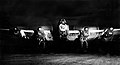 Lancaster of 44 Squadron warming up its engines prior to a raid against Berlin, January 1944
 76 Squadron Halifax 6 August 1941, needs to be cropped


- Images needed:
- Halifax for 35 or 76
- Marston-Moor airfield
- Lancaster for 617
- Mosquito for 617 marker aircraft
- blown out E Boat pens
- Berlin at night during an early raid
File:Basil Embry over burning British tanker.jpg|thumb]]
- Group Captain Jack Goodman, RAF Pathfinder pilot Oral History, IWM
- dropped window at 45 degrees from the bomber stream
- Cheshire and W/O Jackson were reunited at the ceremony of disbandment Bomber Command, 29 April 1968, as was Harris and Portal, [13]
Promotions
- October 7th, 1939: Pilot Officer
- April 7th, 1940: Flying Officer
- April 7th, 1941: Flight Lieutenant
- March 1st, 1942: Temporary Squadron Leader
- March 1st, 1942: Squadron Leader
- March 1943 Group Captain
- September 30th, 1943: Wing Commander (war sub)
- July 1944 stood down from operations at 617 Squadron. Rank returned to Group Captain (when?)
Postings:
- 102 Squadron
- 35 Squadron
- Flight instructor at Marston-Moor
- 76 Squadron commander
- Airfield Marston-Moor commander
- 617 Squadron commander
Dates, postings and rank changes
- 102 Squadron - April 1940 to January 1941. Started flying on his own June 1940. Note: as his first tour came to an end Cheshire did not want to do a desk job, so he managed to get transferred to 35 Squadron and kept flying, ending up completing two tours right off. (4/40)
- 35 Squadron January 1941 to early 1942. In March 1941 he was promoted to acting squadron leader.
- Flight instructor at Marston Moor for seven months. Flew on a number of raids, including two 1,000 plane raids.
- 76 Squadron as CO. The Squadron was just forming up. Arrived August 1942 to April 1943.
- Marston Moor as base commander at the conversion unit. April 1943 to November 1943. Promoted to Group Captain for this post. Was given the promotion and the post out of the line of fire after much politicking by Air Marshall Carr. Felt uncomfortable in this post.
- What did Cheshire do after July 1944? For the next year? When did they divorce? Ans: 1952.
- August 1945 was one of two British observers to the nuclear bombing of Nagasaki.
Dates of 617 Operations
- Pas De Calais 21st January 1944
- Pas De Calais 25th January 1944
- Limoges 8th February 1944
- Antheor Railway Viaduct in Southern France 12th February 1944
- In Transit Accident 13th February 1944
- Albert 2nd March 1944
- St Etienne 4th March 1944
- St Etienne 10th March 1944
- Woippy 15th March 1944
- Clermont Ferrand 16th March 1944
- Bergerac 18th March 1944
- Angouleme 20th March 1944
- Lyons 23rd March 1944
- Lyons 25th March 1944
- Lyons 29th March 1944
- Toulouse 5th April 1944
- St Cyr 10th April 1944
- Juvisy 18th April 1944
- Juvisy 20 April 1944
- Brunswick 22nd April 1944
- Munich 24th April 1944
- Milan 24th April 1944
- Mailly camp 3rd May 1944
- D-Day 'Window' mock invasion fleet raid 5th June 1944
- Saumar railway tunnel France 8th June 1944
- Le Harve 14th June 1944
- Boulogne 15th June 1944
- Watten 19th June 1944
- Wizernes V2 rocket base 20th June 1944
- Wizernes V2 rocket base 22nd June 1944
- Wizernes V2 rocket base 24th June 1944
- Siracourt 25th June 1944
- Creil 4th July 1944
- Mimoyecques 6th July 1944
Kirtland
- Herbert Kirtland, NCO, W/O (Oral history)[14]
- Cheshire was CO at 76 Squadron when half a dozen Norwegian pilots arrived. 76 took all the Norwegian pilots.[14]
- When he arrived 76 had had a hard time. December 1943. Hank Iverson took over as CO. Brought discipline. Had many trips to Berlin.
- First trip as a crew was to Berlin 29/30 December 1943. Next trip was attacked by Ju 88 night fighter.
- 35 trips, became a good crew.[14]
- Captain used his crew to help train himself to find controls blindfolded.[14]
- "Keep on track, keep on time, keep on living."
- personal memories of Cheshire, came to 76 November 1943 after Cheshire had left. Christopher became a tobacco farmer in Spain.
References
- Notes
- Citations
- Braddon 1954, p. 108. sfn error: no target: CITEREFBraddon1954 (help)
- Braddon 1954, pp. 111–112. sfn error: no target: CITEREFBraddon1954 (help)
- Braddon 1954. sfn error: no target: CITEREFBraddon1954 (help)
- Braddon 1954, p. 129. sfn error: no target: CITEREFBraddon1954 (help)
- Braddon 1954, p. 121. sfn error: no target: CITEREFBraddon1954 (help)
- Braddon 1954, p. 122. sfn error: no target: CITEREFBraddon1954 (help)
- Braddon 1954, p. 125. sfn error: no target: CITEREFBraddon1954 (help)
- "Saumur Railway Tunnel". The Dambusters. Retrieved 1 October 2018.
- Ashworth 1995, p. 97. sfn error: no target: CITEREFAshworth1995 (help)
- Ashworth 1995, p. 171. sfn error: no target: CITEREFAshworth1995 (help)
- "Kirtland, Herbert, NCO, W/O (Oral history)". Imperial War Museum. Retrieved 29 September 2018.
- Bibliography
- Ashworth, Chris RAF Bomber Command 1936-1968 Somerset, UK: Haynes Publishing (1995). ISBN 1 85260 308 9
- Braddon, Russell Cheshire V.C. London: Evans Brothers Limited (1954).OCLC 221454400 ??
- Boyle, Andrew. No Passing Glory: The Full and Authentic Biography of Group Captain Cheshire, V.C., D.S.O, D.F.C.. London: Fontana Books, 1955.
- Brickhill, Paul. The Dam Busters. London: Pan Books, 1983. ISBN 0-330-28083-X.
- Garnett, David. The White/Garnett Letters. New York: The Viking Press, 1968. ISBN 978-0-224-61323-1
- Harvey, David. Monuments to Courage. Uckfield, East Sussex, UK: Naval & Military Press Ltd., 1999. ISBN 1-84342-356-1.
- Hastings, Sir Max. Bomber Command (Pan Military Classics) London: Pan Books, 2010. ISBN 978-0-330-51361-6.
- Iveson, Tony and Brian Milton. Lancaster: The Biography. London: Andre Deutsch Ltd, 2009. ISBN 978-0-233-00270-5.
- Laffin, John. British VCs of World War 2: A Study in Heroism. Stroud, Gloucestershire, UK: Sutton Publishing Limited, 1997, ISBN 0-7509-1026-7.
- Mahaddie, T.G. Hamish: the Memoirs of Group Captain T.G. Mahaddie DSO, DFC, AFC, CZMC, CENG, FRAeS. London: Ian Allan (1989).
- Maynard, John Bennett and the pathfinders London: Arms and Armour, (1996).
- Morris, Richard. Cheshire: The Biography of Leonard Cheshire, VC, OM. London: Viking Press, 2000. ISBN 0-670-86735-7.
- Morgan, Eric B. and Edward Shacklady. Spitfire: The History (4th rev. edn.). London: Key Publishing, 1993. ISBN 0-946219-10-9.
- Murray, Williamson Strategy for defeat: the Luftwaffe, 1933-1945 Maxwell Air Force Base, Ala. : Air University Press, (1989)[1983]. ISBN 978 0 933852 45 7.
- "Obituary for Prof. G.C. Cheshire." The Times, 28 October 1978.
- Otter, Patrick. Lincolnshire Airfields in the Second World War. Newbury, Berkshire, UK: Countryside Books, 1996. ISBN 978-1-85306-424-1.
- The Register of the Victoria Cross. London: This England, 1997. ISBN 0-906324-27-0.
- Ward, Chris 4 Group Bomber Command: an operational record Barnsley, South Yorkshire: Pen & Sword Aviation, (2012).
- Ward, Chris 5 Group Bomber Command: an operational record Barnsley, England: Pen & Sword Aviation, (2007).
German night fighter tactics
- dropped flares over the top of the bomber stream and attacked.
- attacked the flanks of the bomber stream, or attacked an aircraft that had lost an engine.
Geoffrey Page images
Obituary from The Times [1]
What's missing
- Air combat with 109s, hit and wounded in left leg, dove to escape to the deck, and a kill with a stall.[2]
- On returning to operations Page was seized with a great fear that his aircraft would become a burning trap. Fear with first combat flight with Mac[3]
- Page had became a killer. Many people died under the guns of his Spitfire. Hundreds.[4] It was the war. He lost the joy of flying. His greatest interest was in air combat, and he became very good at it. But by the end there was no joy in destroying German aircraft. He had become hardened.
- the FW 190 shot down over the tank battle, had to go to get part of the plane to confirm the kill.[5]
Augsburg raid
As the two Vics of 44 Squadron approached Evreux they passed just to the south of the French airfield at Beaumont-le-Roger. The airfield had passed into the hands of the Germans and was in use by JG 2. Unfortunately, through an error in orders issued the Boston bombers and their escorts in the diversionary attacks had run their missions 40 minutes ahead of schedule. The German fighters that had engageded were led by experten and Gruppe II commander Karl-Heinz Greisert, who had his landing gear extended when a great commotion broke out at the airfield, and the warning "Viermots" was broadcast over the wireless. On the field, JG 2 commander Walter Oesau,
them over the Cherbourg area were losing altitude and returning to base. they were preparing to land when Nettleton's aircraft happened to pass by.[6] For a moment the Lancaster crews thought they had gone unnoticed, but then several German fighters were seen to snap up their undercarriages and veered in their direction.[7]
- Route explained: Lincolnshire, Selsey Bill, Dives-sur-Mer, traveling east by southeast and passing to the west and south of Paris, turn towards Sens, route bends southeast at Sens, skirted along the Swiss border till they reached Lake Constance, then on toward Munich until they passed over the Ammersee, where they made a hard left, flew over the hillsides and came upon Augsburg.[8]
- Walter Oesau was the commander of JG 2. He had scored his 100th victory in October.[9] Since then he had been ordered not to fly, but he always had his aircraft and his number 2's aircraft at the ready on a hardstand, and would violate the "schenowzer" policy when he could argue against it.[10]? In Weal.
- JG 2 was in the process of converting over to the Focke Wulf 190.[citation needed], but II Gruppe was still flying the Me 109 F.[9]
- JG 2 was three kills shy of being credited with their 1,000 victory[9]
- Karl-Heinz Greisert.[9], led the pursuit, made the first kill against the trailing vic.[11]
- The Gruppe had responded to the bombing attack against Rouen 30 minutes earlier, but by the time they arrived their the RAF was gone, and they were had to return to base without having engaged them.[9]
- The groups turned at Sens.[12]
- Gasps at Waddington; laughter at Woodhill Spa.[13]
- The vics tightened after the first pass.[14]?
Work point
Hans von Luck | |
|---|---|
| File:Hans von Luck.5.jp Hans von Luck in 1944 | |
| Born | (1911-07-15)15 July 1911 |
| Died | 1 August 1997(1997-08-01) (aged 86) |
| Allegiance |  Weimar Republic (to 1933) Weimar Republic (to 1933) Nazi Germany Nazi Germany |
| Branch | Heer |
| Service years | 1929–45 |
| Rank | Oberst |
| Unit | 7th Panzer-Division 21st Panzer-Division |
| Commands | 3rd Recon. Btl., 21st Pz. Dv. Kampfgruppe von Luck |
| Conflicts | |
| Awards | Knight's Cross of the Iron Cross Medaglia d'Argento |
| Other work | Military lecturer, author |
Hans–Ulrich Freiherr von Luck und Witten (15 July 1911 – 1 August 1997), usually shortened to Hans von Luck, was a officer in the German Armored Forces during World War II. Luck served with the 7th Panzer Division and 21st Panzer Division, seeing action in Poland, France, the Soviet Union, North Africa, Normandy and, in the closing phase of the war, Germany. He attained the rank of Oberst der Panzerwaffe. After the war Luck was held for five years in a Soviet Gulag. Upon being released he found work in the service industry. In time he was asked to speak at Normandy war college talks in Normandy. He came to be friends with John Howard and Steven Ambrose, who encouraged him to write a book of his life experiences, which he titled Panzer Commander. He is best known for his part in checking the British offensive Operation Goodwood.
Early life and career
Luck was born in Flensburg, Province of Schleswig-Holstein, into a Prussian family with a long history in the Prussian military.[15] Luck's father, Otto von Luck, broke with family tradition and served in the Kaiserliche Marine (Imperial German Navy), which explains how Hans came to be born in Flensburg. His father fought in the First World War and was at the Battle of Jutland.[15] He died suddenly in July 1918 from the great flu pandemic. His father's death left his family destitute. His mother remarried to a naval cadet school instructor and chaplin.[16] Luck learned to speak several languages, including French, English and Russian.[15] [citation needed]
Luck went to Army cadet school, from which he was assigned to the cavalry.[15] He served in the Silesian cavalry regiment.[17] His life as a cavalry officer ended with his transfer to the 1st Motorized Battalion, stationed in East Prussia.[18] Through the winter of 1931 to 1932 Luck attended a nine-month course at the infantry school in Dresden to complete his commission as a junior officer. The course was taught by an officer in the infantry whom Luck would come to know well in later years, Colonel Erwin Rommel.[19] In the autumn of 1932 Luck was promoted to Lieutenant.
In 1936 Luck assumed command over the 3rd company in the 8th Armoured Reconnaissance Battalion, stationed in Potsdam. In 1939 he was posted to the 2nd Light Division. The light divisions were developed from the cavalry arm, rather than the panzerwaffe. Luck served with the division's 7th Panzer Reconnaissance Battalion.[20] (may look for another source)
Second World War
Invasion of Poland

2nd Light Division, under General Georg Stumme. Luck was a company commander in the division's 7th Reconnaissance Battalion. In August 1939 Luck's armoured reconnaissance regiment was sent to the Polish frontier along the former Czechoslovakia for manoeuvres. When it had its blank cartridges exchanged for live ammunition. At 0450 hours on September 1, it rolled over the Polish frontier to begin what would, for Luck, be more than five-and-a-half years of almost continual fighting.[17] Driving up through southern Poland, his unit advanced through Kielce and Radom before turning northwest and driving through Łódź. Turning back northeast they reached the outskirts of Warsaw on 9 September.[15] The city did not fall until 27 September. This marked the end of combat for Luck's unit.
After the campaign in Poland, the 2nd Light Division returned to its base at Bad Godesberg in Germany.[21] The light divisions had not been adequate as armoured formations. Their single panzer battalion of light tanks lacked offensive punch.[citation needed] Their battalions had been equipped with the Panzer I and Panzer II, light tanks intended primarily as training vehicles.[citation needed] The light divisions were reorganized and reequipped, with the 2nd Light Division converted to the 7th Panzer Division.[22]
On 6 February 1940 Erwin Rommel assumed command of the division. Luck and his fellow officers esteemed the new commander, but wondered if an infantryman could be a commander of tanks.[23] Any questions they had were soon dispelled.[24] The division's single panzer battalion was expanded to a regiment, and heavier armour was provided with 92 Panzer 38(t)s obtained from Czechoslovakia, supplemented with 24 Panzer IV tanks.[citation needed] Luck served as one of the company commanders in the 7th Panzer Reconnaissance Battalion. The unit was equipped with the Schwerer Panzerspähwagen, a six-wheel scout car armed with a 2.0 cm gun.[23] At the beginning of May 1940 the unit was transferred to the Eifel mountain area in western Germany where it practiced crossing the Moselle in preparation for the invasion of France.[25]
Invasion of France
Luck and his 7th Panzer Division formed part of the XV Army Corps under General Hermann Hoth. The corps made up the right shoulder of Gerd von Rundstedt's Army Group A. In the early morning hours of 10 May 1940 the division moved forward in the invasion of France. Luck's reconnaissance battalion led the division's advance into Belgium, reaching the Meuse river near Dinant in three days.[26] Luck’s reconnaissance battalion crossed the La Bassée canal near the city of Arras.[specify] Luck suffered a wound to several fingers of his hand in the crossing, was bleeding profusely and passed out while being taken to a medical unit, but with his arm in a sling was able to talk his way into returning to his unit the following day.[27]

On 28 May Luck's commanding officer, Major Erdmann, was killed in action.[28] Though one of the youngest captains in the battalion, Rommel selected Luck to take his place as the battalion's commanding officer.[17]
Following the evacuation of British and French troops at Dunkirk, the 7th Panzer Division was given two days to rest and refit, and then was shifted south to participate in the second phase of the campaign in France.[citation needed] On 5 June the division moved southwest for the Seine river, hoping to reach intact bridges at Rouen. Breaking through the Allied defenses, they were able to splinter the defenders and reach Rouen, but upon arriving there found the bridges had all been blown. The drive had cut off the French 9th Corps and the British 51st Highland Division, and they were forced to withdraw toward the coast, hoping to be evacuated at Le Havre. Hoth ordered 7th Panzer to attempt to block them.[29] Rommel wheeled the division north toward Saint Valery, while sending Luck on with a small force further down to the small harbor town of Fécamp. Rommel reached the coast near Saint Valery, cutting off the Allied withdrawal to Le Havre.[29] Luck's battalion arrived on the outskirts of Fécamp late on 11 June, and was able to take the resort town the next morning without causing any damage to the Benedictine abbey or the town's other old buildings.[17] At the same time, Rommel leveraged those forces at Saint Valery to surrender. On 15 Luck's recon battalion was leading 7th Panzer toward Cherbourg. By 17 June they had advanced 350 km. The port was captured the following day. Luck and his reconnaissance battalion then led the division south towards Bordeaux, halting when the armistice was signed on 21 June.
In July Luck's division was sent to the Paris area to prepare for the next offensive. It had been earmarked for Operation Seelöwe, but this operation was called off when it was clear the Luftwaffe would be unable to gain air superiority over the channel and southern England. In February 1941 Rommel was replaced by General Freiherr von Funk, and in June Luck moved with his division to East Prussia in preparation for the invasion of the Soviet Union.
Operation Barbarossa
Luck was made Hauptmann and attached to 7th Panzer Division's headquarters staff.[30] In June the 7th Panzer Division was transferred to East Prussia and assigned to the 3rd Panzer Group of Army Group Center.[31] In the early morning hours of 22 June 1941 the division crossed over the border and drove into Soviet territory as part of Operation Barbarossa. Luck's 7th Panzer Division spearheaded the 3rd Panzer Group as it drove east and the capture of Vilnius in Lithuania, before driving on Minsk and forming the northern arm of the Bialystok-Minsk pocket.[31] With the capture of Minsk the armored group continued on east towards Vitebsk.[31] At Vitebsk the commander of the division's 37th Reconnaissance Battalion was killed in action, and Funck ordered Luck to take his place.[32]

Luck and his unit participated in creating the large pocket around Smolensk, cutting the Smolensk-Moscow road.[31][33]
During most of August and early September the 7th Panzer was holding the line for Army Group Centre. Control of Luck's division was then transferred to the LVI Motorised Corps, which had been transferred to the 3rd Panzer Group for the next assault. In early October Luck's division broke through the Soviet front north of Vyazma in another envelopment attack, creating the northern arm of a large encirclement of Soviet forces in the Vyazma pocket.[34] The spearheads of the Second and Third Panzer Groups met at Vyazma on 10 October 1941.[35]
With the arrival of the heavy rains of fall the roads became a sea of mud, and the wheeled mobile forces of the German Panzerwaffe were unable to maneuver. In November freezing temperatures caused the roads to firm up. Luck and his unit then led the 7th Panzer Division through Kalinin and Klin along the northern approaches to Moscow.[34] On 28 November 1941 Luck's unit captured Yakhroma, and seized a bridge across the Volga-Moscow Canal. He then established a bridgehead on the east side of the canal.[17] However the Germans were at the limit of their strength. With no reserves available to exploit the bridgehead and the weather deteriorating rapidly, the 7th Panzer was forced to withdraw back across the canal.[34] Pressure from the Soviet counteroffensive pressed them further until they had retreated 100 km from Moscow.[36]
For his contribution to the fall campaign on 2 January 1942 Luck was awarded the German Cross in Gold.[37] Luck's time in Russia had come to an end for now. Since the previous November Rommel had requesting the transfer of Luck to his command in Africa to take over the 21st Panzer's 3rd Panzer Reconnaissance Battalion.[17][38][39] Luck had served with Rommel in France where he came to serve as the commander of the 7th Panzer Division's reconnaissance battalion.[40]The transfer had been postponed by Funk, who felt he could not spare Luck.[19] Once the winter crisis and the Soviet counterattack had passed, Funk allowed the transfer to go through. In late January Luck and his aid left the 7th Panzer Division, traveling day and night along snow bound roads to reach his home in Germany.[41] (check the reading from his memoir)
North Africa


Luck was promoted to major, spending February and March 1942 on leave. Reporting back for duty on 1 April 1942, he reached Africa on 8 April and assumed command over the 3rd Panzer Reconnaissance Battalion of the 21st Panzer Division.[40][42] On 26 May the Axis forces moved forward in a sand storm to engage in the opening phase of Operation Venezia, the first encounters in what is referred to as the Battle of Gazala.[43] That night Luck's reconnaissance group formed the outer most formation as the Afrika Korps moved at night by compass to conduct a giant swing around the southern flank, coming up behind the British defensive line. As they continued the following day a sharp clash ensued. It was the first time Luck's command had encountered a the American built Grant tanks.[44] Luck's memoir recounts how he suffered a deep wound to his right leg from a shard of shrapnel and had to be removed to a medical tent.[45] The doctor treating him there wanted Luck evacuated to a field hospital, but by this time the Afrika Korps' supplies of fuel and ammunition were running critically low, and passage back to the east was blocked. Precariously close to defeat, Rommel drew his force back into a defensive position.[46] Luck's unit protected the southern flank during the the Cauldron battle. Unable to walk, Luck commanded his unit from his staff car. On 1 June the Afrika Korps was able to overwhelm the British 150th Infantry Brigade and re-opened a supply route to the west.[47] Luck was evacuated to a hospital in Derna. By this point Luck's leg wound had become infected, and he had to be taken by hospital ship back to a surgical center. He reached Sicily, where the wound was surgically debrided by an Italian surgeon. He was then evacuated to Germany to be hospitalized.[48]
Luck remained in Germany for the next two months, recuperating. By the time he returned to Africa in mid-September the Afrika Korps had won the battle of Battle of Gazala, driven into Egypt and won the Battle of Mersa Matruh.[49] The advance was finally stopped short of the Suez Canal at the First Battle of El Alamein.[50] Upon his arrival Luck resumed command of the 3rd Reconnaissance Battalion, which was positioned behind the Italian Folgore and Pavia divisions at the south end of the Axis line near the escarpment of the Qattara Depression.[51]
On 23 October 1942 the British launched the attack of the Second Battle of El Alamein.[52] After two weeks the Axis position crumbled and they were forced to withdraw or be cut off and destroyed. On 4 November Rommel ordered the withdrawal of the Panzerarmee from El Alamein.[53] Thus began a very long retreat. Lacking fuel and transport, the withdrawal was extremely difficult. There was harassment from the air and the constant threat that the Eighth Army would sweep around the southern flank, cut the coast road and trap the Afrika Korps.[54]

Approaching Libya, the retreat of the Panzerarmee reached a choke point at the Halfaya Pass. The army was strung out along 30 miles of road as it approached the pass.[55] Montgomery sent the British scouting units, the Royal Dragoons and the 11th Hussars, southward to hook around the Axis army.[56] To protect his southern flank, Rommel sent his own reconnaissance units, the 33rd, 580th and Luck’s 3rd reconnaissance battalions into the desert to check the effort. Luck was placed in overall command.[56] He made his headquarters at the Jarabub Oasis, about 120 miles south of Halfaya Pass.[56] Tasked with guarding the southern flank of the Afrika Korps, the posting was largely quiet, with occasional sharp engagements fought against the British Royal Dragoons, the 11th Hussars or at times the Long Range Desert Group.[57]
In the deep desert the units of both sides were isolated from the main force, and fought their own private war.[58] Separated from the main formations, concerns for Luck and the Hussars opposing him turned to lack of scarce medical supplies or men becoming lost in the desert. The two sides initiated a cease fire at 5:00 pm. By mutual agreement, at 5:05 pm by radio contact to allow them to check on missing personnel. They two scouting forces made prisoner exchanges, and trades for malaria drugs and other supplies.[39][59]
Work point
Once the Panzerarmee cleared Halfaya Pass Luck's group moved west, keeping an eye on the southern flank of the army as it moved back. There was a brief pause for supplies at Tobruk, and again at Bengazi, but neither of these positions was defensible due to the weakness of forces and lack of fuel. As the withdrawal continued the scout force would set up to hold a position. As the 8th Army came into contact it was obligated to move out of transport formation and into an attack formation. That night as the blow was struck Luck's group made a sharp counterattack, and then slip away in the darkness.[60][39] A stronger temporary defensive position was at El Agheila, where the position was held for a week in mid-December. The 2nd New Zealand Division was sent to circle around and cut off the Panzerarmee at Nofilia, halfway between Marsa al-Brega and Sirte.[61] Here the 33rd and 580th reconnaissance battalions we moved to the north of the position while Luck's 3rd Reconnaissance Battalion remained on the southern edge. On 11 December Montgomery attacked the position. Lacking the strength to hold it, Rommel began to thin his lines and move the less mobile units back, when it was discovered that a force was swinging around to the south to cut off their retreat. This was the 2nd New Zealand Divsion supplemented with armoured units borrowed from the 7th Armoured Division. Luck's unit was called upon to counterattack, supplemented with tanks from what was left of the 15th Panzer Division.[62] The Axis forces slipped through the blocking positions of the New Zealanders.[61] The Panzerarmee pulled back to Homs, while Luck and his reconnaissance battalion returned to the desert to protect the southern approaches.[63][64]
By December the Panzerarmee had pulled all the way back into Tripoli and was taking up defensive positions at the Mareth Line.[65] By 29 December the Panzerarmee was in Buerat.
Then what? Defensive battles in Tripoli, bids farewell to rommel, is sent out by von Armin.
With the situation in Tunisia becoming more desperate for the Axis forces, in March von Arnim ordered Luck to travel to Germany with a sealed envelope containing an evacuation plan to make an appeal directly to Hitler and request the removal of the German forces. As a junior officer from the field, von Armin believed Hitler might listen to him.[citation needed] At the Berchtesgaden Luck was met by general Alfred Jodl, who accepted the plan Luck carried but refused to allow Luck to see Hitler, telling him there will be no withdrawal from Africa. Luck attempted to return to his men, but he was not allowed passage from Rome to Africa.[66] On 12 May the forces in Africa surrendered, with more than 130,000 Germans taken prisoner.[15][67]
In the reserve
In August 1943 Luck was posted to the Panzertruppenschule at the former French tank training school at Mailly-le-Camp. He served as an instructor of armored reconnaissance officers. He was able to move his fiance, who had Jewish heritage, to Paris where he had friends from before the war in whose company he thought she would be safer. During winter weekends he often made the 100 mile drive to the French capital.[15]
- There were three major training schools for the tank force, located at Paderborn, Grafenwöhr and Sennelager. After the fall of France, the French tank training grounds at Mailly-le-Camp were also used.[68]
In May 1944 he was transferred to the 21st Panzer Division, stationed near Rennes in Brittany.[15] The 21st Panzer Division had been reconstituted in late 1943 with a cadre of veterans from Africa who had been evacuated for wounds, along with some veterans from the Eastern front and new recruits from Germany. The division was commanded by General der Artillerie Edgar Feuchtinger. Feuchtinger was an artillery officer who had commanded the 227th Artillery Regiment in the 227th Infantry Divsion in its campaigns in the Netherlands and Russia. He did have high political connections, having helped to organize the Nazi political rallies in Nuremberg before the war.[69] He had no experience commanding panzer forces.[70] Luck was placed in command of the 125th Panzer Grenadier Regiment. Most of the vehicles of the division were captured or damaged French vehicles which had been repaired and armoured at Baukommando Becker. The assault guns of its anti-tank battalion were also captured French vehicles that had been refitted with heavier German guns.[71][72] Luck's regiment was stationed at Vimont, northeast of Caen, with two companies of assault guns in support.
The Normandy invasion
[[File:Hans von Luck During Goodwood.gif|thumb|Major Hans von Luck (center) receives a report from Lt Gerhardt Bandomir, commanding officer of 3rd Company of the I Battalion, 125th Panzer Grenadier Regt during Operation Goodwood. Looking on is Major Willi Kurz, CO of II Battalion.]]
At the time of the D-Day landings, Luck and his 125th Pz Gdr Btl were positioned east of the Orne. Luck's command post was in a school in Vimont.[73] On 6 June 1944 the invasion of Normandy started. During the night Luck was startled by the reports of paratroopers landing in his area, and establishing a bridgehead on the east side of the Orne River. Luck and his 125th Pz Gdr Reg ready to move by 0300 on 6 June 1944.[74] On his own initiative, Luck committed his 5th Company, part of the 7th and the 6th Company to secure Escoville, Touffréville and Sannerville.[75] Luck requested permission to attack, but Feuchtinger, the 21st Panzer Division's commander, refused to allow him to do so, citing strict orders not to engage in major operations unless cleared to do so by high command.[76] Apart from an order at 4:30 a.m. directing other elements of the division to move against the paratroopers of the British 6th Airborne Division, the 21 Panzer Division remained mostly motionless. As the morning wore on, the defenders on the coast were smashed and the British beachheads secured. Failing to make an early counterattack was Luck's most frustrating event.[citation needed]
Around 10:30 a.m. General Erich Marcks, commander of the German LXXXIV Corps to which 21st Panzer Division was attached, ordered the entire 21st to leave a single company from the division's 22nd Panzer Regiment to deal with the paratroopers and move the rest of the division to attack the British forces advancing from the beachhead toward Caen.[77] Feuchtinger finally ordered his division forward, but leaving a company of panzers as ordered, but also leaving Luck's 125 panzergrenadier Regiment as well. This order was later countermanded as well, this time from 7th Army, and only Luck's detachment was left to attack the paratroopers east of Orne. The confusion and inflexibility of the German command situation markedly delayed the German response. Nevertheless, at 1700 p.m. Luck attempted to break through to the Orne river bridges at Bénouville with his armoured personnel carriers, but heavy fire from the warships supporting the British paratroopers, under Major John Howard, holding the bridges drove his forces back.[78] Added to this, more British paratroopers landed in the rear area of the regiment, causing some of Luck's forces to fall back.
[[File:Bundesarchiv Bild 101I-301-1970-28 Nordfrankreich 21 Pz.jpg|thumb|Panzergrenadiers of the 21st Panzer Division in Normandy]]
On the morning of the 9 June Luck's command was designated Kampfgruppe von Luck, and in addition to the elements of 125th Panzer Grenadier Regiment already under Luck's command it consisted of a battalion, three assault-gun batteries and one antitank company with 88mm guns. With this force Luck was again tasked with assaulting the Orne bridges, and recapturing them from the British paratroopers. Starting one hour before dawn to avoid the worst of the British naval and aerial support, the Kampfgruppe advanced on the village of Ranville, dislodging the enemy there, but it could not penetrate the British lines to reach the bridges. The British paratroopers, reinforced by the British 51st (Highland) Division and the 4th Armoured Brigade, then attempted to advance around the eastern edge of Caen as the left side of an envelopment attack, but there efforts were thwarted by Luck's kaempfgruppe.[79] Over the next several days Luck's group initiated what amounted to a spoiling attack, and tying up the British units. On 12 June Kampfgruppe von Luck engaged in the fighting for the village of Sainte-Honorine, lying on a hill overlooking the invasion beaches.[80] The British forces east of the Orne were unable to move forward unitl 16 June.[79] After these actions the sector was relatively quiet for the next two weeks.
Operation Goodwood
[[File:Firefly burned out.jpg|thumb|Burned out Sherman Firefly is inspected by a GI]] [[File:Sherman Firefly in village.2.jpg|thumb|A Sherman firefly leads a group of armour through Ecosville during Operation Goodwood, 18 July 1944]] [[File:7,5 cm PaK40(Sf) auf Geschützwagen R39H(f).3.jpg|thumb| ]] [[File:Bundesarchiv Bild 101I-301-1970-28 Nordfrankreich 21 Pz.jpg|thumb| ]]
Following six weeks of combat with limited gains, General Montgomery ordered Operation Goodwood to try and break the Normandy stalemate.[citation needed] It is this engagement that Luck is most famous for.[citation needed] In Operation Goodwood, Montgomery committed three armoured divisions in a narrow attack intended to pressure and degrade the German defenders and potentially break out into the open tank country just beyond at Falais.[citation needed] The route of the attack would take the British armour through positions held by primarily by the 21st Panzer Division’s 125th Panzergrenadier Regiment, under command of Hans von Luck. His command had been supplemented by a battalion of Panzer Mk IV tanks from the 22nd Panzer Regiment, a battalion of Tiger tanks from the 503 Heavy Panzer Battalion, and Becker's StuG 200.[81] The Germans termed such an amalgamation a kampfgruppe, and used them throughout the war. Kampfgruppes were named after their commanders, in this case "Kampfgruppe Luck."[82] The area of defense was farm land, interrupted by a scattering of small farm villages. The Germans anticipated an attack through this sector, and had prepared a defense in depth to check such an attack. Taking advantage of the stone walls of the old Norman buildings, the villages had been developed into strong points.[83] The range of the German anti-tank guns allowed overlapping fields of fire. Though the land was considered good tank country the German defenders did not make use of mines, as they felt that would interfere with their plans of fighting a mobile defense.[84] The area prepared, however, extended back to a depth of 12 kilometers. The defensive positions had been reviewed by Rommel on 15 July and he was reported to be satisfied.[85]

In the event of a battle Luck intended his kampfgruppe to fight a mobile defensive battle, with a limited number of men tied to position defenses.[86] His units held defensive positions behind the remnants of the 16th Luftwaffe Field Division south and east of Caen. Becker's battalion was a key element in the defense. The battle that unfolded proved to be the most important of Luck’s career.[87]
In the early morning hours of 18 July the entire defensive position came under an exceptionally heavy bombardment. For nearly 2 hours the most concentrated aerial bombardment of the war was delivered, with over 2,000 Allied heavy and medium bombers dropping high explosives over the avenue of the planned attack.[88] This was followed by a naval and artillery bombardment that lasted for another 30 minutes.[89][90] When it was all over the air was still and filled with floating particles of dirt. Luck had been away in Paris on a three day leave.[91] He had left Paris before dawn, and returned to his command post in Frénouville at about 0900. He found the area to be strangely quiet and the air clouded with dust.[92] From his aide he learned of the heavy bombing and attempted to contact his command, but all the communication lines had been cut and no one was answering the wireless.[84] Mounting a Panzer IV he moved slowly forward toward Le Mesnil Frementel.[93] Reaching Cagney he found the village largely destroyed. Reconnoitering along the western edge he saw 50 to 60 tanks of the 11th Armoured Division across the corn field moving past to the south.[94] These leading tanks were moving toward their first objective: the villages of Bras and Hubert Folie at the base of the Bourguébus ridge.[95] Luck had nothing to check their advance, but as he pulled back he discovered a flak battery of four Luftwaffe 8.8 cm guns in an orchard just outside of Cagney. The anti-aircraft battery was under Luftwaffe control, but Luck commandeered them, had them moved to the northwest edge of Cagny and instructed them to fire upon the second group of advancing tanks.[94][96] Promising to send his command staff infantry squad to screen them, he returned to Frénouville to try to piece together something to create a blocking position. Said Luck: "The main anti-tank defense units we had was the self-propelled assault gun battalion 200 commanded by one Major Becker."[84] Major Alfred Becker was a mechanical engineer by training, who had been pulled from his command of an artillery battery to led a refit unit that used abandoned French and British equipment and re-armed and furbished them. His Baustab Becker was responsible for much of the equipment of the 21st Panzer Division, and he was the commander of a battalion of these refitted guns. Becker's assault gun battalion was made up of five batteries each equipped with six 7.5 cm PaK40/1's and four 10.5 cm leFH18's.[86] The batteries were situated in concealed positions in the small farm villages, with his 1st Battery in Démouville, the 2nd Battery in Giberville, 3rd Battery in Grentheville, 4th Battery in Le Mesnil Frementel, and the 5th Battery in Le Prieuré.[97]
Becker arrived at Luck’s command post in Frénouville and reported he had established radio contact with all of his battery commanders. The commander of the battery in Démouville reported that all ten of the SP guns of his 1st Battery were destroyed in the bombardment. The 2nd Battery at Geberville reported suffering damage but was still operational, while the 3rd, 4th and 5th Batteries were undamaged.
The leading elements of the 11th Armoured Division approached their objective of Bourguébus and Hubert Folie when they were hit by the SP guns of Becker’s Stug 200 firing from Grentheville, Le Mesnil Frementel and Le Prieuré.[98] Becker's vehicles were well hidden and camouflaged.[99] Firing into the flank of the advancing British armour, they caused considerable damage.[100] Major Bill Close, the commander of A Company, noted: "In the cornfield around us were many mortar positions which were firing over our heads. They were dealt with quickly, in some cases by simply running over them with the tank. But the SP anti-tank guns of Major Becker's were a different matter. Opening fire from concealed positions at almost point blank range, they hit three of my tanks out of the 19 in action, and they burst into flames. I could see a squadron from 3rd Royal Tank Regiment to my left also had several tanks burning."[101]
Before the capture of Le Prieuré Major Becker withdrew 5 Battery back to Le Poirier, while he moved 4 Battery from Le Mesnil Frementel to the southeast of Four. Becker moved 2 Battery from Giberville back to Hubert-Folie, while he kept 3 Battery in Grentheville. Following the 23rd Hussars, the 2nd Fife and Forfar Yeomanry were hit while crossing the cornfields to the east and suffered similar damage.[102] With Becker's anti-tank battalion and the Luftwaffe 88’s at Cagney, Luck was able to check the British advance long enough to allow reinforcements to come up.[103] By mid-afternoon the attack had lost its impetus.[104] The leading British division in the assault, the 11th Armoured Division, had lost 126 tanks by the end of the first day, with the 3rd Royal Tank Regiment suffering the loss of 41 tanks, the 2nd Fife and Forfar losing 43, the 23rd Hussars losing 26 and the Northamptonshire Yeomanry reporting 16 tanks lost.[105] The crisis for the defenders had passed[106]

The following day the British the 11th Armoured Division was largely withdrawn and the fighting was pressed forward with the Guards Armoured Division and the 7th Armoured Division. On the German side the fight was dominated by the 1st SS Panzer and the 12th SS Panzer, reinforcements that had been drawn in to the battle. Operation Goodwood ended having engaged and degraded the German armour, but well short of the threatened breakout. [107]
For his service during Operation Goodwood, von Luck was awarded the Knight's Cross of the Iron Cross, and on 8 August, he was promoted to Lieutenant Colonel.
In the beginning of July, the area defended by von Luck's Kampfgruppe came under the control of I SS Panzer Corps under the command of Obergruppenführer Sepp Dietrich. Nearby was the Heavy Tank Battalion 503 equipped with one platoon of Tiger II tanks and two platoons of Tiger I tanks.
On 18 July, Bernard Montgomery launched Operation Goodwood; an operation aimed to wear down the German armoured forces in Normandy in addition to seizing territory, on the eastern flank of Caen, to the extent of the Bourguébus–Vimont–Bretteville area. If successful, the British hoped to drive south towards Falaise.[108][109][110][111] The offensive opened with a massive aerial bombardment, followed by artillery and naval gun fire, intended to suppress or destroy all defences in the path of the attack.[112]
Informed of the air raids, he moved forward to determine the exact situation and soon realized that a major offensive was underway.[113] The air raid had shattered the remnants of the 16th Luftwaffe Field Division, which held the front line, as well elements of the 21st Panzer Division (in particular, elements of the 22nd Panzer Battalion and the 1st battery of Assault Gun Battalion 200) leaving a temporary hole in the German defensive line.[114][115] While elements of the British advance were stalled by the surviving units of Assault Gun Battalion 200,[116] the leading British tanks advanced towards Cagny. At this crucial point, von Luck found a Luftwaffe battery of 88mm flak guns, in Cagny, still positioned for anti-aircraft duties.[117] Von Luck ordered, at pistol point, the reluctant commander to depress his guns and open fire on the flank of the British tanks.[118]}[117] Around Cagny, during this period, 12 tanks of the 2nd Fife and Forfar Yeomanry were destroyed.[119][120]
In the afternoon, the first elements of the 1st SS Division Leibstandarte SS Adolf Hitler had moved up in support and the situation was somewhat stabilized. The following day, von Luck's Kampfgruppe, supported by the armour of 1st SS, held the British in check, and launched counterattacks on the British flanks. The British attack ended on 20 July.[121] In the evening, the 12th SS Panzer Division Hitlerjugend relieved von Luck's men.
The Falaise Pocket
A week later, after a brief rest and refit, the 21st Panzer Division was sent to the Villers Bocage area south of Bayeux. On 26 July Panzer Lehr's lines were broken, and 21st Panzer Division reoriented themselves on this new threat. On 31 July General Patton's forces broke through at Avranches into open country.[122] The German motorized forces were brought west to counterattack in an effort to cut the supply and communication lines of the advancing American forces, but the counterattacked was known due to Ultra decrypts and the attacking formations were heavily shelled and bombarded, stopping the attack before it could jump off.[123] Unable to check the advancing American armour, all the German divisions in Normandy were in danger of being encircled.[124]
Luck reached Falaise after two weeks of delaying action. On 17 August a British attack split the 21st Panzer Division, leaving half inside the now emerging Falaise Pocket, while Luck's command found itself on the outside. Kampfgruppe von Luck was now tasked with holding the Western end of the gap open, which it did until 21 August. About half of the 100,000 trapped troops to escape, though most of the heavy materiel and vehicles were destroyed in the pocket. A new threat was already emerging, with Patton threatening to create yet another pocket, south of the Seine River. Luck was put in command of the remains of 21st Panzer Division and conducted a rearguard action, until the last German forces could be withdrawn over the Seine on 26 August.
The Siegfried Line
On 9 September Luck's command reached Strasbourg, where it was attached to General Hasso von Manteuffel's Fifth Panzer Army. During Operation Nordwind, Luck was ordered to participate in the recapture of Hatten, Bas-Rhin.
Eastern Germany
In January 1945 the division was moved to the Oder front to check the advancing Soviet armies. 21st Panzer took part in fighting along the Reitwein Spur. Kampfgruppe von Luck participated in a counterattack at Lauban. The counterattack was successful, the last successful German offensive action of the war.[125]
In ??? the Ninth Army became encircled in a large pocket in the Spree Forest region south-east of Berlin. An attempted break out westwards through the village of Halbe and the pine forests south of Berlin to link up with the German Twelfth Army commanded by General Walther Wenck with the intention of heading west and surrendering to the Western Allies. To do this, the Ninth Army had to fight their way through three lines of Soviet troops of the 1st Ukrainian Front under the command of Marshal Ivan Konev, while at the same time units of the 1st Belorussian Front, under the command of Marshal Georgy Zhukov, attacked the German rearguard from the northeast.Luck's kampfgruppe led an attempteda breakout from the Battle of Halbe, but they were unsuccessful. On 27 April 1945 Luck and his command began to walk back into the Kessel toward Tornow to report to the 9th Army command and to provide command assistance for another breakout attempt, but Luck and his staff were surrounded and captured near the lake of Teupitzer See south of Berlin.[126]
encirclement in April 1945.
After the war
Luck was taken by rail car to a forced labor camp in Georgia. The camp was similar to a GULAG.[127] After five years, pressure from the western powers resulted in the repatriation of many German soldiers in captivity.[128] Luck was among those released. He returned to Germany and found employment at an international hotel in Hamburg, where his command of multiple languages proved useful.[15] After a few years he met the owner of a German export business, who offered Luck the job of managing his concerns in Europe while the owner opened a new branch in Angola. The job presented Luck with the opportunity to travel, which he had a life long interest in. He took the job, and eventually moved to Africa himself for four years.[15] He married and had three sons.[17] He later was offered a position in the Bundeswehr, but declined the offer in preference to his position in the export firm.[129]
He became involved in veterans' associations, and was frequently asked to lecture at military schools. He spoke annually for the British Staff college during their summer tours of the Normandy battlefields, and subsequently was asked to speak at a number of other military seminars.[130] The interest in the Goodwood operation was that it was an example of how to defeat massed armour in open ground, and with the Soviet threat it was a pertinent concern in the military colleges of western nations.[130] In 1979 he was asked by the UK's Ministry of Defense to be a participant in the Army Department film presentation Operation Goodwood.[131]
Through his involvement as a speaker at military lectures he came to be good friends with several of his former adversaries, including Brigadier David Stileman and British Airborne Major John Howard.[130] After the talks Luck and Howard frequently would have coffee together near the Pegasus bridge in Bénouville, at the Café Gondrée.[132] Luck was a resource person for historian Stephen Ambrose, who was writing a book on the Normandy campaign and the air operation at the Pegasus bridge. The two developed a friendship, and Ambrose encouraged Luck to write his memoirs. Published in 1989, the book was titled Panzer Commander.
Hans von Luck died on 1 August 1997 in his home in Hamburg. He was 86 years old.[133]
Awards

- Iron Cross, First and Second Class [37]
- German Cross in Gold on 2 January 1942 as Hauptmann in Kradschützen-Bataillon 7 [134]
- Silver Medal of Military Valor [37]
- Close Combat Clasp in Bronze [37]
- Knight's Cross of the Iron Cross on 8 August 1944 as Major and leader of Panzergrenadier-Regiment 125 [135][136]
Further reading
- Barnett, Corelli The Desert Generals (pp=19-63)
- Watson, Bruce Allen Desert Battle: Comparative Perspective (Chapter 6)
External links
Sources
- Two Bundesarchive images of Luck. Might want to see if these are available from the Bundesarchive[137]
- Atlantic article with images on the Fall of France
- Kampfgruppe Luck formed to counterattack at Caen, comprised of 125th Pz Gr Reg (less the 1st Battalion), 4 Company Pz Reg 22, Panzer recon Battalion 22 and Sturm Battalion 200.[138]
- Luck’s unit goes into action on 6 June[139]
- Second day of combat, Luck’s unit forms up.[140]
- 16 June, Luck counterattacks near Bois de Bavent.[141]
- Alfred Becker article. Operation Goodwood prep bombing described.[142]. The armoured attack is described as the hour of Sturmgeshutz Abtleilung 200. Fire and move, harassing the attacker, making good use of camouflage and changing position frequently. Movement from town to town described.[143] Repositioning described as the day progressed.[144]
- At 9:15 Luck arrived at his command post at Frénouville. All communications with the forward elements had been severed. He took an armoured vehicle and was driven to Cagny to see what was happening. Luck to command of the Luftwaffe flak battery in Cagny and ordered it to engage the advancing British tanks.[143]
- Luck ordered the Flak in Cagny to blow up their guns 88s to blow up their guns before evacuating the village.[145]
- where is the section on crossing the Seine? Ans: Its next – page 299.
- 21st Panzer attempting to hold the bottleneck of the Falaise gap open. Luck’s unit is to hold the line Mourtiers-en-Auge – Norrey-en-Auge – Vaudeloges area. The Poles of the 1st Polish Armoured Division attempted to close the neck. Luck’s 125th Pz Gdr Reg happened to be on the outside of the bottleneck as it began to close.[146]
- Kampfgruppe von Luck fighting defensive action at the river crossing of the Seine, checking the advance of the 3rd Canadian Division.[147]
- Following the escape from France the surviving elements of 21st Pz concentrated in the Alsace area to reconstitute the division. Luck was there with the remnant of 125 Pz Gdr regiment. The units present were seen ordered to form into a kampfgruppe under Oberst Rauch of 192 Pz Gdr regiment. A week later Rauch became ill, and Luck took over command of the kampfgruppe. The unit had no tanks. The tank crews of Pz Reg 22 waited in the Kaiserlautern area for new tanks. [148]
- Pz Gdr regiment 125 fights the Americans over Oberleuken, 25 November 1944.[149]
- 21st Panzer told to move to Weissenburg area to block the Zaberner Senke, 5 January 1945.[150]
- .[151]
- .[152]
- .[153]
- Luck commanded 125 Pz Grenadiet Battalion plus Stg Btl 200.[154]
- Luck checked the advance of the Guards Armoured Division, making use of 88s at Cagny.[155]
- Luck and Becker's mobile guns checked the advance of the 29th Armoured Brigade(division?).[156]
- Luck’s 125th Panzer Grenadier Regiment was left to contain the airbourne bridgehead.[77]
- Kaempfgruppe Group Luck, supported by elements of the 346th ID, continued to fight east of the Orne, and its operations assumed all the aspects of a spoiling attack.[79]
- As a result, Monty’s left hook never got out of its assembly areas. However the price was for the Germans. Kaempfgruppe Luck lost all but eight of the panzers loaned to it by the 22nd Panzer regiment.[79]
- Impressed Rommel as being brave, intelligent and cool under fire.[39]
- Rommel told Luck that the war was lost, that the material advantage the Americans would supply the Allies made this obvious, Germany must seek an Armistice immediately and force Hitler to abdicate if that was necessary to bring about the ceasefire. Prolonging the war would only bring about Germany’s destruction.[39]
- If Germany’s enemies did not destroy her from without, the Nazis would destroy her from within. (November 1942)(?)[39]
PDF of army evaluation Includes 7th Pz May 1940 as one of its ten examples.
References
Citations
- "Geoffrey Page". The Times. 4 August 2000. Retrieved 6 August 2018.
- Currie 1987, p. 41. sfn error: no target: CITEREFCurrie1987 (help)
- Currie 1987, p. 56. sfn error: no target: CITEREFCurrie1987 (help)
- Weal & year, p. 16?. sfn error: no target: CITEREFWealyear (help)
- Currie 1987, p. 60. sfn error: no target: CITEREFCurrie1987 (help)
- Currie 1987, p. 73. sfn error: no target: CITEREFCurrie1987 (help)
- Currie 1987, p. 38. sfn error: no target: CITEREFCurrie1987 (help)
- Currie 1987. sfn error: no target: CITEREFCurrie1987 (help)
- Atkinson, Rick (22 May 1994). "No Place to Hide". Washington Post. Retrieved 11 April 2018.
- Obituary: Hans von Luck, The London Times, 28 August 1997
- Butler 2015, p. 393.
- Mitcham 2001, p. 79. sfn error: no target: CITEREFMitcham2001 (help)
- Fraser 1993, p. 151.
- Mitcham 2001, p. 80. sfn error: no target: CITEREFMitcham2001 (help)
- Fraser 1993, p. 161.
- Fraser 1993, p. 164.
- Deighton 1980, p. 211.
- Butler 2015, p. 170.
- "British forces south of the river Somme". British Military History. Retrieved 15 April 2018.
- Askey 2013, p. 379.
- Glantz 1993, pp. 389–392.
- Askey 2014, p. 4. sfn error: no target: CITEREFAskey2014 (help)
- Glantz 1995, p. 74.
- Glantz 1995, pp. 88–90.
- "Luck und Witten, von, Hans-Ulrich". WW2 Awards. Retrieved 9 April 2018.
- Butler 2017, p. 213. sfn error: no target: CITEREFButler2017 (help)
- Butler 2017, p. 393. sfn error: no target: CITEREFButler2017 (help)
- Fraser 1993, p. 389.
- Butler 2015, p. 392.
- Jackson 1975, p. 208.
- Jackson 1975, p. 211.
- Jackson 1975, p. 214.
- Jackson 1975, p. 216.
- Lewin 2003, pp. 133–143.
- Jackson 1975, p. 261.
- Watson 2007, p. 20. sfn error: no target: CITEREFWatson2007 (help)
- Lewin 2003, p. 166.
- Fraser 1993, p. 383.
- Fraser 1993, pp. 384–385.
- Watson 2007, pp. 32–33. sfn error: no target: CITEREFWatson2007 (help)
- Watson 2007, p. 35. sfn error: no target: CITEREFWatson2007 (help)
- Watson 2007, p. 36. sfn error: no target: CITEREFWatson2007 (help)
- Watson 2007, p. 37. sfn error: no target: CITEREFWatson2007 (help)
- Fraser 1993, p. 413.
- Lewin 2003, p. 182.
- Watson 2007, p. 42. sfn error: no target: CITEREFWatson2007 (help)
- Watson 2007, p. 44. sfn error: no target: CITEREFWatson2007 (help)
- Jackson 1975, p. 329.
- Watson 2007, pp. 123–124. sfn error: no target: CITEREFWatson2007 (help)
- Jackson 1975, p. 388.
- Jarymowycz 2009, p. 98. sfn error: no target: CITEREFJarymowycz2009 (help)
- Messenger 2018, p. 192. sfn error: no target: CITEREFMessenger2018 (help)
- Mitcham 1997, p. 53. sfn error: no target: CITEREFMitcham1997 (help)
- Keegan 1982, p. 202. sfn error: no target: CITEREFKeegan1982 (help)
- Kortenhaus 2017, p. 63. sfn error: no target: CITEREFKortenhaus2017 (help)
- Kortenhaus 2017, p. 86. sfn error: no target: CITEREFKortenhaus2017 (help)
- Kortenhaus 2017, p. 91. sfn error: no target: CITEREFKortenhaus2017 (help)
- Mitcham 1991, p. 82. sfn error: no target: CITEREFMitcham1991 (help)
- Mitcham 1991, p. 83. sfn error: no target: CITEREFMitcham1991 (help)
- Ambrose, D-Day
- Mitcham 1991, p. 103. sfn error: no target: CITEREFMitcham1991 (help)
- Moore 2007, p. 54. sfn error: no target: CITEREFMoore2007 (help)
- Sweet 1977, pp. 64–65. sfn error: no target: CITEREFSweet1977 (help)
- Moore 2007, p. 7. sfn error: no target: CITEREFMoore2007 (help)
- Moore 2007, p. 53. sfn error: no target: CITEREFMoore2007 (help)
- Moore 2007, p. 5. sfn error: no target: CITEREFMoore2007 (help)
- English 2011, p. 105. sfn error: no target: CITEREFEnglish2011 (help)
- D'Este 1994, p. 370.
- Bernage 1994, p. 70. sfn error: no target: CITEREFBernage1994 (help)
- Sweet 1977, p. 82. sfn error: no target: CITEREFSweet1977 (help)
- D'Este 1994, p. 371.
- Moore 2007, p. 81. sfn error: no target: CITEREFMoore2007 (help)
- D'Este 1994, p. 375.
- Moore 2007, p. 65. sfn error: no target: CITEREFMoore2007 (help)
- Prados 2012, p. 100. sfn error: no target: CITEREFPrados2012 (help)
- Moore 2007, p. 50. sfn error: no target: CITEREFMoore2007 (help)
- Meyer 2005, p. 523. sfn error: no target: CITEREFMeyer2005 (help)
- Moore 2007, pp. 55–56. sfn error: no target: CITEREFMoore2007 (help)
- Keegan 1982, p. 209. sfn error: no target: CITEREFKeegan1982 (help)
- Moore 2007, p. 83. sfn error: no target: CITEREFMoore2007 (help)
- Meyer 2005, p. 524. sfn error: no target: CITEREFMeyer2005 (help)
- D'Este 1994, p. 381.
- Sweet 1977, pp. 113–114. sfn error: no target: CITEREFSweet1977 (help)
- Sweet 1977, p. 87. sfn error: no target: CITEREFSweet1977 (help)
- Moore 2007, p. 136. sfn error: no target: CITEREFMoore2007 (help)
- Jackson 2006, p. 79.
- Trew, p. 66
- Reynolds (2002), p. 44
- Ellis, pp. 330–331
- Keegan 1982, p. 193. sfn error: no target: CITEREFKeegan1982 (help)
- Keegan 1982, pp. 205–206. sfn error: no target: CITEREFKeegan1982 (help)
- Keegan 1982, p. 205. sfn error: no target: CITEREFKeegan1982 (help)
- Dunphie, p. 74
- Napier, Stephen (2015). The Armoured Campaign in Normandy June-August 1944. The History Press. pp. 248–251. ISBN 9780750964739.
- Keegan 1982, p. 206. sfn error: no target: CITEREFKeegan1982 (help)
- Dunphie, p. 74
- Trew, p. 80
- Keegan 1982, p. 216. sfn error: no target: CITEREFKeegan1982 (help)
- Hastings 2006, p. 260.
- Hastings 2006, p. 262.
- Hastings 2006, p. 263.
- Kortenhaus 2017, pp. 408–409. sfn error: no target: CITEREFKortenhaus2017 (help)
- Kortenhaus 2017, pp. 427–428. sfn error: no target: CITEREFKortenhaus2017 (help)
- Karner, Stefan, Im Archipel GUPVI. Kriegsgefangenschaft und Internierung in der Sowjetunion 1941-1956. Wien-München 1995. ISBN 978-3-486-56119-7 (book review, English) (in German)
- Russian translation: 2002, ISBN 5-7281-0424-X
- Biess 2006, p. 45, At the Moscow foreign minister conference in 1947, the Allies agreed to repatriate all German POWs by 31 December 1948, and the Western allies largely lived up to this agreement. By contrast, the repatriation of German POWs from Eastern European countries and from the Soviet Union lasted until the Spring of 1950.
- "Obituary Brigadier David Stileman". The Times. 10 August 2011. Retrieved 22 February 2016.
- Ministry of Defense; Army Department: Operation Goodwood
- Ambrose 2001, p. 198.
- Mitcham 2009, p. xcvii.
- Patzwall & Scherzer 2001, p. 286.
- Scherzer 2007, p. 516.
- Fellgiebel 2000, pp. 297, 497.
- Kortenhaus 2017, p. 65. sfn error: no target: CITEREFKortenhaus2017 (help)
- Kortenhaus 2017, p. 101. sfn error: no target: CITEREFKortenhaus2017 (help)
- Kortenhaus 2017, pp. 122–123. sfn error: no target: CITEREFKortenhaus2017 (help)
- Kortenhaus 2017, p. 126. sfn error: no target: CITEREFKortenhaus2017 (help)
- Kortenhaus 2017, p. 143. sfn error: no target: CITEREFKortenhaus2017 (help)
- Kortenhaus 2017, pp. 210–211. sfn error: no target: CITEREFKortenhaus2017 (help)
- Kortenhaus 2017, p. 214. sfn error: no target: CITEREFKortenhaus2017 (help)
- Kortenhaus 2017, p. 215. sfn error: no target: CITEREFKortenhaus2017 (help)
- Kortenhaus 2017, p. 216. sfn error: no target: CITEREFKortenhaus2017 (help)
- Kortenhaus 2017, p. 276. sfn error: no target: CITEREFKortenhaus2017 (help)
- Kortenhaus 2017, pp. 299–300. sfn error: no target: CITEREFKortenhaus2017 (help)
- Kortenhaus 2017, p. 307. sfn error: no target: CITEREFKortenhaus2017 (help)
- Kortenhaus 2017, p. 328. sfn error: no target: CITEREFKortenhaus2017 (help)
- Kortenhaus 2017, p. 357. sfn error: no target: CITEREFKortenhaus2017 (help)
- Kortenhaus 2017, pp. 383–384. sfn error: no target: CITEREFKortenhaus2017 (help)
- Kortenhaus 2017, p. 398. sfn error: no target: CITEREFKortenhaus2017 (help)
- Kortenhaus 2017, p. 407. sfn error: no target: CITEREFKortenhaus2017 (help)
- English 2011, p. 104. sfn error: no target: CITEREFEnglish2011 (help)
- English 2011, p. 106. sfn error: no target: CITEREFEnglish2011 (help)
- English 2011, p. 107. sfn error: no target: CITEREFEnglish2011 (help)
Bibliography
- Bibliography
- Ambrose, Stephen E (1994). D-Day, June 6, 1944, The Battle for the Normandy beaches. Pocket Books. ISBN 0-7434-4974-6.
-
{{cite book}}: Empty citation (help) -
{{cite book}}: Empty citation (help) -
{{cite book}}: Empty citation (help) -
{{cite book}}: Empty citation (help)
- Ambrose, Stephen E (2001). Pegasus Bridge. Touchstone Books. ISBN 0-671-67156-1.
- Biess, Frank (2006). Homecomings : returning POWs and the legacies of defeat in postwar Germany. Princeton, N.J.: Princeton University Press.
- Askey, Nigel (2013). Operation Barbarossa : the complete organisational and statistical analysis, and military simulation. Lulu Publishing.
- Askey, Nigel Operation Barbarossa: the complete organisational and statistical analysis, and military simulation Volume IIA. [S.l.]: LULU COM, (2014).
- Butler, Daniel Allen (2015). Field Marshal: The Life and Death of Erwin Rommel. Havertown, PA; Oxford: Casemate. ISBN 978-1-61200-297-2.
- Butler, Daniel Allen Field Marshal: the life and death of Erwin Rommel Philadelphia Casemate (2017).
- Deighton, Len (1980). Blitzkrieg: from the rise of Hitler to the fall of Dunkirk. New York: Knopf, Distributed by Random House.
- D'Este, Carlo (1994) [1983]. Decision in Normandy. Old Saybrook, CT: Konecky & Konecky. ISBN 1-56852-260-6.
- Dunphie, Chris (2005). The Pendulum of Battle: Operation Goodwood - July 1944. MLRS Books. ISBN 978-1-844-15278-0.
- Ellis, Major L. F.; with Allen RN, Captain G. R. G. Allen; Warhurst, Lieutenant-Colonel A. E. & Robb, Air Chief-Marshal Sir James (2004) [1st. pub. HMSO 1962]. Butler, J. R. M. (ed.). Victory in the West: The Battle of Normandy. History of the Second World War United Kingdom Military Series. Vol. I. Naval & Military Press. ISBN 1-84574-058-0.
- English, John Surrender Invites Death: Fighting the Waffen SS in Normandy Mechanicsburg, PA: Stackpole Books (2011). ISBN 978-0-8117-0763-3
- Glantz, David M. (1993). The initial period of war on the Eastern Front. London; Portland, Origon: F. Cass. ISBN 978-0-7146-3375-6.
- Fellgiebel, Walther-Peer (2000) [1986]. Die Träger des Ritterkreuzes des Eisernen Kreuzes 1939–1945 — Die Inhaber der höchsten Auszeichnung des Zweiten Weltkrieges aller Wehrmachtteile [The Bearers of the Knight's Cross of the Iron Cross 1939–1945 — The Owners of the Highest Award of the Second World War of all Wehrmacht Branches] (in German). Friedberg, Germany: Podzun-Pallas. ISBN 978-3-7909-0284-6.
- Forty, George The Armies of Rommel London: Arms and Armour Press, (1999).
- Fraser, David (1993). Knight's Cross: A Life of Field Marshal Erwin Rommel. New York: HarperCollins. ISBN 978-0-06-018222-9.
- Glantz, David M. (1995). When Titans Clashed: How the Red Army Stopped Hitler. Lawrence, KS: University Press of Kansas. ISBN 0-7006-0899-0.
- Hastings, Max (2006) [1985]. Overlord: D-Day and the Battle for Normandy. Vintage Books USA; Reprint edition. ISBN 0-307-27571-X.
- Jackson, Sir William G. F. (1975). The Battle for North Africa, 1940–43. New York: Mason/Charter. ISBN 0-88405-131-5.
{{cite book}}: CS1 maint: ref duplicates default (link) - Keegan, John Six Armies in Normandy: from D-Day to the liberation of Paris, June 6th-August 25th, 1944. New York, Viking Press (1982) ISBN 0 14-02-3542-6
- Jackson, G. S. (2006) [1945]. 8 Corps: Normandy to the Baltic. MLRS Books. ISBN 978-1-905696-25-3.
- Kortenhaus, Werner Combat History of the 21st Panzer Division 1943-45 [S.l.]: Helion & Co Ltd. (2017) [2012].
- Lewin, Ronald (2003) [1977]. Korps. Yorkshire: Pen & Sword Books. ISBN 0-85052-931-X.
- von Luck, Hans Panzer Commander: The Memoirs of Colonel Hans von Luck. New York, Dell Publishing of Random House (1989) ISBN 0-440-20802-5
- Meyer, Hubert The 12th SS : the history of the Hitler Youth Panzer Division Mechanicsburg, PA : Stackpole Books, (2005).
- Messenger, Charles The Last Prussian: a Biography of Field Marshal Gerd von Rundstedt [S.l.]: PEN & SWORD MILITARY, (2018).
- Mitcham, Samuel The Panzer Legions: A Guide to the German Army Tank Divisions of World War II and their Commanders Westport, Conn. Greenwood Press, (2001).
- Mitcham, Samuel W (2009). Defenders of Fortress Europe. Washington, D.C.: Potomac Books. ISBN 978-1-59797-274-1.
- Mitcham, Samuel W Rommel's Last Battle: the Desert Fox and the Normandy campaign New York: Berkeley, (1991)[1983].
- Mitcham, Samuel W. Jr., The Desert Fox in Normandy. Praeger Publishers, Westport, Connecticut, (1997) ISBN
- Mitcham, Samuel German Order of Battle Volume One: 1st thru 290th Infantry Divisions in WWII. Mechanicsburg, PA : Stackpole Books (2007) [1985] ISBN 0 8117 3416 1
- Moore, Perry Operation Goodwood July 1944: A Corridor of Death Solihull, West Midlands, UK: Helion & Company (2007).
- Patzwall, Klaus D.; Scherzer, Veit (2001). Das Deutsche Kreuz 1941 – 1945 Geschichte und Inhaber Band II [The German Cross 1941 – 1945 History and individuals Volume II (?)] (in German). Norderstedt, Germany: Verlag Klaus D. Patzwall. ISBN 978-3-931533-45-8.
- Prados, John The Normandy Crucible: the decisive battle the shaped World War II in Europe New York: NAL Caliber, (2012).
- Reynolds, Michael (2002). Sons of the Reich: The History of II SS Panzer Corps in Normandy, Arnhem, the Ardennes and on the Eastern Front. Casemate. ISBN 0-9711709-3-2.
- Scheibert, Horst, Panzerjäger (Tank destroyer) German. Schiffer Publishing, Ltd., Atglen, PA, (1998) ISBN
- Scherzer, Veit (2007). Die Ritterkreuzträger 1939–1945 Die Inhaber des Ritterkreuzes des Eisernen Kreuzes 1939 von Heer, Luftwaffe, Kriegsmarine, Waffen-SS, Volkssturm sowie mit Deutschland verbündeter Streitkräfte nach den Unterlagen des Bundesarchives [The Knight's Cross Bearers 1939–1945 The Holders of the Knight's Cross of the Iron Cross 1939 by Army, Air Force, Navy, Waffen-SS, Volkssturm and Allied Forces with Germany According to the Documents of the Federal Archives] (in German). Jena, Germany: Scherzers Miltaer-Verlag. ISBN 978-3-938845-17-2.
- Sweet, John Mounting the Threat: July 1944 San Rafael, CA: Presidio Press (1977).
- Trew, Simon; Badsey, Stephen (2004). Battle for Caen. Battle Zone Normandy. Faber and Faber. ISBN 0-7509-3010-1.
- War Office German order of battle, 1944: the regiments, formations and units of the German ground forces London: Arms & Armour Press; New York : Hippocrene Books, (1975).
- Watson, Bruce Allen Exit Rommel: the Tunisian Campaign, 1942 - 43 Mechanicsburg, PA: Stackpole Books (2007) [1999]. ISBN 13: 978-0-8117-3381-6
- Willmott, H.P. June, 1944. New York, N.Y.: Blandford Press, 1984. ISBN 0-7137-1446-8
- Zetterling, Niklas Normandy, 1944: German military organization, combat power and organizational effectiveness. Winnipeg, Man., J.J. Fedorowicz Pub., (2000) ISBN 0921991 56-8

{{Authority control}} {{DEFAULTSORT:Luck, Hans Von}} [[Category:1911 births]] [[Category:1997 deaths]] [[Category:People from Flensburg]] [[Category:People from the Province of Schleswig-Holstein]] [[Category:German military personnel of World War II]] [[Category:Barons of Germany]] [[Category:Recipients of the Gold German Cross]] [[Category:Recipients of the Knight's Cross of the Iron Cross]] [[Category:World War II prisoners of war held by the Soviet Union]] [[Category:Recipients of the Silver Medal of Military Valor]] [[Category:German prisoners of war]] [[Category:Panzer commanders]] [[Category:Operation Overlord people]]