User:Modernist/work II
From Wikipedia, the free encyclopedia
Lenore Jaffee was born in New York City in 1925-2022, and was an American artist, painter and poet. During the 1940s she attended the Art Students League of New York where she studied with Will Barnet among others. Jaffee began to exhibit her Abstract expressionist paintings during the late 1950s and 1960s in New York City and Provincetown, Massachusetts.[1] During the late 1950s and the early 1960s she showed her work at the Phoenix Gallery in New York. [2] The Phoenix was a prominent gallery among the 10th Street galleries in New York City and it was an avant-garde alternative to the Madison Avenue and 57th Street galleries that were both conservative and highly selective. During the 1970s Le Jaf's video work was exhibited at the Hundred Acres Gallery in New York City.[3] Among other works she has published several volumes of poetry.
 | This article about a painter from the United States is a stub. You can help Wikipedia by adding missing information. |
- Beat MuseumRetrieved June 20, 2010
- Smithsonian Archives of American ArtRetrieved June 20, 2010
 | This user page is actively undergoing a major edit for a little while. To help avoid edit conflicts, do not edit it while this notice is displayed. This page was last edited 58 days ago, at 10:05, 17 January 2026 (UTC) (). Please remove this template if this page hasn't been edited for a significant time. If you added this notice, remember to remove it or replace it with {{under construction}} between editing sessions. |
L J was born in New York City in 1925 and is an American artist. During the 1940s she attended the Art Students League of New York. J began to exhibit her Abstract expressionist paintings during the 1950s and 1960s in New York City and Provincetown, Massachusetts.[1] During the late 1950s and the early 1960s she showed her work at the Phoenix Gallery in New York. [2] The Phoenix was a prominent gallery among the 10th Street galleries in New York City and it was an avant-garde alternative to the Madison Avenue and 57th Street galleries that were both conservative and highly selective. During the 1970s LJ's work was exhibited at the Hundred Acres Gallery in New York City.[3] MALE MODERN ART NASTY LIMERICKS L J SIGNED, {{US-painter-stub
References


.jpg)


_painted_by_Francois_Boucher_(1703–1770).jpg)
.jpg)


references
Guide to referencing
Old thing

Gallery
,_1887.jpg)


_-_The_Old_Mill_(1888).jpg)


Gallery


![1819-23 Spanish: Saturno devorando a su hijo [Saturn Devouring His Son] Error: {{Langx}}: text has italic markup (help)](//upload.wikimedia.org/wikipedia/commons/thumb/8/82/Francisco_de_Goya%2C_Saturno_devorando_a_su_hijo_%281819-1823%29.jpg/120px-Francisco_de_Goya%2C_Saturno_devorando_a_su_hijo_%281819-1823%29.jpg) 1819-23
1819-23
Spanish: Saturno devorando a su hijo
[Saturn Devouring His Son] Error: {{Langx}}: text has italic markup (help)![1819-23 Spanish: Átropos/Las Parcas [Atropos (The Fates)] Error: {{Langx}}: text has italic markup (help)](//upload.wikimedia.org/wikipedia/commons/thumb/c/c8/Atropos_o_Las_Parcas.jpg/250px-Atropos_o_Las_Parcas.jpg) 1819-23
1819-23
Spanish: Átropos/Las Parcas
[Atropos (The Fates)] Error: {{Langx}}: text has italic markup (help)![1819-23 Spanish: El Gran Cabrón/Aquelarre [Witches' Sabbath] Error: {{Langx}}: text has italic markup (help)](//upload.wikimedia.org/wikipedia/commons/thumb/a/a8/El_Aquelarre.jpg/250px-El_Aquelarre.jpg) 1819-23
1819-23
Spanish: El Gran Cabrón/Aquelarre
[Witches' Sabbath] Error: {{Langx}}: text has italic markup (help)![1819-23 Spanish: Duelo a garrotazos [Fight with Cudgels] Error: {{Langx}}: text has italic markup (help)](//upload.wikimedia.org/wikipedia/commons/thumb/2/2b/Ri%C3%B1a_a_garrotazos.jpg/250px-Ri%C3%B1a_a_garrotazos.jpg) 1819-23
1819-23
Spanish: Duelo a garrotazos
[Fight with Cudgels] Error: {{Langx}}: text has italic markup (help)![1819-23 Spanish: Dos viejos comiendo sopa [Two Old Men Eating Soup] Error: {{Langx}}: text has italic markup (help)](//upload.wikimedia.org/wikipedia/commons/thumb/c/cf/Viejos_comiendo_sopa.jpg/250px-Viejos_comiendo_sopa.jpg) 1819-23
1819-23
Spanish: Dos viejos comiendo sopa
[Two Old Men Eating Soup] Error: {{Langx}}: text has italic markup (help)![1819-23 Spanish: Vision fantástica/Asmodea [Fantastic Vision or Asmodeas] Error: {{Langx}}: text has italic markup (help)](//upload.wikimedia.org/wikipedia/commons/thumb/e/e0/Vision_fant%C3%A1stica_o_Asmodea_%28Goya%29.jpg/250px-Vision_fant%C3%A1stica_o_Asmodea_%28Goya%29.jpg) 1819-23
1819-23
Spanish: Vision fantástica/Asmodea
[Fantastic Vision or Asmodeas] Error: {{Langx}}: text has italic markup (help)![1819-23 Spanish: La romería de San Isidro [A Pilgrimage to San Isidro] Error: {{Langx}}: text has italic markup (help)](//upload.wikimedia.org/wikipedia/commons/thumb/e/ec/La_romer%C3%ADa_de_San_Isidro.jpg/250px-La_romer%C3%ADa_de_San_Isidro.jpg) 1819-23
1819-23
Spanish: La romería de San Isidro
[A Pilgrimage to San Isidro] Error: {{Langx}}: text has italic markup (help)![1819-23 Spanish: El perro [The Dog] Error: {{Langx}}: text has italic markup (help)](//upload.wikimedia.org/wikipedia/commons/thumb/3/38/Goya_Dog.jpg/120px-Goya_Dog.jpg)
![1819-23 Spanish: Dos viejos/Un viejo y un fraile [Two Old Men] Error: {{Langx}}: text has italic markup (help)](//upload.wikimedia.org/wikipedia/commons/thumb/3/30/2_alte_M%C3%A4nner%2C_um_1821-23.jpg/120px-2_alte_M%C3%A4nner%2C_um_1821-23.jpg) 1819-23
1819-23
Spanish: Dos viejos/Un viejo y un fraile
[Two Old Men] Error: {{Langx}}: text has italic markup (help)![1819-23 Spanish: Hombres leyendo [Men Reading] Error: {{Langx}}: text has italic markup (help)](//upload.wikimedia.org/wikipedia/commons/thumb/3/34/Hombres_leyendo.jpg/120px-Hombres_leyendo.jpg)
![1819-23 Spanish: Judith y Holofernes [Judith and Holofernes] Error: {{Langx}}: text has italic markup (help)](//upload.wikimedia.org/wikipedia/commons/thumb/2/27/Judith_y_Holofernes.jpg/120px-Judith_y_Holofernes.jpg) 1819-23
1819-23
Spanish: Judith y Holofernes
[Judith and Holofernes] Error: {{Langx}}: text has italic markup (help)![1819-23 Spanish: Mujeres riendo [Women Laughing] Error: {{Langx}}: text has italic markup (help)](//upload.wikimedia.org/wikipedia/commons/thumb/7/71/Mujeres_riendo.jpg/120px-Mujeres_riendo.jpg)
![1819-23 Spanish: Peregrinación a la fuente de San Isidro/Procesión del Santo Oficio [Procession of the Holy Office] Error: {{Langx}}: text has italic markup (help)](//upload.wikimedia.org/wikipedia/commons/thumb/6/65/Peregrinaci%C3%B3n_a_la_fuente_de_San_Isidro.jpg/250px-Peregrinaci%C3%B3n_a_la_fuente_de_San_Isidro.jpg)
![1819-23 Spanish: Una manola/La Leocadia [Leocadia] Error: {{Langx}}: text has italic markup (help)](//upload.wikimedia.org/wikipedia/commons/thumb/3/36/La_Leocadia_%28Goya%29.jpg/250px-La_Leocadia_%28Goya%29.jpg)

Spanish: Cabezas en un paisaje) (Stanley Moss collection, New York). Possibly the fifteenth Black Painting
![1819-23 Spanish: Saturno devorando a su hijo [Saturn Devouring His Son] Error: {{Langx}}: text has italic markup (help)](#/media/File:Saturno_devorando_a_sus_hijos.jpg)
![1819-23 Spanish: Átropos/Las Parcas [Atropos (The Fates)] Error: {{Langx}}: text has italic markup (help)](#/media/File:Atropos_o_Las_Parcas.jpg)
![1819-23 Spanish: El Gran Cabrón/Aquelarre [Witches' Sabbath] Error: {{Langx}}: text has italic markup (help)](#/media/File:El_Aquelarre.jpg)
![1819-23 Spanish: Duelo a garrotazos [Fight with Cudgels] Error: {{Langx}}: text has italic markup (help)](#/media/File:Riña_a_garrotazos.jpg)
![1819-23 Spanish: Dos viejos comiendo sopa [Two Old Men Eating Soup] Error: {{Langx}}: text has italic markup (help)](#/media/File:Viejos_comiendo_sopa.jpg)
![1819-23 Spanish: Vision fantástica/Asmodea [Fantastic Vision or Asmodeas] Error: {{Langx}}: text has italic markup (help)](#/media/File:Vision_fantástica_o_Asmodea_(Goya).jpg)
![1819-23 Spanish: La romería de San Isidro [A Pilgrimage to San Isidro] Error: {{Langx}}: text has italic markup (help)](#/media/File:La_romería_de_San_Isidro.jpg)
![1819-23 Spanish: El perro [The Dog] Error: {{Langx}}: text has italic markup (help)](#/media/File:Goya_Dog.jpg)
![1819-23 Spanish: Dos viejos/Un viejo y un fraile [Two Old Men] Error: {{Langx}}: text has italic markup (help)](#/media/File:2_alte_Männer,_um_1821-23.jpg)
![1819-23 Spanish: Hombres leyendo [Men Reading] Error: {{Langx}}: text has italic markup (help)](#/media/File:Hombres_leyendo.jpg)
![1819-23 Spanish: Judith y Holofernes [Judith and Holofernes] Error: {{Langx}}: text has italic markup (help)](#/media/File:Judith_y_Holofernes.jpg)
![1819-23 Spanish: Mujeres riendo [Women Laughing] Error: {{Langx}}: text has italic markup (help)](#/media/File:Mujeres_riendo.jpg)
![1819-23 Spanish: Peregrinación a la fuente de San Isidro/Procesión del Santo Oficio [Procession of the Holy Office] Error: {{Langx}}: text has italic markup (help)](#/media/File:Peregrinación_a_la_fuente_de_San_Isidro.jpg)
![1819-23 Spanish: Una manola/La Leocadia [Leocadia] Error: {{Langx}}: text has italic markup (help)](#/media/File:La_Leocadia_(Goya).jpg)

- Saturno devorando a su hijo, Saturn Devouring His Son, 1819-1823
- Átropos/Las Parcas, Atropos (The Fates), 1819-1823
- El Gran Cabrón/Aquelarre, Witches' Sabbath, 1819-1823
- Duelo a garrotazos, Fight with Cudgels, 1819-1823
- Dos viejos comiendo sopa, Two Old Men Eating Soup, 1819-1823
- Vision fantástica/Asmodea, Fantastic Vision, 1819-1823
- La romería de San Isidro, A Pilgrimage to San Isidro, 1819-1823
- El perro, The Dog, 1819-1823
 Dos viejos/Un viejo y un fraile, Two Old Men, 1819-1823
- Hombres leyendo, Men Reading, 1819-1823
- Judith y Holofernes, Judith and Holofernes, 1819-1823
- Mujeres riendo, Women Laughing, 1819-1823
- Peregrinación a la fuente de San Isidro/Procesión del Santo Oficio, Procession of the Holy Office, 1819-1823
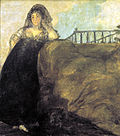 Una manola/La Leocadia, Leocadia, 1819-1823
.jpg)
| This user page is actively undergoing a major edit for a little while. To help avoid edit conflicts, do not edit it while this notice is displayed. This page was last edited 58 days ago, at 10:05, 17 January 2026 (UTC) (). Please remove this template if this page hasn't been edited for a significant time. If you added this notice, remember to remove it or replace it with {{under construction}} between editing sessions. |
Lenore Jaffee was born in New York City on November 30, 1925, and she died on November 8, 2022. She was an American artist, painter and poet. During the 1940s she attended the Art Students League of New York where she studied with Will Barnet among others. Jaffee began to exhibit her Abstract expressionist paintings during the late 1950s and 1960s in New York City and Provincetown, Massachusetts.[32] During the late 1950s and the early 1960s she showed her work at the Phoenix Gallery in New York. [33] The Phoenix was a prominent gallery among the 10th Street galleries in New York City and it was an avant-garde alternative to the Madison Avenue and 57th Street galleries that were both conservative and highly selective. [34] During the 1970s Lenore Jaffee's video work was exhibited at the Hundred Acres Gallery in New York City.[35] Among other works she has published several volumes of poetry. [36]

- Reference details go here
- Hughes (1990), 144
- Tralbaut (1981), p.216
- Ronald Pickvance, Van Gogh In Arles, pp. 38-39 , Exhibition catalog, Published: Metropolitan Museum of Art 1984, ISBN 0-87099-375-5
- Ronald Pickvance, Van Gogh In Arles, pp. 102-103, Exhibition catalog, Published: Metropolitan Museum of Art 1984, ISBN 0-87099-375-5
- Ronald Pickvance, Van Gogh In Arles, The Yellow House pp. 175-176, Exhibition catalog, Published: Metropolitan Museum of Art 1984, ISBN 0-87099-375-5
- Tralbaut (1981), p.286
- Hulsker (1980) 196-205
- Hulsker (1980), 356
- Pickvance (1984), 168-169;206
- Schaefer, von Saint-George & Lewerentz (2008), pp. 105-110
- See Ives, Stein & alt. (2005)
- Struik, Tineke van der, ed. Casciato Paul, "Hidden Van Gogh revealed in color by scientists", Reuters, 30 July 2008. Retrieved 3 August 2008.
- "'Hidden' Van Gogh painting revealed", Delft University of Technology, 30 July 2008. Retrieved 3 August 2008. A photo on this site shows the revealed older image under the new painting.
- Tralbaut (1981), p.293
- Tralbaut (1981), p.176
- Tralbaut (1981), 216
- Pickvance (1984), 38-39
- Pickvance (1984), 45-53
- Pickvance (1984), 234-235
- Seeing Feelings. Buffalo Fine Arts Academy. Retrieved June 26, 2009
- Pickvance (1984), 102-103
- Pickvance (1986), 154-157
- Pickvance (1986), 189-191
- Ronald Pickvance, Van Gogh In Saint-Remy and Auvers. 132-133. Exhibition catalog. Metropolitan Museum of Art, 1986. ISBN 0-87099-477-8
- Hulsker (1980), 385
- Pickvance (1986), 101
- Pickvance (1986), 272-273
- Beat MuseumRetrieved June 20, 2010
- The Beat Scene, photographs by Fred McDarrah, Edited and with an introduction by Elias Wilentz
- Smithsonian Archives of American ArtRetrieved June 20, 2010
- Catalog of Copyright Entries. Third Series: 1955 Retrieved June 20, 2011
| This article about a painter from the United States is a stub. You can help Wikipedia by adding missing information. |
Copying from another artist’s work had been out of style for a good part of the twentieth century; the avant-garde had increasingly set store by invention. In resorting to old-fashioned copying (and of such 'unartistic' models), Lichtenstein did something characteristic: he made it so obvious that he was copying that everyone knew it. In effect he threw down the gauntlet, challenging the notion of originality as it prevailed at that time.
_by_Matisse.jpg)

_-_Google_Art_Project.jpg)


