As seen in the previous example, the ratio test may be inconclusive when the limit of the ratio is 1. Extensions to the ratio test, however, sometimes allows one to deal with this case. [3][4][5][6][7][8][9][10][11]
In all the tests below we assume that Σan is a sum with positive an. These tests also may be applied to any series with a finite number of negative terms. Any such series may be written as:
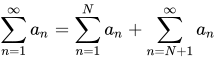
where aN is the highest-indexed negative term. The first expression on the right is a partial sum which will be finite, and so the convergence of the entire series will be determined by the convergence properties of the second expression on the right, which may be re-indexed to form a series of all positive terms beginning at n=1.
Each test defines a test parameter (ρn) which specifies the behavior of that parameter needed to establish convergence or divergence. For each test, a weaker form of the test exists which will instead place restrictions upon limn->∞ρn.
All of the tests have regions in which they fail to describe the convergence properties of ∑an. In fact, no convergence test can fully describe the convergence properties of the series[3][9]. This is because if ∑an is convergent, a second convergent series ∑bn can be found which converges more slowly: i.e., it has the property that limn->∞ (bn/an) = ∞. Furthermore, if ∑an is divergent, a second divergent series ∑bn can be found which diverges more slowly: i.e., it has the property that limn->∞ (bn/an) = 0. Convergence tests essentially use the comparison test on some particular family of an, and fail for sequences which converge or diverge more slowly.
The De Morgan Heirarchy
Augustus De Morgan proposed a hierarchy of ratio-type tests[8]
The ratio test parameters ( ) below all generally involve terms of the form
  . This term may be multiplied by
  to yield
  . This term can replace the former term in the definition of the test parameters and the conclusions drawn will remain the same. Accordingly, there will be no distinction drawn between references which use one or the other form of the test parameter.
1. d’Alembert’s Ratio test
The first test in the De Morgan Heirarchy is the ratio test as described above.
2. Raabe's test
This extension is due to Joseph Ludwig Raabe. Define:
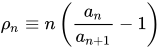
The series will:[6][9][8]
- Converge when there exists a c > 1 such that
 for all n > N.
- Diverge when
 for all n > N.
- Otherwise, the test is inconclusive.
Defining  , the limit version states that the series will[11][12]:
- Converge if ρ > 1 (this includes the case ρ = ∞)
- Diverge if ρ < 1.
- If ρ=1, the test is inconclusive.
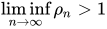
When the above limit does not exist, it may be possible to use limits superior and inferior[3]. The series will:
- Converge if
- Diverge if

- Otherwise, the test is inconclusive.
3. Bertrand’s test
This extension is due to Joseph Bertrand and Augustus De Morgan.
Defining:

Bertrand's test[3][9] asserts that the series will:
- Converge when there exists a c > 1 such that for all n > N.
- Diverge when for all n > N.
- Otherwise, the test is inconclusive.
Defining , the limit version states that the series will:
- Converge if ρ > 1 (this includes the case ρ = ∞)
- Diverge if ρ < 1.
- If ρ=1, the test is inconclusive.
When the above limit does not exist, it may be possible to use limits superior and inferior[3][8][13]. The series will:
- Converge if

- Diverge if

- Otherwise, the test is inconclusive.
4. Gauss’s test
This extension is due to Carl Friedrich Gauss.
Assuming an > 0 and r > 1, if a bounded sequence Bn can be found such that for all n:[3][4][6][8][9]:

then the series will:
- Converge if

- Diverge if

5. Kummer’s test
This extension is due to Ernst Kummer.
Let ζn be an auxiliary sequence of positive constants. Define:
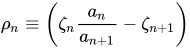
Kummer's test states that the series will:[4][5][9][10]:
- Converge if there exists a c > 0 such that for all n > N.
- Diverge if
 for all n > N and
  diverges.
- Otherwise, the test is inconclusive
Defining , the limit version states that the series will[14][6][8]:
- Converge if ρ > 0
- Diverge if ρ < 0 and diverges.
- If ρ=0, the test is inconclusive.
When the above limit does not exist, it may be possible to use limits superior and inferior[3]. The series will:
- Converge if
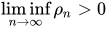
- Diverge if
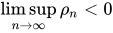 and
and  diverges.
- Otherwise, the test is inconclusive
Proof of Kummer's test[4]
If  then fix a positive number
  . There exists
a natural number
. There exists
a natural number  such that for every
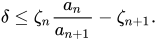
Since  , for every

In particular  for all
  which means that starting from the index
the sequence
which means that starting from the index
the sequence  is monotonically decreasing and
positive which in particular implies that it is bounded below by 0. Therefore the limit
is monotonically decreasing and
positive which in particular implies that it is bounded below by 0. Therefore the limit
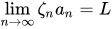 exists.
This implies that the positive telescoping series
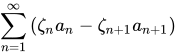 is convergent,
and since for all

by the direct comparison test for positive series, the series
 is convergent.
On the other hand, if  , then there is an N such that
  is increasing for
  . In particular, there exists an
  for which
  for all , and so
 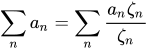 diverges by comparison with
  .
.
The Second Ratio Test
A more refined ratio test is the second ratio test:[6][8]
For  define:
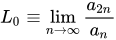 |
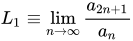 |
 |
By the second ratio test, the series will:
- Converge if

- Diverge if

- If
 then the test is inconclusive.
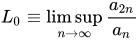
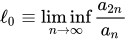
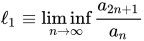
If the above limits do not exist, it may be possible to use the limits superior and inferior. Define:
 |
|
 |
 |
|
 |
|
|
 |
Then the series will:
- Converge if
- Diverge if

- If
 then the test is inconclusive.
The second ratio test can be generalized to an m-th ratio test, but higher orders are not found to be as useful[6][8].
Duris, Frantisek (2009). Infinite series: Convergence tests (PDF) (Bachelor's thesis). Katedra Informatiky, Fakulta Matematiky, Fyziky a Informatiky, Univerzita Komensk´eho, Bratislava. Retrieved 28 November 2018.


 ,
,  ...
...


