The presence of pertubing particles near an emitting atom will cause a broadening and possible shift of the emitted radiation.
There is two types impact and quasistatic
In each case you need the profile, represented by Cp as in C6 for Lennard-Jones potential

Assume Maxwell-Boltzmann distribution for both cases.
Quasistatic broadening
From (Peach 1981, p. 408) harv error: no target: CITEREFPeach1981 (help)
For quasistatic, functional form of lineshape varies. Generally its a Levy skew alpha-stable distribution (Peach, page 408)
![{\displaystyle \Delta \omega _{0}L(\omega )={\frac {1}{\pi }}\Re \left[\int _{0}^{\infty }\exp(i\beta x-(1+i\tan \theta )x^{3/p})\,dx\right]}](//wikimedia.org/api/rest_v1/media/math/render/svg/fcda761391efed14bf4134435d7e62db74d92392)
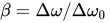



- Broadening by linear Stark effect

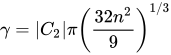

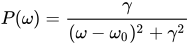

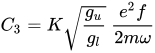
where K is of order unity. Its just an approximation.
- Broadening by quadratic Stark effect

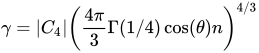
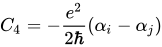 (Peach1981 & Peach 1981, Eq 4.95) harv error: no target: CITEREFPeach1981Peach1981 (help)
where  and
and  are the static dipole polarizabilities of the i and j energy levels.

- Broadening by Van der Waals forces gives a Van der Waals profile. C6 is the wing term in the Lennard-Jones potential.
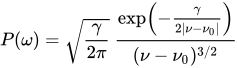
for

0 otherwise.
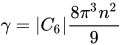
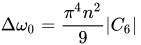 (Peach 1981, Eq 4.101) harv error: no target: CITEREFPeach1981 (help)
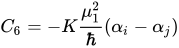 (Peach 1981, Eq 4.100) harv error: no target: CITEREFPeach1981 (help)
where K is of order 1.


![{\displaystyle w+id=\alpha _{p}\pi nv\left[{\frac {\beta _{p}|C_{p}|}{v}}\right]^{2/(p-1)}\Gamma \left({\frac {p-3}{p-1}}\right)\exp \left(\pm {\frac {i\pi }{p-1}}\right)}](http://wikimedia.org/api/rest_v1/media/math/render/svg/968ded8ca6e4832be0715300d8ae91fed7217807)


![{\displaystyle \Delta \omega _{0}L(\omega )={\frac {1}{\pi }}\Re \left[\int _{0}^{\infty }\exp(i\beta x-(1+i\tan \theta )x^{3/p})\,dx\right]}](http://wikimedia.org/api/rest_v1/media/math/render/svg/fcda761391efed14bf4134435d7e62db74d92392)


