Vuong's closeness test
From Wikipedia, the free encyclopedia
In statistics, the Vuong closeness test is a likelihood-ratio-based test for model selection using the Kullback–Leibler information criterion. This statistic makes probabilistic statements about two models. They can be nested, strictly non-nested or partially non-nested (also called overlapping). The statistic tests the null hypothesis that the two models are equally close to the true data generating process, against the alternative that one model is closer. It cannot make any decision whether the "closer" model is the true model.
With strictly non-nested models and iid exogenous variables, model 1 (2) is preferred with significance level α, if the z statistic
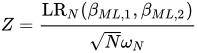
with

exceeds the positive (falls below the negative) (1 − α)-quantile of the standard normal distribution. Here K1 and K2 are the numbers of parameters in models 1 and 2 respectively.
The numerator is the difference between the maximum likelihoods of the two models, corrected for the number of coefficients analogous to the BIC, the term in the denominator of the expression for Z, , is defined by setting equal to either the mean of the squares of the pointwise log-likelihood ratios , or to the sample variance of these values, where


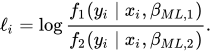
For nested or partially non-nested (overlapping) models the statistic

has to be compared to critical values from a weighted sum of chi squared distributions. This can be approximated by a gamma distribution (in shape-rate form):

with

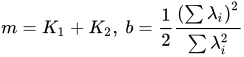
and
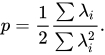
is a vector of eigenvalues of a matrix of conditional expectations. The computation is quite difficult, so that in the overlapping and nested case multiple authors[who?] only derive statements from a subjective evaluation of the Z statistic (is it subjectively "big enough" to accept my hypothesis?).




