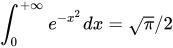
Wallis' integrals
From Wikipedia, the free encyclopedia

In mathematics, and more precisely in analysis, the Wallis integrals constitute a family of integrals introduced by John Wallis.
The Wallis integrals are the terms of the sequence defined by

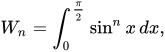
or equivalently,
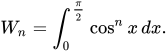
The first few terms of this sequence are:
| ... | ||||||||||
| ... |


The sequence is decreasing and has positive terms. In fact, for all


- because it is an integral of a non-negative continuous function which is not identically zero;
- again because the last integral is of a non-negative continuous function.


Since the sequence is decreasing and bounded below by 0, it converges to a non-negative limit. Indeed, the limit is zero (see below).
Recurrence relation
By means of integration by parts, a reduction formula can be obtained. Using the identity , we have for all ,



Integrating the second integral by parts, with:
- , whose anti-derivative is
- , whose derivative is

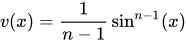
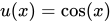

we have:
![{\displaystyle \int _{0}^{\frac {\pi }{2}}\sin ^{n-2}x\cos ^{2}x\,dx=\left[{\frac {\sin ^{n-1}x}{n-1}}\cos x\right]_{0}^{\frac {\pi }{2}}+{\frac {1}{n-1}}\int _{0}^{\frac {\pi }{2}}\sin ^{n-1}x\sin x\,dx=0+{\frac {1}{n-1}}W_{n}.}](https://wikimedia.org/api/rest_v1/media/math/render/svg/a9bc041e854a7886c226ea1ef97744ddfec878b4)
Substituting this result into equation (1) gives
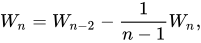
and thus

for all

This is a recurrence relation giving in terms of . This, together with the values of and give us two sets of formulae for the terms in the sequence , depending on whether is odd or even:




Another relation to evaluate the Wallis' integrals
Wallis's integrals can be evaluated by using Euler integrals:
- Euler integral of the first kind: the Beta function:
- for Re(x), Re(y) > 0
- Euler integral of the second kind: the Gamma function:
- for Re(z) > 0.

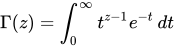
If we make the following substitution inside the Beta function:
we obtain:
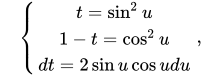

so this gives us the following relation to evaluate the Wallis integrals:
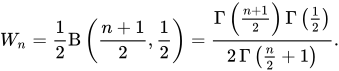
So, for odd , writing , we have:


whereas for even , writing and knowing that , we get :



Equivalence
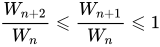
- From the recurrence formula above , we can deduce that

- (equivalence of two sequences).

- Indeed, for all :
- (since the sequence is decreasing)
- (since )
- (by equation ).
- By the sandwich theorem, we conclude that , and hence .



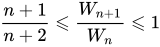

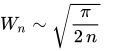
- By examining , one obtains the following equivalence:

- (and consequently ).
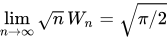
For all , let .

It turns out that, because of equation . In other words is a constant.


It follows that for all , .

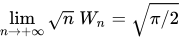
Now, since and , we have, by the product rules of equivalents, .


Thus, , from which the desired result follows (noting that ).

Deducing Stirling's formula
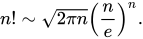
Suppose that we have the following equivalence (known as Stirling's formula):
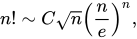
for some constant that we wish to determine. From above, we have

- (equation (3))
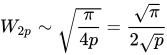
Expanding and using the formula above for the factorials, we get

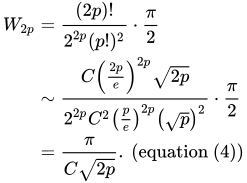
From (3) and (4), we obtain by transitivity:
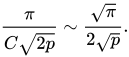
Solving for gives In other words,

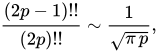
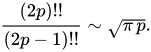
Deducing the Double Factorial Ratio
Similarly, from above, we have:
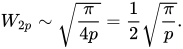
Expanding and using the formula above for double factorials, we get:
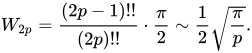
Simplifying, we obtain:
or



![{\displaystyle t\in [0,1]}](https://wikimedia.org/api/rest_v1/media/math/render/svg/31a5c18739ff04858eecc8fec2f53912c348e0e5)