Wigner–Seitz radius
From Wikipedia, the free encyclopedia
The Wigner–Seitz radius , named after Eugene Wigner and Frederick Seitz, is the radius of a sphere whose volume is equal to the mean volume per atom in a solid (for first group metals).[1] In the more general case of metals having more valence electrons, is the radius of a sphere whose volume is equal to the volume per a free electron.[2] This parameter is used frequently in condensed matter physics to describe the density of a system. is typically calculated for bulk materials.

Formula
In a 3-D system with free valence electrons in a volume , the Wigner–Seitz radius is defined by


where n is the particle density. Solving for we obtain
![{\displaystyle r_{\rm {s}}={\sqrt[{3}]{\frac {3}{4\pi n}}}.}](http://wikimedia.org/api/rest_v1/media/math/render/svg/5f5520d52c284221562ae91e08a8a9620e01111f)
The radius can also be calculated as where M is molar mass, NV is the count of free valence electrons per particle, ρ is the mass density, and NA is the Avogadro constant, 6.02214076×10²³ mol−1[3].
![{\displaystyle r_{\rm {s}}={\sqrt[{3}]{\frac {3M}{4\pi \rho N_{V}N_{\rm {A}}}}}}](http://wikimedia.org/api/rest_v1/media/math/render/svg/7455aeab372d9bcc194fb3660c99cf82ac4fc615)
This parameter is normally reported in atomic units, i.e., in units of the Bohr radius.
Assuming that each atom in a simple metal cluster occupies the same volume as in a solid, the radius of the cluster is given by where n is the number of atoms.[4][5]

Values of for the first group metals:[2]
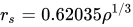
Wigner–Seitz radius is related to the electronic density by the formula where ρ can be regarded as the average electronic density in the outer portion of the Wigner-Seitz cell.[6]