Wikipedia talk:WikiProject Molecular Biology/Molecular and Cell Biology/Archive 3
From Wikipedia, the free encyclopedia
 | This is an archive of past discussions about Wikipedia:WikiProject Molecular Biology. Do not edit the contents of this page. If you wish to start a new discussion or revive an old one, please do so on the current talk page. |
| Archive 1 | Archive 2 | Archive 3 | Archive 4 | Archive 5 | → | Archive 10 |
Someone to have a look at move of gene synthesis
Could someone please have a look at the requested move of Gene synthesis → Synthetic DNA (see Talk:Gene synthesis#Requested move)? I'm thinking of making additional changes to the article once the location is determined, but can't move it myself. Mikael Häggström (talk) 04:23, 25 May 2010 (UTC)
Low-frequency collective motion in proteins and DNA
Help needed. An anon has deleted 90% of this article, along with most of the references, the marked the rest for deletion. The article has plenty of problems but WAS sourced beyond the initiator's papers. I'm just a page-watcher on this tho I did try to clarify and wikify a little a few months ago. Please see article discussion pageI'll revert the hatchet job but I don't have the time, journal access, or expertise to broaden the article.Dankarl (talk) 22:22, 27 May 2010 (UTC)
- The same thing has happened to Pseudo amino acid composition, both articles being created by the same author. I'll see what I can do, but it might be appropriate to either merge or broaden each article. Antony-22 (talk) 22:52, 27 May 2010 (UTC)
PRG4/lubricin
Hi, I'm not sure what the policy on pages for genes and their protein products is, but there seems to be a page each dedicated to PRG4 (the gene) and lubricin (the protein product). Is this OK, or do they need to be merged in some way? Ka Faraq Gatri (talk) 22:27, 27 May 2010 (UTC)
List of restriction enzyme cutting sites
Hi, I have created some time ago some lists about restriction enzyme cutting sites:
- The main article that drives you to the lists: List of restriction enzyme cutting sites
- The lists:
I don't know if it would be useful to add these pages to this WikiProject. What should I do? Just to add the banner? anything else?
The first article (List of restriction enzyme cutting sites: A) is completed, with the most available higher impact references added, and 8-10 isoschizomers/enzyme added too. I am working in the rest ones, day by day. Flakinho (talk) 14:28, 28 May 2010 (UTC)
- Wow - that's an impressive amount of work done there. Considering the amount of effort necessary to compile these pages, do you think that they'll be able to compete in utility with (or fill a different niche than) similar resources provided by (for example) NEB ? – ClockworkSoul 17:17, 28 May 2010 (UTC)
- Agree. I am a strong inclusionist, yet I don't know if this kind of articles really belong here. That said, I appreciate a lot the great work! --Cyclopiatalk 19:20, 28 May 2010 (UTC)
- Thank you for your assessments guys, I really appreciate that. Some time ago, I realized that this kind of information (restriction sites and anything) was almost in "private hands", like NEB. Even the REBASE database is hosted on the NEB webpage. So, I thought: it should be free and public, it should be in Wikipedia. Really, I am doing an effort to finish including references and isoschizomers, but it takes long time. I am using the information of REBASE (http://rebase.neb.com/) to check isoschizomers and references. I think this webpage is the most comprehensive DB about restriction enzymes I have ever seen. What should I do to include this articles in the your Wikiproject? Just to add the banner? Anything else? Thank you very much for your fast reply. Flakinho (talk) 19:39, 28 May 2010 (UTC)
- Ok, I should include {{Wikiproject MCB}} in the talk pages but, who rates the importance and class of the articles? Flakinho (talk) 19:46, 28 May 2010 (UTC)
- Don't get me wrong: I'm not opposed to it in any way... just be sure you know what you're getting into! To answer your question about the MCB template: "list" would be most appropriate I think. As for importance... that can be a little fuzzy sometimes. I can imagine this becoming a resource that people start to use (I know I would: I'm buried in a mutagenesis project right now), so I don't think that "mid" would be entirely inappropriate. – ClockworkSoul 20:33, 28 May 2010 (UTC)
- Don't worry, I understood right. I will do it as you said. Good luck with your mutagenesis project. Flakinho (talk) 20:44, 28 May 2010 (UTC)
- A quirky thing in wikipedia is that despite the How-to ban, pages about practical side of things have more viewers than expected compared to theoretical pages... ELISA is viewed more than the cell cycle and pipette more than gene expression (despite having given it clean up several months ago I have no idea what people to find in pipette). So do not doubt for a minute that the list is useless it will be far from it. Consequently for both the effort and the utility, I took the liberty of giving Flakinho a WP:barnstar. (forgot to sign... --Squidonius (talk) 23:34, 29 May 2010 (UTC)
- Don't worry, I understood right. I will do it as you said. Good luck with your mutagenesis project. Flakinho (talk) 20:44, 28 May 2010 (UTC)
- Don't get me wrong: I'm not opposed to it in any way... just be sure you know what you're getting into! To answer your question about the MCB template: "list" would be most appropriate I think. As for importance... that can be a little fuzzy sometimes. I can imagine this becoming a resource that people start to use (I know I would: I'm buried in a mutagenesis project right now), so I don't think that "mid" would be entirely inappropriate. – ClockworkSoul 20:33, 28 May 2010 (UTC)
cryptic, misplaced question
what are the four things connected when a protein is formed in translation? —Preceding unsigned comment added by 97.89.161.119 (talk) 02:05, 2 June 2010 (UTC)
- Is that a question for school homework? As you probably know the point of homework is understanding and not getting a good mark for good answers which translate into pocket money, so please read Introduction to genetics. Anyway, The essential components in translation are
- mRNA, acts as a instruction manual
- ribosome, acts as a jig to keep the pieces together
- tRNAs, act as a decoding mask to translate codons into amino acids
- and of course.. the new protein! --Squidonius (talk) 04:01, 2 June 2010 (UTC)
Crizotinib
Crizotinib
The new-ish Wikipedian ScienceRulz2012 (talk · contribs) has created the article Crizotinib, and asked for my help in developing it.
I think it is within the remit of this project group, so I added the project on the talk page, with an initial assessment of start class/low priority.
I would be very grateful if anyone could look at the article, possibly change the assessment, and make comments on the talk page. Best, Chzz ► 16:28, 10 June 2010 (UTC)
Major urinary proteins at FAC
The article on Major urinary proteins is at FAC here. This is probably the most relevant community for the article, so I figured I'd let folks know it's up for review. Emw (talk) 00:06, 11 June 2010 (UTC)
Eukaryotic gene example
See eukaryotic gene example. Surely an arbitrary example is not an appropriate topic for an article? Should this be edited and moved to eukaryotic gene or merged somewhere or.. ? mgiganteus1 (talk) 01:07, 9 June 2010 (UTC)
- I agree. It currently reads like a tutorial for a course rather than an article. The topic is I also agree not right for Wikipedia. I think that the figures might be useful, but I can't see too much in the textual content that would be useful to merge. Alexbateman (talk) 08:02, 9 June 2010 (UTC)
- So what do we do with it? mgiganteus1 (talk) 02:30, 29 June 2010 (UTC)
- To be honest, it seems to me that it focuses on the undergrad awe at discovering the fact that anyone can get protein sequences from home (I used to be amused that you could find Ebola genes in NCBI), but has not yet discovered PyMol etc. Hence I would vote delete, but something that strikes me is that oddly it has 10-30 viewers a day, even last year and some pages link to it, such as exon and intron (which are really poor). (why and how do people get there?) I cannot really think what it should look like if the article were to be saved. The only caveat for deletion I can say is that it was created for a reason either to fill a gap a user felt (=call to improve linked articles) or by the user to do something useful with his/her homework, the fact it get viewers makes me think the former may be the case, which means there are many lost people out there. However, being forced to improve articles is not fun so I am not sure how to solve this. --Squidonius (talk) 20:07, 29 June 2010 (UTC)
- So what do we do with it? mgiganteus1 (talk) 02:30, 29 June 2010 (UTC)
- I agree. It currently reads like a tutorial for a course rather than an article. The topic is I also agree not right for Wikipedia. I think that the figures might be useful, but I can't see too much in the textual content that would be useful to merge. Alexbateman (talk) 08:02, 9 June 2010 (UTC)
Seeking input at FAC for 'Homologous recombination'
The FAC nomination for Homologous recombination has been up for about a week and a half, and is in need of further review. As it is a major mechanism of DNA repair and genetic diversification, the subject is one of WikiProject MCB's "High Importance" articles. I'd greatly appreciate any input! Emw (talk) 00:49, 24 June 2010 (UTC)
- I noticed that the term non-allelic homologous recombination (NAHR) is one that occurs a lot in the literature but doesn't appear to be represented in the article. Alexbateman (talk) 16:31, 24 June 2010 (UTC)
Two articles that might need to be merged
Science isn't my area which is why I'm not inclined to do anything about this myself but it seems to me that these two articles are pretty much identical and that one should be turned into a redirect for the other. --*Kat* (talk) 14:38, 12 July 2010 (UTC)
- Yep. I completely agree. Is there someone familiar with this area of research who can do the merge? - Richard Cavell (talk) 10:46, 16 July 2010 (UTC)
 Done (see Talk:HIBADH for justification). Boghog (talk) 21:32, 16 July 2010 (UTC)
- Yep. I completely agree. Is there someone familiar with this area of research who can do the merge? - Richard Cavell (talk) 10:46, 16 July 2010 (UTC)

Microscopy
I have, again, been doing some major tidying of microscopy related articles, particularly microscope, optical microscope and some smaller edits on digital microscope, USB microscope, stereo microscope, and immunofluorescence. I have been trying to remove strong biases in the articles (most had a bias towards very old and very new technology) and split pages into more logical chunks (for example stereo microscope is now a standalone article). I would greatly appreciate it if anyone could take a quick look at my changes and let me know about any big mistakes or omissions!
I am also trying to create some good example pictures of light microscopy illumination techniques, what do you think of these?
- Four examples of transilumination techniques used to generate contrast in a sample of tissue paper. 1.559 μm/pixel.
 Bright field illumination, sample contrast comes from absorbance of light in the sample.
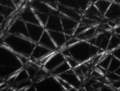 Cross-polarized light illumination, sample contrast comes from rotation of polarized light through the sample.
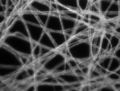 Dark field illumination, sample contrast comes from light scattered by the sample.
 Phase contrast illumination, sample contrast comes from interference of different path lengths of light through the sample.


Wikipedia:Categories for discussion/Log/2010 July 12
Hi, everyone. I'm proposing to recategorise all hormones. My idea is to make the subcategories more distinct from each other, and to give more options to someone searching through the categories. Looking for input! - Richard Cavell (talk) 02:07, 16 July 2010 (UTC)
DIC microscopy images
I recently took some nice DIC microscopy images (or I believe them to be nice anyway) that I took at an internship and I own all the rights to the images...those that I have uploaded have been licenced anyhow. I took a lot of movies which showed vesicles moving about, a cell capturing two gold nanorods and internalizing them, cells thickening and thinning, intercellular connection formation and destruction and also just aesthetically pleasing images? Someone tell me where I could put them or where they might be useful. I particularly like a set of images which showed the fine focal plane precision of DIC (cells visible and in focus in all of the images, but cytoneme and filopodia-like connections disappeared and appeared depending on their focal plane). John Riemann Soong (talk) 01:43, 19 August 2010 (UTC)
- are you sure you own the copyright to it? --CarTick 01:50, 19 August 2010 (UTC)
- I'm fairly sure. I made all the observations. I took the images. I ran the project. I analysed all the data. They let me do with the images as I like. They even know I uploaded the images to wiki. The equipment was Department of Energy property so in any case they're good! John Riemann Soong (talk) 01:56, 19 August 2010 (UTC)
Old merge proposal
this discussion has been going on for three years. Anyone want to do the deed? Totnesmartin (talk) 13:33, 23 September 2010 (UTC)
Gene Wiki news
Dear MCBers, I have two quick announcements regarding the Gene Wiki project. First, the NIH has recently funded a grant proposal in my group focused on the Gene Wiki. Some of the work will be on improving the gene pages themselves, and others will be focused on mining the pages for useful data. You can read some more in our blog post. Details are a bit sparse, but only because I haven’t gotten more organized yet. We definitely want to engage as many people as are interested! Feel free to ask any questions here or via email...
Second, Ben Good and I will be presenting on our efforts in a webinar next week (Oct 6, 10AM Pacific) for the NCBO. Anyone is welcome to join in to listen what we’ve been up to. And of course, profuse acknowledgments always go out to the editors who really make the Gene Wiki project successful. Cheers, AndrewGNF (talk) 00:57, 30 September 2010 (UTC)
- Fantastic! I am delighted that your proposal was funded and look forward to the improvements in the Gene Wiki that this grant will make possible. The goals of updating the Gene Wiki, increasing trust, and mining the data are all very important and will help to maintain the momentum of the project. 10,000 down, 10,000 to go! ;-) Cheers. Boghog (talk) 16:45, 2 October 2010 (UTC)
Polycentric chromosome
Hello,
Could someone take a look at Polycentric chromosome? It's a new stub. I suspect, from a quick google search, that the original editor may have the wrong end of the stick and the definition could well be incorrect. I'm also not sure whether the subject warrants an entire article or whether it would be best off merged with Chromosome or maybe Chromosome abnormality. Ka Faraq Gatri (talk) 22:37, 11 October 2010 (UTC)
God Gene hypothesis
A disagreement on whether it is appropriate to mention the "God Gene" in the Vesicular monoamine transporter 2 article has developed. I would appreciate input from third parties. Thanks. Boghog (talk) 04:18, 18 October 2010 (UTC)
Need some help
There are three outstanding "expert assistance" requests related to MCB on the list:
{{Expert-subject}} sometimes gets spammed to articles that just need some attention from anybody, but if someone here could please look over these three and figure out what help, if any, was wanted -- and to either fix the articles or to remove the tags, if you can't figure out what's going on -- I'd appreciate it. WhatamIdoing (talk) 18:01, 18 October 2010 (UTC)
Articles listed for deletion
Articles needing review for neutrality
Could someone with some knowledge of the field check over Pseudo amino acid composition and Low-frequency collective motion in proteins and DNA which were written by two related SPAs, to make sure they are important enough to merit their own articles and whether it is correct to give so much importance to Kuo-Chen Chou's name and work? All of Low-frequency internal (talk · contribs)'s edits could probably do with being closely scrutinised in fact. Cheers Smartse (talk) 19:19, 19 October 2010 (UTC)
- I would advise blocking the user as all the edits seem to be related to the work of Kuo-Chen Chou, which are in fact a subset of the field of amino acid composition, which includes papers which may be more relevant to wikipedia that analysis tools, such as amino acid differences across species & cog homologues by Pasamontes, the 1940s early ester method, amino acid composition & thermophilic adaptation and so forth. --Squidonius (talk) 22:20, 22 October 2010 (UTC)
- The user in question has been warned a number of times about excessive self citation (see talk) and apparently the message has finally gotten though since the editor has not made any contributions since 22 August 2010 (see contribs). Hence I don't think a block is warranted at this time, however we should of course be on the lookout for resumption of this pattern of edits. In addition, I have gone through all of this editor's contributions and have edited or reverted many of them that were not already reverted by other editors. Finally as discussed here, the material in question I believe is notable and verifiable, but at the same time I am also very concerned about the large number of citations to a single author. Unfortunately these articles are outside my area of expertise, so I am not in the position to judge whether these violate WP:NPOV and WP:UNDUE. Boghog (talk) 06:11, 23 October 2010 (UTC)
Your suggestions sought for citations list.
Several participants in this WikiProject have advanced knowledge of genetics, and I'd like to suggest a way to contribute your knowledge of the professional literature for improving articles all over Wikipedia. Wikipedians reading or editing articles are welcome to look at a bibliography of Anthropology and Human Biology Citations, posted for the use of all Wikipedians who have occasion to edit articles on human genetics and related issues. I happen to have circulating access to a huge academic research library at a university with an active research program in these issues (and to another library that is one of the ten largest public library systems in the United States) and have been researching these issues sporadically since 1989. You can help other Wikipedians by suggesting new sources through comments on that page. It will be extremely helpful for articles on human genetics to edit them according to the Wikipedia standards for reliable sources for medicine-related articles, as it is important to get these issues as well verified as possible. -- WeijiBaikeBianji (talk) 19:46, 27 October 2010 (UTC)
Articles listed for deletion
Antibiotics - only antibacterial?
Our antibiotic article currently says that they only are only antibacterial, however I just made a stub about a family of antibiotics (peptaibols) that are antifungal and this usage also appears to apply to other antibiotics like clotrimazole (see this paper). Should the antibiotic article be changed in account of this? (The article is also written from a totally human perspective, something I've bought up elsewhere previously, as it only discusses their use as drugs, rather than by microbes in nature.) Smartse (talk) 17:37, 29 October 2010 (UTC)
- Most dictionary definitions refer to antibiotics as substances that inhibit the growth of or kill microorganisms. The definition of microorganism includes protozoa, algae, fungi, etc. in addition to bacteria. Hence it would appear that antibiotics are synonymous with antimicrobials. Boghog (talk) 19:08, 29 October 2010 (UTC)
- Ok, thanks for that. Could an even broader definition be any compound which mediates antibiosis? It looks to me as if antibiotic should be moved to antibiotic drug and that a new article should be made to cover antibiotics in the broader sense, and from a less anthropocentric viewpoint. Smartse (talk) 20:05, 29 October 2010 (UTC)
- IUPAC definition are generally great but this is odd link: a natural or derivative compound produced by some organism which at low doses can kill other forms of life, often nasty ones. So accordingly, Strychnine (made by some tree and kills humans) is an antibiotic and so are natural antivirals (if they exist), but antimicrobial NCE generated by combinatorial chemistry are not (EMEA/FDA approval appart): which is hard to swallow. At least, alcohol produced by yeast (= not an antibiotic due to low potency (but is used as a disinfectant)) nor is azide (synthetic (not an antibiotic) and kills all (= biocide)) are not. In common use the term "antibiotic compound" means a medical drug, despite the etymology (this mismatch is not too uncommon, eg. solvatochromic fluorophores change spectral emissions and not colour in solvents), so do ecologists use the word antibiotic? do medics call a not-yet/not approved antimicrobial drug an antibiotic? If no to both, I'd say antibiotic compound=medical drug, despite liking the non-anthropogenic cause more. --Squidonius (talk) 00:59, 30 October 2010 (UTC)
- "do ecologists use the word antibiotic?" they certainly do: JSTOR 4250863 and this paper (and many more), not sure about the second. Just realised that Arcadian has taken care of this and moved antibiotic to antibacterial citing WP:MEDMOS. Not sure if this is entirely correct either per WP:COMMONNAME, and based on what I've said above, antibiotic has a much wider usage than antibacterial, so shouldn't necessarily redirect to antibacterial without any explanation. SmartSE (talk) 11:28, 30 October 2010 (UTC)
WP:MCB Blues
It seems that WP:MCB is not feeling too communicative.

This graph shows the number of edits in the four WP:MCB talk pages, it would be great if it were actually of articles in WP:MCB but that would take more time to do, but I'd assume that the traffic on the WP reflects it's articles (unless everyone is more efficient). Note: The graph has been subjected to SMA-5.
Basically, WP:MCB's hayday was in 2006 when Help and Announcements were split from Discussion and up to last year it was gathering strength, with a nasty dip between Sept-Dec 08, but now it is drammatically loosing edits.
Two situations:
- The work is done: molecular biology on wikipedia is a perfect expression system with no leaky expression and 100% knowledge transformation efficiency!
- User apathy. I probably fall into this category as I have been editing many completely recreational other stuff.
I am aware there a similar WP-wide effect, but not sure if it is this pronounced. If it is the latter, what can be done? The only thing I can think of is to make it more rewarding for editors and making a MCB barnstar and encorage its use, maybe? (when I give them out I give the bio one but I do not think it is quite the right one) --Squidonius (talk) 21:49, 20 September 2010 (UTC)
- Interesting graph. I suspect measuring the number of good and featured WP:MCB articles promoted per month over the last 4 or 5 years would show similar patterns of activity. While I suppose it probably wouldn't hurt, unfortunately I don't think barnstars will make a significant positive impact on MCB editor activity. In my opinion recommendations from the recently concluded Strategic Planning drive like http://strategy.wikimedia.org/wiki/Task_force/Recommendations/Community_health_1 offer some promising ideas for increasing editor activity in content generation (i.e., producing and expanding articles) and retaining core content contributors. At the recent Wikiconf NYC, Sue Gardner discussed how the WMF plans to enact procedures along the lines of those recommendations, which bodes well. Emw (talk) 23:17, 20 September 2010 (UTC)
- Good work on the graph. My feeling is that there is plenty of editing going on for articles. But most of the major issues for the project are somewhat sorted out. That means I can work on the content without bringing suggestions to this discussion page. Alexbateman (talk) 09:49, 21 September 2010 (UTC)
- I guess we have become somewhat gnomish. There are still some of us lurking around in the dark corners quietly improving articles ;-)
- Good work on the graph. My feeling is that there is plenty of editing going on for articles. But most of the major issues for the project are somewhat sorted out. That means I can work on the content without bringing suggestions to this discussion page. Alexbateman (talk) 09:49, 21 September 2010 (UTC)
- Albeit it will not make much of a difference as Emw mentioned, it does not hurt either, so using images I had previously I made a barnstar... I was not sure if to use images of double helix/vectors and protein or tools of the trade. How about this:

The Molecular Biology Star Not the most valuable award, but some recognition is better than none!

--Squidonius (talk) 20:46, 22 September 2010 (UTC)
To verify the hypothesis that all the edits go on the background, aka the gnome hypothesis :) , I wrote a script to download and analyse all the MCB pages.

The decrease is quite marginal (the data is unmodified, while the black line is a 12-month period moving average (e.i. smoothed out version), whereas the previous graph had relative few edits per month so more noisy so was smoothed), so here is a more succinct pictograph (why a pictograph? It makes the data look more believable in the popular press!), showing there is a 15% drop from last year. I am talking about an absolute difference of 30k edits so any stats will give infinitesimal p-values.

. So there are less edits, but it is not as drammatic as first predicted and it started actually last year... Shame, I quite liked the Gnome hypothesis. The data shows some periodicity, when I have more time I'll do a Furrier analysis to see if it has to do with Northern hemisphere university term times. However, I think there is the Bot hypothesis, in which bots have done most edits, although I have had trouble automatically filtering out bot edits (upto a 3 fold underestimate), which account for over 1/7th of all edits... Parenthetically, edits and editors, as expected, form a power law distribution with a kink caused by bots.

--Squidonius (talk) 21:13, 3 October 2010 (UTC)
- I spotted the error in the filtering (I was checking for the "(bot)" tag in the description whereas all the bots seem to finish in -bot, having fixed that, here is the monthly graph split into bots, humans and "gods", the dozen or some editors who have done over 10k edits, although some of these may be bots in disguise.


The decrease is caused mostly by bots: Bot edits have dropped by 65% from last year (October-Dec 2010 corrected) and 75% from 2008, whereas human edits have dropped by 5% per annum since 2010 (gods dropped by 45%), so not so dire after all, but still not good. (apropos, I think I'll bring this analysis somewhere else and stop spamming.) --Squidonius (talk) 08:11, 4 October 2010 (UTC)
- "human edits have dropped by 5% per annum since 2010" -- I hope you mean 2008. I don't think this is too bad actually. All the low hanging fruit have been plucked and now the hard articles are left to expand. As long as our long-tail ninjas keep dropping in and adding their improvements and we keep plodding along, then WP-MCB is still a great place for the bio-interested people. --Paul (talk) 10:25, 4 October 2010 (UTC)
- This is useful data. Squidonious, did your analysis control for reversions? Edits that simply revert vandalism seem like they would be easily identifiable (by adding probably a dozen-or-so regular expressions to match the most common edit summaries in reverts) and a major source of noise. It would also be good to exclude "minor" edits, which are detectable by parsing out bold m strings from edit summaries. I estimate that over 50% of human MCB edits are reverts or marked as minor or both.
- The class of edits I think is the most relevant to the health of MCB and Wikipedia as a whole is that which adds quality to articles: adding at least several sentences of prose, adding in-line citations, adding infoboxes, etc -- not the class that includes reverts and minor edits. This additive class of edits could be (naively?) detected by taking only edits that are not reverts, minor, or bot-made and that add a significant number of bytes (>100?) to the article.
- Also, who are those high-activity editors in your "god" category? If they only number about a dozen, it should be trivial to determine if they are bots or core MCB editors. Emw (talk) 12:13, 4 October 2010 (UTC)
- All this navel gazing is going to skew the statistics! Kidding aside, great job Emw and Squidonius in compiling these statistics. My interpretation is there has been a decline in the edits by humans, but the decline has not been precipitous. Perhaps I am reading too much into the graphs, but the spike in both human and bot edits in 12/2007 corresponds closely to the major expansion in the Gene Wiki. There was a lot of activity during this period in creating these gene articles as well as cross linking them to pre-exisiting MCB articles, adding categories, navboxes, talk page templates, etc. This effort resulted in an enormous number of edits in a short period of time. After this initial flurry of article creation and integration came to an end, the more time consuming task of expanding these articles started. To be sure, there has been a lot of MCB edits not related to the Gene Wiki, but the 12/2007 spike and the slow decline since then may in part be due to Gene Wiki activity. Boghog (talk) 18:03, 4 October 2010 (UTC)
- I should also mention sister projects such as WP:RNA (06/2007 – 08/2008), {{enzyme}} (10/2007 – 12/2007, User:WillowW), and {{pfam}} that also had initial bursts of activity that has since settled down. Boghog (talk) 18:16, 4 October 2010 (UTC)
- "human edits have dropped by 5% per annum since 2010" -- I hope you mean 2008. I don't think this is too bad actually. All the low hanging fruit have been plucked and now the hard articles are left to expand. As long as our long-tail ninjas keep dropping in and adding their improvements and we keep plodding along, then WP-MCB is still a great place for the bio-interested people. --Paul (talk) 10:25, 4 October 2010 (UTC)
- At a glance Squidonius' data makes this project look like a representative microcosm of Wikipedia as a whole. Compare the running average on the Total MCB Monthly edits graph to the total monthly edits graph on page 4 of The Singularity is Not Near: Slowing Growth of Wikipedia (pdf, 1.32 Mb) – the shape is extremely similar. The declining edit rate was widely reported with remarkable pessimism (eg), though I've always thought like Paul above – as the low-hanging fruit is plucked, it becomes harder to contribute, so the edit rate declines. Wikipedia wasn't going to sustain exponential growth indefinitely. The revert rate has also increased over time, but again I think this is to be expected as Wikipedia matures – the higher the average article quality, the less likely that any given edit will improve its quality. (I also wonder whether increased use of Twinkle, Rollback etc made reverts easier to identify.) Adrian J. Hunter(talk•contribs) 03:01, 5 October 2010 (UTC)
I spent an hour today playing around with the data and got some interesting results regarding the periodicity of edits across the day (I was surprised as I though that the Euro/US time zones would cancel each out), week (monday procrastination) and year (dip in the summer), any handwaving ideas and hypotheses welcome. As I do not want to spam, I have made a page on my userpage with the graphs [] and one day I'll get round to finishing it (promise). --Squidonius (talk) 23:34, 1 November 2010 (UTC)
References
I have managed to get a created article and an expansion on the "Did You Know..." list, namely Fluorescent glucose biosensors and Mycoplasma laboratorium, which is always quite fun (and terribly time consuming). I the process I was told by Smartse about the existence of these templates: {{cite pmid}}, {{cite doi}} and {{cite jstor}} which automatically add a full citation and would have saved me uptillions of mouse clicks. So I though I pass the word! A page I have found useful is WP:FOOT, a how-to for references. I have not found a good way of inserting endnote into wikipedia, doi appart). --Squidonius (talk) 19:37, 27 October 2010 (UTC)
- I prefer Diberri's tool at . It's more direct. WhatamIdoing (talk) 21:39, 2 November 2010 (UTC)
Porins and LPS
Hi guys,
It'd be great if you could take a look at Wikipedia:Articles for deletion/Porins and LPS. Ka Faraq Gatri (talk) 12:36, 6 November 2010 (UTC)
MCB articles have been selected for the Wikipedia 0.8 release
Version 0.8 is a collection of Wikipedia articles selected by the Wikipedia 1.0 team for offline release on USB key, DVD and mobile phone. Articles were selected based on their assessed importance and quality, then article versions (revisionIDs) were chosen for trustworthiness (freedom from vandalism) using an adaptation of the WikiTrust algorithm.
We would like to ask you to review the MCB articles and revisionIDs we have chosen. Selected articles are marked with a diamond symbol (♦) to the right of each article, and this symbol links to the selected version of each article. If you believe we have included or excluded articles inappropriately, please contact us at Wikipedia talk:Version 0.8 with the details. You may wish to look at your WikiProject's articles with cleanup tags and try to improve any that need work; if you do, please give us the new revisionID at Wikipedia talk:Version 0.8. We would like to complete this consultation period by midnight UTC on Sunday, November 14th.
We have greatly streamlined the process since the Version 0.7 release, so we aim to have the collection ready for distribution by the end of November, 2010. As a result, we are planning to distribute the collection much more widely, while continuing to work with groups such as One Laptop per Child and Wikipedia for Schools to extend the reach of Wikipedia worldwide. Please help us, with your WikiProject's feedback!
If you have already provided feedback, we deeply appreciate it. For the Wikipedia 1.0 editorial team, SelectionBot 16:34, 6 November 2010 (UTC)
Marteilia
A new user that I am trying to help get acquainted and familiar with Wikipedia has worked on this article and asked me how it looks, if everything is formatted right (like the infobox he added). Would it be possible for someone to take a look at it? Thanks in advance. AaronY (talk) 17:23, 12 November 2010 (UTC)
- To clarify its just a stub so it won't take long. AaronY (talk) 17:34, 12 November 2010 (UTC)
- The formatting looks absolutely fine. Really nice job. :) I'd suggest splitting the paragraphs that talk about the details of the two species into two separate articles, one for each species. It leaves the genus article a bit bare but that's not unusual for genus articles on Wikipedia.
- My one concern at the moment is actually the detail in the taxobox. I know little to nothing about protists but the taxonomy in this area looks far from settled, which is possibly the reason the article's been lacking a taxobox. My specific worry about this article is the layers of classification between Rhizaria and the genus itself. I presume the article is currently following Parker 1982's classification? My problem is there are later classifications eg. the classification used by Margulis et al in 1990. Most references I can find that talk at length about the genus call it a member of the phylum Paramyxea (so do the references cited in the article (for the most part)). I realise our articles are horribly confused and confusing on this (very few of them match each other or match the navbox). Quite what the official status of Paramyxea as a phylum is I don't know. As I said, I think the field is in flux this paper from 2009 is proposing more taxonomic changes. I'm going to drop a note a Wikipedia:WikiProject Microbiology because this is really their area. I'm happy to move the discussion there or to the Marteilia talkpage if MCB think this is liable to clog their project talk page up too much? Ka Faraq Gatri (talk) 00:56, 13 November 2010 (UTC)
- If it was thought more suitable for each of the 2 species mentioned to be the subject of separate articles, it would be good practice for me to create these. I agree that the taxonomy of the protists is far from settled. Cwmhiraeth (talk) 19:58, 13 November 2010 (UTC)
Gene shears
I just found doi:10.1038/342609a0 and was wondering if we have an article to which gene shears could redirect to? I think it should go to hammerhead ribozyme but just want to check, as that article doesn't mention them and I've never heard of them before. SmartSE (talk) 11:23, 18 November 2010 (UTC)
- I have not heard of the term before either. The hammerhead ribozyme article is a bit of a mess. Hence I think it would be better to add this to the ribozyme article as part of an application section, since ribozymes with motifs other than hammerhead also have potential therapeutic applications. I went ahead and created a Ribozyme#Applications section and linked gene shears to it. If you think it is better placed in the hammerhead ribozyme, I would not object if you moved it. Finally it appears that the reason why we never head of gene shears is that the field of therapeutic ribozymes never really took off and have largely been overshadowed by RNA interference. Cheers. Boghog (talk) 11:42, 19 November 2010 (UTC)
Wikipedia:Scientific citation guidelines
(Just a courtesy note.) There has been some discussion recently about whether Wikipedia:Scientific citation guidelines needs to be updated to reflect current practice. This wikiproject is one of the projects that had signed on to this guideline in the past. If you have any comments or concerns about the guideline, please feel free to comment at Wikipedia talk:Scientific citation guidelines. If this project no longer wants to be named on the guideline page, you may remove yourself from the list at the top of the guideline page. — Carl (CBM · talk) 18:56, 22 November 2010 (UTC)
JC Venter's bug
The article about the bacterium with the genome which was synthesised by the JCVI institute is in Mycoplasma laboratorium, which is a different organism but work of the same group. Should be split? if so, what name should it have? Mycoplasma genitalium JCVI-1.0? Is the name Mycoplasma laboratorium the best choice for the page name? (see discussion) --Squidonius (talk) 21:55, 1 December 2010 (UTC)
Nonhuman gene/protein template
There are a number of articles concerning gene/proteins where there is no human ortholog. Some of these articles transclude the {{infobox protein}} template. This is less than ideal since many of the external links are to human databases (e.g., HGNCid and OMIM) whereas others are "hard wired" to human data (e.g., RefSeq and Chromosome). In order to overcome this limitation, I created a new {{infobox nonhuman protein}} template in which the RefSeq and Chromosome link now should work with any species. In addition, two additional parameters, organism and TaxID have been added so that the species may be specified. An example of the template in use may be found in a recently created uterine serpin article. Comments and suggestion for improving the {{infobox nonhuman protein}} template are welcome.
I also wanted to acknowledge new MCB WikiProject member User:Ufpete for the great job he did in creating the uterine serpin article! Boghog (talk) 07:41, 2 December 2010 (UTC)
Origin and Function of Meiosis
Hi. This article was tagged as a suspected copyvio; I don't find any evidence to support that, but it looks like a potential content fork of Meiosis. It had been tagged for merger, but no conversation opened on the subject. I went ahead and redirected the article, but I'm hoping to get some review from somebody who can determine if there is valid content to be merged or if it can/should be turned into a stand-alone article. I'd be grateful if somebody with the background for that would take a shot at it. :) --Moonriddengirl (talk) 22:55, 21 November 2010 (UTC)
- Thanks for dropping us a note. It's almost certainly not a copyvio and I think it's more like a subsection of meiosis rather than a duplication, so I have turned it back in to a stand alone article for now. If you check the editor's contributions and the articles they've written, you can probably see that they are an expert in the fields they've written about as they appear to have cited their own papers (in a way that is looks ok per WP:SELFCITE). The article could do with some copyediting to make them less essay like and wikifying to make them look more normal, but otherwise they are ok. SmartSE (talk) 00:41, 22 November 2010 (UTC)
- I agree with SmartSE that there are no major issues with the article and also agree that it needs copyediting. I think merging Origin and Function of Meiosis into the Meiosis article makes some sense (see Talk:Meiosis#Merge_discussion for my rationale). I would be interested in hearing what others think. Boghog (talk) 12:39, 22 November 2010 (UTC)
- I couldn't find any published article which the text might come from. Either the article is still not published or it is truly the work of the author Bernstein0275. I am also for merging the article to Meiosis article since its topic already partially overlaps in "Function" part. The "Origin" part might be used for extension of History and Evolution sections in Meiosis. I am not sure if the topic is enough broad to be kept as separate article. The amount of text will decrease during the style conversion from assay to more formal text. --Mashin6 (talk) 02:02, 24 November 2010 (UTC)
- I've commented on this at Talk:Meiosis#Merge_discussion. On a somewhat related note, I think Meiosis is one of those MCB articles that should really be improved. It is a top-importance MCB article that averaged about 5,500 views per day in November, and a common subject in high school biology, but it's a 'C' class article with only 8 references. Compare that to other top-importance MCB articles like Genetics or Immune system, which are both featured yet have considerably (1,000 to 2,000) fewer views per day: http://toolserver.org/~emw/wikistats/?p1=Meiosis&p2=Genetics&p3=Immune_system&project1=en&from=11/01/2010&to=11/30/2010&plot=1. Emw (talk) 17:07, 3 December 2010 (UTC)
- I couldn't find any published article which the text might come from. Either the article is still not published or it is truly the work of the author Bernstein0275. I am also for merging the article to Meiosis article since its topic already partially overlaps in "Function" part. The "Origin" part might be used for extension of History and Evolution sections in Meiosis. I am not sure if the topic is enough broad to be kept as separate article. The amount of text will decrease during the style conversion from assay to more formal text. --Mashin6 (talk) 02:02, 24 November 2010 (UTC)
- I agree with SmartSE that there are no major issues with the article and also agree that it needs copyediting. I think merging Origin and Function of Meiosis into the Meiosis article makes some sense (see Talk:Meiosis#Merge_discussion for my rationale). I would be interested in hearing what others think. Boghog (talk) 12:39, 22 November 2010 (UTC)
Split out interaction section in Gene Wiki articles
Alliin lyase vs Alliinase
One focuses on the biology/enzymology, other on the chemistry, of apparently the same actual enzyme-class. Seems ripe for merge/redirect, but which should be the actual article? Is there an MCB naming guideline for enzymes, or anyone have a feel for the "more common" name for this one? DMacks (talk) 14:08, 12 December 2010 (UTC)
Does this very old edit make sense ?
I stumbled upon it while doing cleanup, and it strikes me as something very odd to write. Headbomb {talk / contribs / physics / books} 04:01, 31 December 2010 (UTC)
- The "anti-citation" added in the above edit is equivalent to stating a citation is needed. A quick PubMed search gave several review articles that support that metachromatic leukodystrophy is autosomal recessive. I have replaced the anti-citation with a citation to one of these review articles. Cheers. Boghog (talk) 09:04, 31 December 2010 (UTC)
- It is a very odd edit that is the opposite of WP:V. Nowadays we would be using {{citation needed}} as Boghog indicated. JFW | T@lk 09:09, 31 December 2010 (UTC)
Protein C nominated for good article
The protein C article is currently undergoing a good article review (see Talk:Protein_C/GA1). Your input is welcome. Boghog (talk) 22:01, 3 January 2011 (UTC)
- Its good to see the article improve! Does someone know how to remove the skype highlighting that has crept in. Its really ugly. Alexbateman (talk) 15:59, 5 January 2011 (UTC)
AAAS and Wikipedian Scientists
Fellow WP:MCBers. I've recently been speaking with a (responsible) New York based journalist who is working on a story on the people and motivations behind the biological content on Wikipedia. She is attending the upcoming American Association for the Advancement of Science meeting and was wondering whether any Wikipedians were going. If you are, she would like to meet with you. Leave me a message or email me and I can put you in touch with her. Her request is as follows:
- “I’m a journalist with The Scientist magazine and I’m writing an article about the creators of Wikipedia pages on basic biology. I’m planning on attending the AAAS meeting in Washington DC in February 17-21st , and am looking to meet up with Wikipedia writers and editors. I’d like to get a group together and get a better sense of the culture of contributors that write and polish these entries. Alternately, if you know of a different upcoming meeting of life science-Wiki-writers/editors on the east coast, let me know.”
Need someone who knows immunology

I've removed the diagram on the right from six articles, as its accuracy has been contested. Help from knowledgeable contributors would be appreciated. Please keep discussion consolidated at Talk:Cytotoxic T cell#Misleading Diagram. Adrian J. Hunter(talk•contribs) 13:12, 22 January 2011 (UTC)
- Maybe someone at WP:MED might know more? SmartSE (talk) 00:42, 28 January 2011 (UTC)
- I asked there too – guess I should have noted that here. Adrian J. Hunter(talk•contribs) 05:22, 28 January 2011 (UTC)
- Does anybody know the specs of svg files for wikipedia? (version, supported features... etc.) I tried to upload a bit remastered version of the picture I think is more correct but any svg I exported from illustrator was not accepted. Mashin6 (talk) 14:46, 28 January 2011 (UTC)
- I don't know anything myself, but are any of the links from Wikipedia:SVG image support helpful? Adrian J. Hunter(talk•contribs) 14:51, 28 January 2011 (UTC)
Gene expression: feedback wanted
I've worked a little bit on Mechanism section. I would be grateful if anybody could go through the text and check style, comprehensiveness, grammar... I would like to push it to FA or GA status but biggest problem are missing citations. If you know any article which can be cited there, please do so. Thanks. Mashin6 (talk) 00:30, 28 January 2011 (UTC)
GA reassessment for Lipid raft
Hello MCB members! I came across the article "Lipid raft" and found that it did not meet GA criteria. I have asked for a reassessment. However, because there is no "GA review page", I suspect that user:WIstutts (who labeled the article "GA class") may have classified it without knowing of the GA review process. This user appears to be no longer active.
I would appreciate any input on this matter. I am not sure what to do in this situation. --Tea with toast (talk) 22:06, 3 February 2011 (UTC)
Taxobox color RfC
There's an RfC at Template talk:Taxobox colour#In light of the luminosity increase. Please share your thoughts there. Bob the WikipediaN (talk • contribs) 15:53, 7 February 2011 (UTC)
Small nucleolar RNA SNORA64/SNORA10 family
Can someone here who actually knows the field (unlike myself) take a look at Small nucleolar RNA SNORA64/SNORA10 family? I found this entry while working on Great Backlog Drive. Looking as an outsider, it seems odd to me that this one entry, out of all of the small nucleolar RNA articles, has a really unusual name. Is there a good reason for SNORA64 and SNORA10 to be grouped together into the same article? I understand that they are homologous, but it seems like they should still have separate entries. The external links don't help (the Rfam page is mostly just a copy of this WP article, and the snoRNAbase entries both say "Nothing was found." Before I do the cleanup that the page needs, I'd like to confirm whether or not this should actually be a single article, and if this is the correct. Thanks for your expert help! Qwyrxian (talk) 05:50, 5 February 2011 (UTC)
- Thanks for your input Qwyrxian. I've fixed the links to snoRNAbase. The reason the article is one entry is because it is derived from the corresponding Rfam entry which groups genes into families of homologous groups. I've added a sequence alignment below of the human ACA10 and ACA64, it's annotated with a predicted consensus secondary structure.
ACA10           GGTCTCTCAGCTCCGCTTAACCACACGGGTCCAGTGTGTGCTTGGCGTGTTTTCAGGGAG
ACA64           -----GTTGGTTGAAAATCGCCCC-CGGCTTTGGCCGTGGCCGCGGGTGAGATTCGGCGC
                      *  * *     *  ** * *** *   *     **   * ***   *  **
                ........(((((.((((.(((.((((.(((((((....))))))).))))....)))))


ACA10           GCAGAGAAA--GGCTCTCCTAATGCACGACAGACCCGCCCAGAATGGCCTCTCTGTTCCT
ACA64           CCAGAGCCCCCGGGGGCCTCAGCTCACCGCGCGCTGCCCCATG--TGCGGCGGTGAAACC
                 *****     **    *  *   ***  *   *   ****     **  *  **   *
                )).)))))....(((((((((..(((((((.(((............))))))))))...)


ACA10           AGGAGTGCGACAATT
ACA64           CAGGCCCCGACAGGC
                  *    *****
                )))))))).......
- I hope this illustrates the relationship between the two genes. --Paul (talk) 07:01, 5 February 2011 (UTC)
- I was waiting to see if someone else had more input; the problem is that the above doesn't answer my question, because I don't understand. I mean, I understand the general concept that these two are homologous, and thus closely related. What I'm trying to understand is from a Wikipedia perspective, it seems quite odd that this one pair SNR are grouped together into a single Wikipedia article, while this doesn't seem to be true for any of the other SNORA. It seems like this should either be split into two articles, or renamed to cover just one of them, while including information inside about the other two. I'm looking at this from an organizational/editing perspective, rather than a molecular biology perspective, I guess. Qwyrxian (talk) 15:32, 12 February 2011 (UTC)
- Here are a few more snoRNA articles that describe either two homologous snoRNAs or the same snoRNA that has two different names: Small_nucleolar_RNA_F1/F2/snoR5a, Small_nucleolar_RNA_psi18S-841/snoR66, Small_nucleolar_RNA_snoR31/Z110/Z27, Small_nucleolar_RNA_snoR639/H1, Small_nucleolar_RNA_snoZ7/snoR77, Small_nucleolar_RNA_Z195/SNORD33_family, Small_nucleolar_SNORD12/SNORD106 and Small nucleolar RNA SNORA62. I think it is good practice to merge articles for orthologous genes. E.g. there is little point to seperate articles for the human, mouse, yeast, E. coli and Haloferax volcanii versions of SSU rRNA. For paralogous genes it is less clear, the function is often related but diverged. For our purposes the articles for the merged paralogous snoRNA articles are useful since they describe a single entry in our database (Rfam). However, whether this is the best approach for Wikipedia is a different question. Personally, I think many of these snoRNA articles are distinctly lacking in notability. Many are derived from a single article (eg. Kiss et al. (2004)).--Paul (talk) 08:31, 13 February 2011 (UTC)
- I agree that in the vast majority of cases, orthologous genes should be covered by a single article since the function of these gene in different species is very similar if not identical. There are a few exceptions where the gene from one species has special significance (see for example bovine serum albumin). Boghog (talk) 09:28, 13 February 2011 (UTC)
Epitope Mapping
Squint talk
I have a difficulty with the way this entire section has been handled. The people who use Wikipedia aren't just scientists. Housewives and high school students and writers use this as a reference source too. They have no idea what you're talking about when you start right out with the high end information. I'm a computer engineer and writer. I have no training in biology whatsoever. ...even managed to miss high school biology. I came here to get information about triticale. I'm well read and know quite a bit about the subject already. I'm also pretty intelligent. With all that I couldn't manage to get any information out of that page. All the sentences were for those people "in the know". A reference page that can only be used by those people who already know the information is no use to anyone. At least lighten up on the first paragraph. Give us lay people a break! — Preceding unsigned comment added by Sack36 (talk • contribs) 11:13, 30 January 2011 (UTC)
- Which article are you referring to? Please provide a link. Thanks. Boghog (talk) 11:37, 30 January 2011 (UTC)
- Without wishing to pre-empt Sack36, I'm guessing from a combination of their talk page (they're interested in fanfiction) and the above statement they were referring to Triticale (which was sort-of referenced in Star Trek). The article isn't in the scope of MCB but does contain links in the lead which are within the scope of MCB (eg. colchicine, polyploidy) which could explain how they ended up here. Ka Faraq Gatri (talk) 13:05, 30 January 2011 (UTC)
- The reference wasn't fan fiction--although that was where I first heard about it--but nutrition. It wasn't a specific article. This is the second article I've referenced in the last month from this section and both obfuscated the information. (Sack36)deepsack (talk) 19:21, 30 January 2011 (UTC)
- OK, so which articles precisely are you finding difficult to understand as they're currently written? Ka Faraq Gatri (talk) 22:06, 30 January 2011 (UTC)
- The reference wasn't fan fiction--although that was where I first heard about it--but nutrition. It wasn't a specific article. This is the second article I've referenced in the last month from this section and both obfuscated the information. (Sack36)deepsack (talk) 19:21, 30 January 2011 (UTC)
- Without wishing to pre-empt Sack36, I'm guessing from a combination of their talk page (they're interested in fanfiction) and the above statement they were referring to Triticale (which was sort-of referenced in Star Trek). The article isn't in the scope of MCB but does contain links in the lead which are within the scope of MCB (eg. colchicine, polyploidy) which could explain how they ended up here. Ka Faraq Gatri (talk) 13:05, 30 January 2011 (UTC)
Sigh. I consider this quirk rather extensive but I will give you a list of the articles I looked at most recently:
- Triticale,
- Polyploidy,
- Caryopsis, and
- Antibody.
By the way, I'd like to commend you all for the Quinoa article. Very clear and informative with very little geek speak.deepsack (talk) 13:08, 31 January 2011 (UTC)
- Thank you for taking the time to let us know about your concerns. Even when the problems are extensive, it's very helpful to us to have a few concrete examples.
- Triticale, Caryopsis, and Quinoa (all about grains) aren't really MCB articles, so I won't comment on them. MCB doesn't really deal with anything that you can see without a microscope.
- Polyploidy and Antibody, however, are within MCB's scope.
- I thought that Polyploidy's introduction was all right, and the first section was easy. The other sections vary—maybe one paragraph is good, and the next is a bit complicated. Overall, I thought that the majority of paragraphs were okay, but some readers might give up when they hit the first complicated one. Also, the ==Further reading== list is a bit of a link farm. Does my assessment of this article line up more or less with yours? Is there a particular spot that you thought was much better or much worse than the rest?
- Skimming through it, I thought that Antibody was well written. It's pretty long, and it covers a lot of territory. People may have trouble keeping track of all the terms, symbols, and abbreviations, but I'm not sure how we can avoid that. What do you think? WhatamIdoing (talk) 02:25, 1 February 2011 (UTC)
- Perhaps it's the part of the country/world we're in. I've noticed that people who live in an area dominated by the health industry understand more biological/medical terms than someone who, say, lives in a computer dominated area. I live in a computer dominated area and thus have very little vocabulary here. I didn't understand these or I wouldn't have listed them. Length of an article means nothing to me. If there had been a way to make money reading I would have been a professional. lol deepsack (talk) 05:35, 2 February 2011 (UTC)
- That might be the case, but I kind of hope that, say, a reasonably smart teenager in a good high-school biology class could pick up the major points from these articles, and even get some of the details. If they can't, then that's our fault.
- So from polyploidy article, did you get the idea that most (e.g., plants and animals) chromosomes have multiple copies, and that pairs of chromosomes are normal (e.g., humans have 23 pairs/46 chromosomes), and multiple pairs is less common?
- I'm asking because I need to know just how broken the article is, from the perspective of a normal, non-MCB person; I hope I'm not embarrassing you. WhatamIdoing (talk) 05:54, 2 February 2011 (UTC)
- I also think that the Antibody and Polyploidy articles are reasonably clear. Please note that there are an enormous number of articles that fall within the scope of MCB. Some like Antibody are fundamental "core" articles that are likely to be read by a wide audience and therefore it is especially important that these articles are accessible. Others like Polyploidy are more specialized. At least the first paragraph of the lead of all articles should be understandable to wide audience. However more specialized articles may by nature be unavoidably technical and it is important that details are included to be of value to more technical readers.
- As WhatamIdoing suggested, if you could indicate how far you got within each of these articles before becoming completely bogged down, that would be helpful. Boghog (talk) 07:04, 2 February 2011 (UTC)
- With Antibody, I got lost at the second sentence, "They are typically made of basic structural units—each with two large heavy chains and two small light chains—to form, for example, monomers with one unit, dimers with two units or pentamers with five units".
- With Polyploidy, it never says what it is. It begins with where it occurs and by the time I gave up it still hadn't gotten off that subject.deepsack (talk) 22:22, 2 February 2011 (UTC)
- Ignoring Antibody for a moment and just focusing on Polyploidy; yes, I see why the use of the word "occurs" is confusing. What about moving the article to the redirect page Polyploid and changing the first sentence to read "Polyploid is a term which describes cells or organisms which contain more than two paired (homologous) sets of chromosomes." Ka Faraq Gatri (talk) 00:50, 5 February 2011 (UTC)
- Good suggestions concerning the Polyploidy article. I have modified the lead sentence per your suggestion and requested that the Polyploid redirect page be deleted so that we can move Polyploidy to Polyploid. Finally I have made some additional changes to the lead so that it is hopefully clearer. How does it look now? Boghog (talk) 10:16, 5 February 2011 (UTC)
- Ignoring Antibody for a moment and just focusing on Polyploidy; yes, I see why the use of the word "occurs" is confusing. What about moving the article to the redirect page Polyploid and changing the first sentence to read "Polyploid is a term which describes cells or organisms which contain more than two paired (homologous) sets of chromosomes." Ka Faraq Gatri (talk) 00:50, 5 February 2011 (UTC)
- Thanks for completing the page move SmartSE. Concerning the Antibody article, I noticed that it is listed as a good article. Please take a look at the previous version at the time when it was promoted . I think the lead of that version is somewhat clearer. If so, perhaps we should restore some of the language of the previous version. Boghog (talk) 15:35, 5 February 2011 (UTC)
- I think that the recent changes to Polyploid constitute an improvement. I was a little concerned about the lack of a simple, direct definition at the start. Sack, when you have a few minutes, please let us know what you think.
- Could we get a simpler image for the lead? I'm thinking of something that shows a couple of chromosomes in diploid vs a couple of chromosomes in tetraploid. The tree just doesn't illustrate the concept directly enough, and the speciation image shows a specialized issue, rather than the plain old normal state.
- Also: Would it be useful to say that in tetraploid, the offspring receives pairs of chromosomes from each parent, to parallel the statement about the singles that are received in diploid organisms? WhatamIdoing (talk) 18:14, 5 February 2011 (UTC)

- What about a modified version of this image? Since it was only uploaded last year we might be able to get the original creator to modify it. Ka Faraq Gatri (talk) 18:54, 5 February 2011 (UTC)
- I am the creator and would be happy to make an extended version of the image. I'll get it done some time during next week (14–20 February). Ehamberg (talk) 05:08, 10 February 2011 (UTC)
- Great! A extended version of your graphic would be perfect for the polyploid and several related articles. Cheers. Boghog (talk) 07:50, 10 February 2011 (UTC)
- I made an extended version. It's available here: File:Haploid, diploid ,triploid and tetraploid.svg Ehamberg (talk) —Preceding undated comment added 13:49, 15 February 2011 (UTC).
- Great! A extended version of your graphic would be perfect for the polyploid and several related articles. Cheers. Boghog (talk) 07:50, 10 February 2011 (UTC)
- I am the creator and would be happy to make an extended version of the image. I'll get it done some time during next week (14–20 February). Ehamberg (talk) 05:08, 10 February 2011 (UTC)
- What about a modified version of this image? Since it was only uploaded last year we might be able to get the original creator to modify it. Ka Faraq Gatri (talk) 18:54, 5 February 2011 (UTC)
- There's also the Ploidy page to consider, but merging the two pages would be a huge task. Nadiatalent (talk) 19:13, 5 February 2011 (UTC)
- I'd like to remove the second image at Polyploid because it is such a bizarrely unusual example of polyploid speciation, and also from Speciation#Speciation_via_polyploidization. Nadiatalent (talk) 19:13, 5 February 2011 (UTC)
- I support removing the second image. The File:Haploid vs diploid.svg image looks great, but exactly how should this be extended? Triploid or tetraploid or ... ? The author Ehamberg was recently active, so there is a good chance that (s)he can update the image. Boghog (talk) 19:50, 5 February 2011 (UTC)
- Re: the File:Haploid vs diploid.svg image. Maybe if the chromosomes were shrunk a little so we could fit two images alongside each other. Perhaps triploid, tetraploid and one other? Caption could read something like "examples of polyploidy"? Ka Faraq Gatri (talk) 23:39, 5 February 2011 (UTC)
- Sounds good, but perhaps we should stop at tetraploid to prevent the graphic from becoming too complex. I have contacted Ehamberg to request a new version. Concerning Antibody, I have started a discussion on the articles talk with a suggestion on how to simplify the lead. Boghog (talk) 11:14, 6 February 2011 (UTC)
- Re: the File:Haploid vs diploid.svg image. Maybe if the chromosomes were shrunk a little so we could fit two images alongside each other. Perhaps triploid, tetraploid and one other? Caption could read something like "examples of polyploidy"? Ka Faraq Gatri (talk) 23:39, 5 February 2011 (UTC)
- I support removing the second image. The File:Haploid vs diploid.svg image looks great, but exactly how should this be extended? Triploid or tetraploid or ... ? The author Ehamberg was recently active, so there is a good chance that (s)he can update the image. Boghog (talk) 19:50, 5 February 2011 (UTC)
Thanks, Ehamberg. It looks great. I've added it to the article. WhatamIdoing (talk) 18:05, 15 February 2011 (UTC)
- Lovely. :) Ka Faraq Gatri (talk) 18:57, 15 February 2011 (UTC)
- A big improvement. Thanks Ehamberg for creating the new graphic, Ka Faraq Gatri for suggesting it, and WhatamIdoing for adding a caption and inserting it, and Nadiatalent for further copyedit. A real team effort. Boghog (talk) 19:48, 15 February 2011 (UTC)
- Yes indeed, a big improvement! I've also removed the image from Speciation because it is so unrepresentative. There are several much more common routes to polyploidy, but I'm rather at a loss to think how to adequately represent them, and inclined to think that it would be a mistake to try, because a diagram would give the impression that all the possibilities are shown.
- It is very nice indeed to see real progress in this subject area, thanks to a team effort! Nadiatalent (talk) 22:23, 15 February 2011 (UTC)
- A big improvement. Thanks Ehamberg for creating the new graphic, Ka Faraq Gatri for suggesting it, and WhatamIdoing for adding a caption and inserting it, and Nadiatalent for further copyedit. A real team effort. Boghog (talk) 19:48, 15 February 2011 (UTC)
Partial cloning and Partial Cloning (PCL)
Someone familiar with cloning might want to take a look at these articles. There is a merge proposal and some cleanup in tone and referencing is needed. Regards, P. D. Cook Talk to me! 19:58, 24 February 2011 (UTC)
Small nucleolar RNA SNORA Template
Hi—another question from the editor entirely ignorant of molbio info. The reason I'm editing these articles is because I'm trying to work on the backlog of pages with Stylistic problems, which a number of snoRNA pages are marked with (usually with {{jargon}}</jargon>). While looking for models to follow, I saw that all of the SNORA articles use at the bottom the navigational template <nowiki>{{Small nucleolar RNA SNORA}}. This template contains not only SNORA snoRNA, but also a variety of others (J, MB, etc.). However, articles other than SNORA articles don't have this template. It seems to me that an article like Small nucleolar RNA J33, which is listed on and linked in {{Small nucleolar RNA SNORA}} should also have that template. Alternatively, it seems like we could remove the non-snoRNA articles from that template. Does that make sense? It's odd to me to see a navigational template that has links to articles that do not themselves use that template. Is there some specific reason for this? Do you believe the template should be added to all of the articles it links to (and, if so, possibly renamed?), or should the other articles be removed from the template.
Thanks again for bearing with a clear non-expert. Qwyrxian (talk) 05:09, 18 February 2011 (UTC)
- I don't think anyone would object if you added the template to those pages.--Paul (talk) 09:26, 21 February 2011 (UTC)
- I just took a look at the template, and it turns out that "Small nucleolar RNA SNORA" redirects to "Small nucleolar RNA". I'm going to go ahead and add the latter to all of the articles currently linked from the template (it may take me a little while, though). Qwyrxian (talk) 07:05, 2 March 2011 (UTC)
Lil help please
These articles
Have empty references - the PMID id is there in the ref name (where I've looked)but the content is null - an HTML comment and some markup.
Secondly reading one of the references I found we didn't have an article on amino acid response - so I made a little stub. For reasons I won't go into I think this is a very important area of cell biology - unfortunately my ignorance in this area is somewhat staggering. It would be fantastic if we had a decent article (or set of articles) that lad out the current state of knowledge of the pathways for each deficiency, and from ATF4 onwards.
- Many thanks if you are able to help. Rich Farmbrough, 22:48, 2 March 2011 (UTC).
- Rich, thanks for pointing the problem. For an unknown reason the reference was removed between two jobs of my robot ( http://en.wikipedia.org/w/index.php?title=RPL31&diff=next&oldid=303699564 ). I'm sorry, I currently don't have the time to find the reason of this problem.--Plindenbaum (talk) 11:27, 3 March 2011 (UTC)
Good to have them fixed. Rich Farmbrough, 00:32, 4 March 2011 (UTC).


