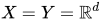
Young's inequality for integral operators From Wikipedia, the free encyclopedia Bound on the Lp -> Lq operator norm In mathematical analysis, the Young's inequality for integral operators, is a bound on the L p → L q {\displaystyle L^{p}\to L^{q}} operator norm of an integral operator in terms of L r {\displaystyle L^{r}} norms of the kernel itself. Assume that X {\displaystyle X} and Y {\displaystyle Y} are measurable spaces, K : X × Y → R {\displaystyle K:X\times Y\to \mathbb {R} } is measurable and q , p , r ≥ 1 {\displaystyle q,p,r\geq 1} are such that 1 q = 1 p + 1 r − 1 {\displaystyle {\frac {1}{q}}={\frac {1}{p}}+{\frac {1}{r}}-1} . If ∫ Y | K ( x , y ) | r d y ≤ C r {\displaystyle \int _{Y}|K(x,y)|^{r}\,\mathrm {d} y\leq C^{r}} for all x ∈ X {\displaystyle x\in X} and ∫ X | K ( x , y ) | r d x ≤ C r {\displaystyle \int _{X}|K(x,y)|^{r}\,\mathrm {d} x\leq C^{r}} for all y ∈ Y {\displaystyle y\in Y} then [1] ∫ X | ∫ Y K ( x , y ) f ( y ) d y | q d x ≤ C q ( ∫ Y | f ( y ) | p d y ) q p . {\displaystyle \int _{X}\left|\int _{Y}K(x,y)f(y)\,\mathrm {d} y\right|^{q}\,\mathrm {d} x\leq C^{q}\left(\int _{Y}|f(y)|^{p}\,\mathrm {d} y\right)^{\frac {q}{p}}.} Particular cases Convolution kernel If X = Y = R d {\displaystyle X=Y=\mathbb {R} ^{d}} and K ( x , y ) = h ( x − y ) {\displaystyle K(x,y)=h(x-y)} , then the inequality becomes Young's convolution inequality. See also Young's inequality for products Notes ↑ Theorem 0.3.1 in: C. D. Sogge, Fourier integral in classical analysis, Cambridge University Press, 1993. ISBN 0-521-43464-5 This mathematical analysis–related article is a stub. You can help Wikipedia by expanding it.vte Related Articles~TimelinesTop QsFact Checks
 and
and  are measurable spaces,
  is measurable and
  are such that
 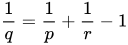 . If
. If 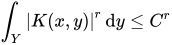 for all
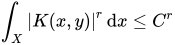 for all