Region in Asien
From Wikipedia, the free encyclopedia
Südasien ist ein Teil des asiatischen Kontinents und wird im Nordwesten, Norden und Nordosten durch Gebirge vom übrigen Asien abgetrennt. Der Raum wird bis heute, obwohl der Begriff teilweise als veraltet und kolonial-historisch besetzt gilt, wie früher immer noch auch als Vorderindien bezeichnet. Zwischen den Begriffen Mittlerer Osten, indischer Subkontinent und Südasien bestehen weitreichende Überlappungen.
IranIran wird durch die UNSD, einer Abteilung der Vereinten Nationen, zu statistischen Zwecken ebenfalls zu Südasien gezählt.[1] Dieses Land kann auch zu Westasien gezählt werden.
Literatur
Feroz Hassan Khan: Subcontinent Adrift: Strategic Futures of South Asia. Cambria, Amherst 2022, ISBN 978-1-62196-648-7.
Indian subcontinent. In: New Oxford Dictionary of English. Oxford University Press, New York 2001, ISBN 0-19-860441-6, S. 929: "the part of Asia south of the Himalayas which forms a peninsula extending into the Indian Ocean, between the Arabian Sea and the Bay of Bengal
Stephen Adolphe Wurm, Peter Mühlhäusler, Darrell T. Tryon: Atlas of languages of intercultural communication in the Pacific, Asia, and the Americas. International Council for Philosophy and Humanistic Studies. Walter de Gruyter, 1996, ISBN 3-11-013417-9, S. 787.
The Columbia Electronic Encyclopedia. 6. Auflage. Columbia University Press, 2003: "region, S central Asia, comprising the countries of Pakistan, India, and Bangladesh and the Himalayan states of Nepal, and Bhutan. Sri Lanka, an island off the southeastern tip of the Indian peninsula, is often considered a part of the subcontinent."
Svante E.Cornell: Modernization and Regional Cooperation in Central Asia: A New Spring? Central Asia-Caucasus Institute and the Silk Road Studies (englisch, silkroadstudies.org[PDF]).


_without_national_boundaries.svg)
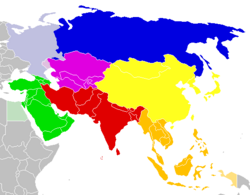

 Afghanistan (auch Teil Zentralasiens im weiteren Sinne[9]; von DIERCKE zu Westasien gezählt)
 Bangladesch
 Bhutan
 Indien
 Malediven
 Nepal
Nepal Pakistan
 Sri Lanka


 Iran wird durch die UNSD, einer Abteilung der Vereinten Nationen, zu statistischen Zwecken ebenfalls zu Südasien gezählt.[1] Dieses Land kann auch zu Westasien gezählt werden.