13 Egeria
Main-belt asteroid
From Wikipedia, the free encyclopedia
13 Egeria is a large main-belt G-type asteroid.[9] It was discovered by Annibale de Gasparis on 2 November 1850. Egeria was named by Urbain Le Verrier, whose computations led to the discovery of Neptune, after the mythological nymph Egeria of Aricia, Italy, the wife of Numa Pompilius, second king of Rome.[10]

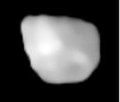 A deconvolved image of 13 Egeria by VLT/SPHERE | |
| Discovery[1] | |
|---|---|
| Discovered by | Annibale de Gasparis |
| Discovery site | Naples Obs. |
| Discovery date | 2 November 1850 |
| Designations | |
| (13) Egeria | |
| Pronunciation | /ɪËdÊɪÉriÉ/[2] |
Named after | Egeria |
| 1850 VA | |
| Main belt | |
| Adjectives | Egerian |
| Symbol | .svg) (historical) (historical).svg) (historical, variant) (historical, variant) |
| Orbital characteristics[3] | |
| Epoch 17.0 October 2024 (JD 2460600.5) | |
| Uncertainty parameter 0 | |
| Observation arc | 63566 days (174.03 yr) |
| Aphelion | 2.79788 AU |
| Perihelion | 2.35759 AU |
| 2.57774 AU | |
| Eccentricity | 0.085403 |
| 4.14 yr (1511.7 d) | |
Average orbital speed | 18.56 km/s |
| 305.547° | |
| 0° 14m 17.34s / day | |
| Inclination | 16.532° |
| 43.208° | |
| 79.222° | |
| Earth MOID | 1.43636 AU |
| Jupiter MOID | 2.35842 AU |
| TJupiter | 3.363 |
| Physical characteristics | |
| Dimensions | 214.8 km à 192 km[4] 238 km à 199 km à 182 km (± 12 km à 11 km à 10 km)[5] |
| 202±3 km[5] 207.6 ± 8.3 km (IRAS)[3] | |
| Flattening | 0.24[a] |
| Mass | (9.2±2.1)Ã1018 kg[5] (15.9±4.4)Ã1018 kg[b][6] |
Mean density | 2.13±0.49 g/cm3[5] 3.4±1.0 g/cm3[6] |
Equatorial surface gravity | â0.0580 m/s2 |
Equatorial escape velocity | â0.1098 km/s |
| 7.045 h[3] 7.046664±0.000003 h[5] | |
| 59°[5] | |
Pole ecliptic longitude | 38°±5°[5] |
Pole ecliptic latitude | 31°±5°[5] |
| 0.087[5] 0.049 ± 0.028[3] 0.085 ± 0.007[7] | |
| Temperature | ~174 K |
| G-type asteroid[3] | |
| 9.71 to 12.46[8] | |
| 6.91[3] 6.74[5] | |
History
Egeria was discovered on the evening of 2 November 1850 by Italian astronomer Annibale de Gasparis at the Astronomical Observatory of Capodimonte.[11][12]:â128â Whereas de Gasparis's previous two discoveriesâ10 Hygiea and 11 Parthenopeâwere identified by comparison with the Berlin Academy star charts, Egeria was identified using his own ecliptic charts intended for finding new celestial objects.[13]:â119â[12]:â128â Egeria's discovery was announced in December 1850 by astronomer Benjamin A. Gould through The Astronomical Journal.[14] Following the discovery, de Gasparis delegated the naming rights of the asteroid to Urbain Le Verrier. Le Verrier chose to name the asteroid after Egeria, a mythological nymph and councillor of Numa Pompilius.[12]:â128â
Upon its discovery, both de Gasparis and Gould labelled Egeria as a new planet.[11][14] However, by the mid-1800s, the classification and terminology of the asteroids were quickly evolving.[15] Soon after Egeria's discovery, other astronomers described it as an "asteroid"[16] or a "minor planet".[17]:â25â Throughout the latter half of the 19th century, the terms "asteroid" and "minor planet" became favored,[15] although some publications continued to label Egeria and other asteroids as planets.[15][18]:â42â
In 1851, de Gasparis announced his chosen symbol for Egeriaâthat of a buckler. However, Gould had apparently not seen the announcement, and in an 1852 table of asteroid symbols he left Egeria's blank.[19]:â8â[16] No mention of a star was made, though in 1852 John Russell Hind included one in his drawn symbol for Egeria: .svg) (U+1CEC6 ð» in Unicode 17.0). The symbol is sometimes depicted with a round form (),[19]:â8â though only Hind's form was encoded.[20] As the number of asteroids assigned a symbol grew in number through the mid-1800s, the practicality of assigning each a unique astronomical symbol was questioned. In 1851, astronomer Johann Franz Encke proposed an alternative system of a numberâdenoting the object's order of discoveryâinscribed in a circle. For Egeria, this would be â¬.[15][16] This system was quickly adopted by astronomers, though eventually astronomers switched from an inscribed circle to parentheses and eventually a bare number[15]âhence (13) Egeria or 13 Egeria in modern notation.[1][3]
(U+1CEC6 ð» in Unicode 17.0). The symbol is sometimes depicted with a round form (),[19]:â8â though only Hind's form was encoded.[20] As the number of asteroids assigned a symbol grew in number through the mid-1800s, the practicality of assigning each a unique astronomical symbol was questioned. In 1851, astronomer Johann Franz Encke proposed an alternative system of a numberâdenoting the object's order of discoveryâinscribed in a circle. For Egeria, this would be â¬.[15][16] This system was quickly adopted by astronomers, though eventually astronomers switched from an inscribed circle to parentheses and eventually a bare number[15]âhence (13) Egeria or 13 Egeria in modern notation.[1][3]
Orbit
Egeria orbits the Sun at an average distanceâits semi-major axisâof 2.58 astronomical units (AU), placing it within the main asteroid belt and near the 3:1 mean-motion resonance with Jupiter.[3][21]:â323â Along its orbit, its distance from the Sun varies between 2.36 AU at perihelion to 2.80 AU at aphelion due to its orbital eccentricity of 0.09. Its orbit is inclined by 16.5° with respect to the ecliptic, and it takes 4.14 years to complete one orbit.[3] Egeria is classified as a background asteroid, as it does not belong to an asteroid family.[22]
Physical properties

Egeria occulted a star on 8 January 1992. Its disc was determined to be quite circular (217Ã196 km). On 22 January 2008, it occulted another star, and this occultation was timed by several observers in New Mexico and Arizona, coordinated by the IOTA Asteroid Occultation Program.[4] The result showed that Egeria presented an approximately circular profile to Earth of 214.8Ã192 km, well in agreement with the 1992 occultation.[citation needed] It has also been studied by radar.[23]
In 1988 a search for satellites or dust orbiting this asteroid was performed using the UH88 telescope at the Mauna Kea Observatories, but the effort came up empty.[24] Spectral analysis of Egeria shows it to be unusually high in water content, 10.5â11.5% water by mass.[25]
.png)

