145 G. Canis Majoris
Star in the constellation Canis Major
From Wikipedia, the free encyclopedia
145 G. Canis Majoris (HD 56577) is a single[13] K giant or supergiant star in the southern constellation of Canis Major. This star is Gould's 145th of Canis Major in his Uranometria Argentina.[14] SIMBAD erroneously lists the star in its object query result as "* 145 CMa â Star".[15]

 | |
| Observation data Epoch J2000 Equinox J2000 | |
|---|---|
| Constellation | Canis Major[1] |
| Right ascension | 07h 16m 36.83456s[2] |
| Declination | â23° 18â² 56.1383â³[2] |
| Apparent magnitude (V) | 4.79[3] |
| Characteristics | |
| Spectral type | K3Ib-[4] or K4III[5] |
| BâV color index | 1.710[3] |
| Astrometry | |
| Radial velocity (Rv) | +28.05±0.42[6] km/s |
| Proper motion (μ) | RA: â3.816[2] mas/yr Dec.: +3.896[2] mas/yr |
| Parallax (Ï) | 1.2155±0.0998 mas[2] |
| Distance | 2,700 ± 200 ly (820 ± 70 pc) |
| Absolute magnitude (MV) | â4.03[7] |
| Details | |
| Mass | 7.8±0.5[8] Mâ |
| Radius | 315[9] Râ |
| Luminosity | 23,660[9] Lâ |
| Surface gravity (log g) | 0.70[10] cgs |
| Temperature | 3,986[9] K |
| Metallicity [Fe/H] | 0.03[10] dex |
| Rotational velocity (v sin i) | 7.4±1.0[11] km/s |
| Age | 35.4±2.0[8] Myr |
| Other designations | |
| 145 G. CMa, NSV 3503, CDâ23°5189, HD 56577, HIP 35210, HR 2764, SAO 173349, WDS J07166-2319A[12] | |
| Database references | |
| SIMBAD | data |
Stellar properties
The spectral type of 145 G. Canis Majoris has been given as K4III in 1978,[5] with the luminosity class "III" corresponding to a giant star. In 1989, the spectral type was revised to K3Ib, with a luminosity class Ib suggesting the star is at the lower luminosity range of supergiant stars.[4]
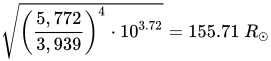
Measurement of stellar properties such as radius, luminosity and mass depend on the star's distance, which is not well-known. The Hipparcos mission measured a parallax of 2.30±0.52 mas,[16] resulting in a distance of 1,400±300 ly. Based on this distance, a luminosity 5,250 times that of the Sun (Lâ) was calculated. From the luminosity and a temperature of 3,937±141 K, a radius of 156 ± 11 Râ is obtained,[a] and a mass and age of 1.90 Mâ and 1.05 Gyr have been obtained using the stellar parameters and isochrones. Those values are consistent with the star being a giant.[3] However, parallax measurements by the Gaia spacecraft suggest the star is more distant than previously thought,[6][2] hence has higher luminosity, radius and mass. A radius of 315 Râ and a luminosity of 23,660 Lâ have been derived using the Gaia DR3 distance, suggesting the star is indeed a supergiant.[9] At the Gaia DR2 parallax, the star should have a luminosity of 14,000 Lâ, also rather high for a giant.[6] Values for the mass and age at the Gaia distance have not been computed yet, but a 2012 study give 7.8±0.5 Mâ and 35.4±2.0 Myr.[8]
The effective temperature of the star is around 4,000 K,[9] which gives it an orange hue typical of K-type stars.[17]
The star is one component of a close double, the other being HD 56578 which on its own would be a faint naked-eye star. The two are separated by 27â³.[18] The two stars appear to be unrelated and the close alignment accidental, with HD 56578 being a much closer and less luminous Am star.[19]
Notes
- Applying the StefanâBoltzmann law with a nominal solar effective temperature of 5,772 K:
- .