169 series
Japanese train type
From Wikipedia, the free encyclopedia
The 169 series (169系) was an express electric multiple unit (EMU) train type introduced in 1969 by Japanese National Railways (JNR), and later operated by East Japan Railway Company (JR East) until 1996 and by Shinano Railway in Nagano Prefecture until 2013. The 169 series was developed from the 165 series EMUs.

| 169 series | |
|---|---|
A 169 series set in Shonan livery in July 1982 | |
| In service | 1969–2013 |
| Manufacturers | Kinki Sharyo, Nippon Sharyo, Tokyu Car Corporation |
| Number built | 187 vehicles |
| Number in service | None |
| Number preserved | 4 vehicles |
| Operators | JNR (1969–1987) JR East (1987–1996) Shinano Railway (1997–2013) |
| Specifications | |
| Maximum speed | 110 km/h (68 mph) |
| Traction system | Resistor control |
| Power supply | 1,500 V DC overhead |
| Bogies | DT32, TR69 |
| Multiple working | 165 series |
| Track gauge | 1,067 mm (3 ft 6 in) |
Interior
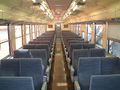 Interior of Mitaka Depot set modified with reclining seats for use on Shinkansen Relay rapid services, 2001

Livery variations
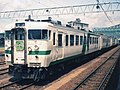 "New Express" livery in 1987
 Early "Nagano" livery in 1991
 "Shinshu" livery
 Shinkansen Relay livery in May 2001


Shinano Railway
The third-sector operator Shinano Railway operated a fleet of three 3-car 169 series sets (numbered S51 to S53) formerly operated by JR East. These operated on services between Karuizawa and Togura Stations.[1] These sets were scheduled to be withdrawn from regular service in April 2013, with final runs on 29 April 2013.[2]
Formations
The 3-car sets operated by Shinano Railway were formed as shown below, with two motored cars (KuMoHa and MoHa) and one trailer car (KuHa).[1]
| Numbering | KuMoHa 169 | MoHa 168 | KuHa 169 |
|---|
The MoHa 168 car was fitted with one lozenge-type pantograph.[1]
 Shinano Railway 169 series set S51 in January 2011
 Shinano Railway 169 series set S52 in JNR Shonan livery in March 2013
 Interior of a Shinano Railway 169 series

.jpg)

Preserved examples
As of 2014[update], four 169 series cars are preserved, as follows.[3]
- KuMoHa 169 1: Next to Sakaki Station on the Shinano Railway in Sakaki, Nagano
- KuMoHa 169 6: Next to Karuizawa Station in Karuizawa, Nagano
- KuHa 169 27: Next to Sakaki Station on the Shinano Railway in Sakaki, Nagano
- MoHa 168 1: Next to Sakaki Station on the Shinano Railway in Sakaki, Nagano
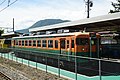 Preserved KuMoHa 169 6 next to Karuizawa Station in July 2016
 The cab end of car KuMoHa 169 27 preserved next to Shimoyoshida Station on the Fujikyuko Line in Yamanashi Prefecture


