19 Fortuna
Main-belt asteroid
From Wikipedia, the free encyclopedia
19 Fortuna is one of the largest main-belt asteroids. It has a composition similar to 1 Ceres: a darkly colored surface that is heavily space-weathered with the composition of primitive organic compounds, including tholins.

 | |
| Discovery | |
|---|---|
| Discovered by | John Russell Hind |
| Discovery site | George Bishop's Observatory |
| Discovery date | 22 August 1852 |
| Designations | |
| (19) Fortuna | |
| Pronunciation | /fÉËrËtjuËnÉ/[1] |
Named after | Fortūna |
| A902 UG | |
| Main belt | |
| Adjectives | Fortunian /fÉËrËtjuËniÉn/ |
| Symbol | .svg) (historical) (historical) |
| Orbital characteristics[2] | |
| Epoch 21 November 2025 (JD 2461000.5) | |
| Aphelion | 2.828 AU |
| Perihelion | 2.056 AU |
| 2.442 AU | |
| Eccentricity | 0.159 |
| 3.816 yr (1393.907 d) | |
| 96.500° | |
| Inclination | 1.573° |
| 211.001° | |
| 182.515° | |
| Earth MOID | 1.062 AU |
| Jupiter MOID | 2.601 AU |
| TJupiter | 3.483 |
| Physical characteristics | |
| Dimensions | (225 à 205 à 195) ± 12 km[3] (242 à 203 à 192) ± 10 km[4] |
| 211±2 km[4] 225 km[5][6] | |
| Flattening | 0.21[a] |
| Mass | (8.8±1.4)Ã1018 kg[4] 12.7Ã1018 kg[3] |
Mean density | 1.80±0.29 g/cm3[4] 2.70±0.48 g/cm3[3] |
Equatorial surface gravity | ~0.0629 m/s² |
Equatorial escape velocity | ~0.1190 km/s |
| 7.4432 h (0.3101 d)[2] 7.443224±0.000001 h[4] | |
| 29°[4] | |
Pole ecliptic longitude | 103°±3°[4] |
Pole ecliptic latitude | 60°±3°[4] |
| 0.056[4] 0.037[2] | |
| Temperature | ~180 K |
| G[2] | |
| 8.88[7] to 12.95 | |
| 7.49[2] 7.13[4] | |
| 0.25" to 0.072" | |
Fortuna is 225 km in diameter and has one of the darkest known geometric albedos for an asteroid over 150 km in diameter. Its albedo has been measured at 0.028 and 0.037.[8] The spectra of the asteroid displays evidence of aqueous alteration.[9]
History
Discovery
Fortuna was discovered by English astronomer John Russell Hind on the evening of 22 August 1852.[10] He was observing from George Bishop's Observatory in London, England, when he spotted a magnitude 9 object with a yellowish color (possibly caused by the atmosphere).[10][11] His discovery was announced in the scientific journal Astronomische Nachrichten on 31 August.[10]
Name and symbol
Soon after discovery, the observatory's owner George Bishop encouraged Hind to choose a name for the asteroid.[11] He chose "Fortuna", after the Roman goddess of fortune and misfortune.[12]:â15â No astronomical symbol was provided in Hind's discovery announcements. A symbol of a star over Fortune's wheel (U+1CECC ð») appeared in the book An Astronomical Vocabulary, written by Hind and published on the year of Fortuna's discovery, but no explanation for the symbol was provided.[13]:â9â
Orbit
Fortuna orbits the Sun with an average distance (or semi-major axis of 2.44 astronomical units (AU), an orbital period of 3.82 years, and an orbital inclination of 1.57°,[2] placing it within the inner main asteroid belt.[14]:â87â Along its elliptical orbit, its distance from the Sun varies between 2.06 AU at perihelion to 2.83 AU at aphelion due to an orbital eccentricity of 0.16.[2] It does not belong to any known asteroid family, making it a background asteroid.[15]
Physical characteristics
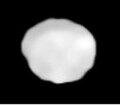
The Hubble Space Telescope observed Fortuna in 1993. It was resolved with an apparent diameter of 0.20 arcseconds (4.5 pixels in the Planetary Camera) and its shape was found to be nearly spherical. Satellites were searched for but none were detected.
Stellar occultations by Fortuna have been observed several times. Fortuna has been studied by radar.[16]
Fortuna has been perturbed by the 80 km 135 Hertha and was initially estimated by Baer to have a mass of 1.08Ã1019 kg.[6] A more recent estimate by Baer suggests it has a mass of 1.27Ã1019 kg.[3]

