A hydrogen-like atom or a hydrogenic atom is an atom with one electron. Except for the hydrogen atom itself (which is neutral), these atoms carry positive charge  , where
  is the atomic number of the atom. Because hydrogen-like atoms are two-particle systems with an interaction depending only on the distance between the two particles, their (non-relativistic) Schrödinger equation can be exactly solved in analytic form. The solutions are one-electron functions and are referred to as hydrogen-like atomic orbitals.[2]
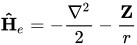
The electronic Hamiltonian (in atomic units) of a Hydrogenic system is given by
 ,
,
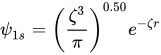
where is the nuclear charge of the hydrogenic atomic system. The 1s electron of a hydrogenic systems can be accurately described by the corresponding Slater orbital:
 ,
,
where  is the Slater exponent. This state, the ground state, is the only state that can be described by a Slater orbital. Slater orbitals have no radial nodes, while the excited states of the hydrogen atom have radial nodes.
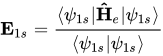
The energy of a hydrogenic system can be exactly calculated analytically as follows:
 , where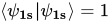
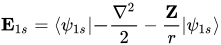

 .
.
Using the expression for Slater orbital, the integrals can be exactly solved. Thus,
![{\displaystyle \mathbf {E} _{1s}=\left\langle \left({\frac {\zeta ^{3}}{\pi }}\right)^{0.50}e^{-\zeta r}\right|\left.-\left({\frac {\zeta ^{3}}{\pi }}\right)^{0.50}e^{-\zeta r}\left[{\frac {-2r\zeta +r^{2}\zeta ^{2}}{2r^{2}}}\right]\right\rangle +\langle \psi _{1s}|-{\frac {\mathbf {Z} }{r}}|\psi _{1s}\rangle }](https://wikimedia.org/api/rest_v1/media/math/render/svg/6d84c58364976b1f5d92abea086369f321a2f11b)
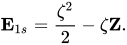
The optimum value for is obtained by equating the differential of the energy with respect to as zero.
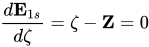 . Thus
The following energy values are thus calculated by using the expressions for energy and for the Slater exponent.
Hydrogen: H
 and
and 
 −0.5 Eh
−13.60569850 eV
−313.75450000 kcal/mol
Gold: Au(78+)
 and
and 
−3120.5 Eh
−84913.16433850 eV
−1958141.8345 kcal/mol.
Hydrogenic atomic systems are suitable models to demonstrate the relativistic effects in atomic systems in a simple way. The energy expectation value can calculated by using the Slater orbitals with or without considering the relativistic correction for the Slater exponent . The relativistically corrected Slater exponent  is given as
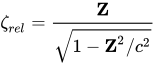 .
.
The relativistic energy of an electron in 1s orbital of a hydrogenic atomic systems is obtained by solving the Dirac equation.
 .
.
Following table illustrates the relativistic corrections in energy and it can be seen how the relativistic correction scales with the atomic number of the system.
| Atomic system | |  | |  |  using using | using |
| H | 1 | 1.00000000 | 1.00002663 | −0.50000000 Eh | −0.50000666 Eh | −0.50000666 Eh |
| −13.60569850 eV | −13.60587963 eV | −13.60587964 eV |
| −313.75450000 kcal/mol | −313.75867685 kcal/mol | −313.75867708 kcal/mol |
| Au(78+) | 79 | 79.00000000 | 96.68296596 | −3120.50000000 Eh | −3343.96438929 Eh | −3434.58676969 Eh |
| −84913.16433850 eV | −90993.94255075 eV | −93459.90412098 eV |
| −1958141.83450000 kcal/mol | −2098367.74995699 kcal/mol | −2155234.10926142 kcal/mol |


