2017 Democratic Republic of the Congo Ebola outbreak
Disease outbreak in the Democratic Republic of the Congo
From Wikipedia, the free encyclopedia
On 11 May 2017, the Democratic Republic of the Congo (DRC) was identified by the World Health Organization (WHO) as having one Ebola-related death.[4][5]

As of 8 June 2017, there were five confirmed cases and three probable cases. Of these, four survived and four died.[6] The affected areas of the DRC are Mabongo (one confirmed), Ngayi (one probable), and Nambwa (four confirmed and two probable) in Likati health zone.[6] According to the WHO, "Modelling suggests the risk of further cases is currently low but not negligible.... As of ... [8 June], 83% of simulated scenarios predict no further cases in the next 30 days."[6]
According to the U.S. Centers for Disease Control and Prevention, "Ebola ... is a rare and deadly disease caused by infection with one of the Ebola virus species. Ebola can cause disease in humans and nonhuman primates (monkeys, gorillas, and chimpanzees)." Ebola was first identified in 1976 near the Ebola River in the DRC.[7] More than 11,300 people died in the 2013 to 2016 Ebola outbreak in West Africa.[8]
According to the WHO's "Global Health Observatory", the DRC's population in 2015 was 77,267,000.[9] On 1 July 2017, DRC Minister of Public Health, Dr Oly Ilunga Kalenga, declared that the country had passed a 42-day period with no new recorded cases, and therefore the outbreak was over.[2][10][11] A subsequent outbreak of Ebola was declared by WHO on 8 May 2018, in the northwest Province of Équateur.[12]
Epidemiology
The first "situation report" from the WHO on 15 May 2017 listed 19 suspected cases and 3 deaths.[13] The first person to request treatment was a 39-year-old male.[13]
On 16 May, the WHO indicated that there had been 21 suspected cases and 3 deaths. Approximately 400 additional individuals were being monitored in the same region of the DRC.[14] On 17 May, WHO said that the number of individuals being monitored had risen to about 416,[15] while the following day, the number of confirmed and suspected cases had risen to 29.[16] As of 24 May, 520 individuals were reported to be on the contact list to monitor their health status. Of those, 226 had completed 21 days of monitoring.[17] As of 27 May, 30 cases had been reclassified as not Ebola-related.[18]
Responses
Organizations
On 13 May 2017, Doctors Without Borders indicated that they would send a team to the most recently affected area in the DRC.[19]
The GAVI vaccine alliance indicated that 300,000 doses of the experimental Ebola vaccine were available if needed.[1] On 28 May, it was reported that the DRC had authorized use of the vaccine.[20]
Nearby countries
As of 8 June 2017, the WHO does not recommend any restrictions of travel and trade in relation to this outbreak.[6] The following nine countries have instituted entry screening at airports and ports of entry: Kenya, Malawi, Nigeria, Rwanda, South Africa, Tanzania, Uganda, Zambia, and Zimbabwe.[6] Rwanda has issued travel advisories to avoid unnecessary travel to the DRC.[6] Kenya and Rwanda have implemented information checking on arrival for passengers with a travel history from or through the DRC.[6] According to the WHO, countries have the right to implement these measures.[6]
On 20 May, the news media reported Rwanda's closure of its border with the DRC for passengers coming from affected areas in the DRC.[17] On 23 May, the WHO confirmed that Rwanda is denying entry to visitors with fever who have been to those areas.[17] Under Article 43 of the International Health Regulations (2005),[21] the WHO considers these actions to be "additional health measures ... that significantly interfere with international traffic".[17] As of 8 June the WHO is attempting to obtain and review Rwanda's public health rationale and relevant scientific information for implementing these measures.[6]
Virology
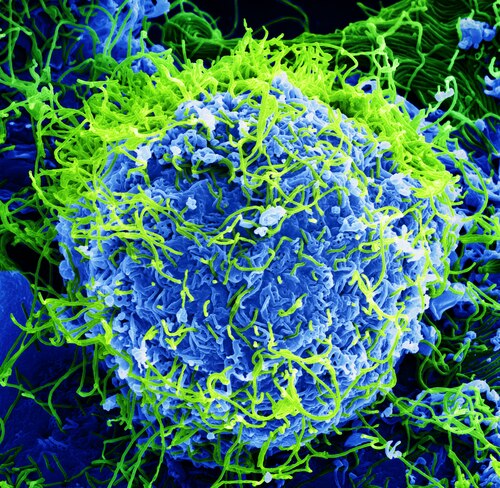
The sub-type Zaire ebolavirus has been confirmed in the current outbreak,[22] from the family Filoviridae.[23] It is a single stranded RNA virus, with a 60-90 percent mortality rate (the highest among the strains).[24]
An unusually high mortality has been reported in the local pig population. An investigation into potential causes is being considered.[17]
Previous and subsequent outbreaks in the DRC
The virus took its name from the Ebola River near the village in Zaire (now the DRC) where the first documented outbreak occurred.[25] Multiple documented outbreaks of Ebola virus disease have occurred in the DRC since 1976,[26] with the eleven outbreaks that have occurred summarised in the table below.
| Date | Country | Major location | Outbreak information | Source | |||
|---|---|---|---|---|---|---|---|
| Strain | Cases | Deaths | CFR | ||||
| Aug 1976 | Zaire | Yambuku | EBOV | 318 | 280 | 88% | [27] |
| Jun 1977 | Zaire | Tandala | EBOV | 1 | 1 | 100% | [28][29] |
| May–Jul 1995 | Zaire | Kikwit | EBOV | 315 | 254 | 81% | [30] |
| Aug–Nov 2007 | Democratic Republic of the Congo | Kasai-Occidental | EBOV | 264 | 187 | 71% | [31] |
| Dec 2008–Feb 2009 | Democratic Republic of the Congo | Kasai-Occidental | EBOV | 32 | 14 | 45% | [32] |
| Jun–Nov 2012 | Democratic Republic of the Congo | Orientale | BDBV | 77 | 36 | 47% | [28] |
| Aug–Nov 2014 | Democratic Republic of the Congo | Tshuapa | EBOV | 66 | 49 | 74% | [33] |
| May–Jul 2017 | Democratic Republic of the Congo | Likati | EBOV | 8 | 4 | 50% | [34] |
| Apr–Jul 2018 | Democratic Republic of the Congo | Équateur Province | EBOV | 54 | 33 | 61% | [35] |
| Aug 2018–June 2020 | Democratic Republic of the Congo | Kivu | EBOV | 3,470 | 2,280 | 66% | [36] |
| June–Nov 2020 | Democratic Republic of the Congo | Équateur Province | EBOV | 130 | 55 | 42% | [37] |
| Feb 2021–May 2021 | Democratic Republic of the Congo | North Kivu | EBOV | 12 | 6 | 50% | [38] |
| April 2022 | Democratic Republic of the Congo | Équateur Province | EBOV | 5 | 5 | 100% | [39][40] |
| August 2022 | Democratic Republic of the Congo | North Kivu | EBOV | 1 | 1 | 100% | [41] |

