.jpg)
2017 Norwegian parliamentary election
From Wikipedia, the free encyclopedia
Parliamentary elections were held in Norway on 11 September 2017 to elect all 169 members of the unicameral Norwegian Parliament, the Storting. The non-socialist parties retained a reduced majority of 88 seats, allowing Prime Minister Erna Solberg's Conservative-Progress coalition to remain in government.[1][2] The Liberal Party joined the coalition in January 2018 but it remained a minority cabinet until the Christian Democratic Party joined the coalition in 2019. The three largest centre-left parties won 79 seats. The Green Party retained its single seat, while the Red Party won its first ever seat.

 | |||||||||||||||||||||||||||||||||||||||||||||||||||||||||||||||||||||||||||||||||||||||||||||||||||||||||||||||||||||||||||||||||||||
11 September 2017
| |||||||||||||||||||||||||||||||||||||||||||||||||||||||||||||||||||||||||||||||||||||||||||||||||||||||||||||||||||||||||||||||||||||
All 169 seats in the Storting 85 seats are needed for a majority | |||||||||||||||||||||||||||||||||||||||||||||||||||||||||||||||||||||||||||||||||||||||||||||||||||||||||||||||||||||||||||||||||||||
|---|---|---|---|---|---|---|---|---|---|---|---|---|---|---|---|---|---|---|---|---|---|---|---|---|---|---|---|---|---|---|---|---|---|---|---|---|---|---|---|---|---|---|---|---|---|---|---|---|---|---|---|---|---|---|---|---|---|---|---|---|---|---|---|---|---|---|---|---|---|---|---|---|---|---|---|---|---|---|---|---|---|---|---|---|---|---|---|---|---|---|---|---|---|---|---|---|---|---|---|---|---|---|---|---|---|---|---|---|---|---|---|---|---|---|---|---|---|---|---|---|---|---|---|---|---|---|---|---|---|---|---|---|---|
| |||||||||||||||||||||||||||||||||||||||||||||||||||||||||||||||||||||||||||||||||||||||||||||||||||||||||||||||||||||||||||||||||||||


| |||||||||||||||||||||||||||||||||||||||||||||||||||||||||||||||||||||||||||||||||||||||||||||||||||||||||||||||||||||||||||||||||||||
| |||||||||||||||||||||||||||||||||||||||||||||||||||||||||||||||||||||||||||||||||||||||||||||||||||||||||||||||||||||||||||||||||||||
_-_Global_Citizen_Festival_Hamburg_06.jpg)
.jpg)

.jpg)


.JPG)
_portrait.jpg)
.jpg)

Background
The last parliamentary elections in Norway were held on 9 September 2013. The outcome was a victory for the Conservatives and their populist right-wing allies. The Conservative Party, led by Erna Solberg, and the right-wing populist Progress Party formed a two-party minority government, with Solberg as Prime Minister. The two parties received confidence and supply from two centrist parties, the Liberals and the Christian Democrats.[3]
Electoral system
The election used party-list proportional representation in nineteen multi-member constituencies, one for each of the counties of Norway.
The number of members to be returned from each constituency varies between 4 and 19. To determine the apportionment of the 169 seats amongst the 19 counties, a two-tier formula is used, based on population and geographic size. Each inhabitant counts one point, while each square kilometer counts 1.8 points.[4]
150 of the seats are regular district seats. These are awarded based on the election results in each county, and are unaffected by results in other counties. Nineteen of the seats (one for each county) are leveling seats, awarded to parties who win fewer seats than their share of the national popular vote otherwise entitles them to. A modification of the Sainte-Lague method, where the first quotient for each party is calculated using a divisor of 1.4 instead of 1, is used to allocate both the constituency and leveling seats. A party must win 4% of the popular vote in order to win compensation seats, but may still win district seats even if it fails to reach this threshold. The system for apportioning seats is biased in favour of rural areas since the area of the county is a factor, but the system of compensation seats reduces the effect this has on final party strength.[5]
| Constituency | Population | Area (km2) | Seats |
|---|---|---|---|
| Østfold | 278,352 | 4,182 | 9 |
| Akershus | 556,254 | 4,918 | 17 |
| Oslo | 613,285 | 454 | 19 |
| Hedmark | 192,791 | 27,398 | 7 |
| Oppland | 187,147 | 25,192 | 7 |
| Buskerud | 265,164 | 14,911 | 9 |
| Vestfold | 236,424 | 2,224 | 7 |
| Telemark | 170,023 | 15,298 | 6 |
| Aust-Agder | 111,495 | 9,157 | 4 |
| Vest-Agder | 174,324 | 7,277 | 6 |
| Rogaland | 443,115 | 9,376 | 14 |
| Hordaland | 490,570 | 15,440 | 16 |
| Sogn og Fjordane | 108,201 | 18,623 | 4 |
| Møre og Romsdal | 256,628 | 15,115 | 9 |
| Sør-Trøndelag | 297,950 | 18,856 | 10 |
| Nord-Trøndelag | 133,390 | 22,415 | 5 |
| Nordland | 238,320 | 38,462 | 9 |
| Troms | 158,650 | 25,870 | 6 |
| Finnmark | 73,787 | 48,617 | 5 |
Date
According to the Norwegian constitution, parliamentary elections must be held every four years. The Norwegian parliament may not be dissolved before such a four-year term has ended, a rather rare trait of a political system found in few, if any democracies besides Norway and the USA.
On 22 April 2016, the Norwegian government announced that the date of the election is set to be Monday, 11 September 2017.[7] Additionally, each municipal council may vote to extend voting by one day, by also opening the polling stations on Sunday, 10 September.
Participating parties
Eight political parties were represented in the Norwegian parliament prior to the election, all of whom went on to contest the 2017 election.
- The Labour Party (Ap) is with its 55 seats in parliament the largest party of the 2013-2017 parliament. Labour describes itself as a social-democratic party of the centre-left. The party is led by former minister of foreign affairs Jonas Gahr Støre, who has served as party leader and leader of the opposition since June 2014.
- The Conservative Party (H) is the largest party of the incumbent government. Currently, the Conservatives hold 48 seats, after having garnered close to 27 percent of the vote in the previous election. The Conservatives' party leader is Prime Minister Erna Solberg. The Conservative Party is considered to be a moderate centre-right party in the Norwegian political spectrum, and it officially subscribes to the liberal conservative ideology.[8]
- The Progress Party (FrP) is led by Siv Jensen and currently serves as the junior partner in the Solberg cabinet. The party identifies as classical liberal and conservative-liberal. Political scientists broadly consider it a right-wing populist party,[9][10][11] a label the party denies.
- The Christian Democratic Party (KrF) is a centre to centre-right party, based on Christian democratic values. The party is led by Knut Arild Hareide, and participated in the 2013 election as a proponent of the centre-right coalition led by the Conservatives.
- The Centre Party (Sp) is the fifth largest party in the Norwegian legislature, with 10 seats. Between 2005 and 2013 the party served as a junior partner in the Red-Green government. The party is led by Trygve Slagsvold Vedum. The party is centrist and primarily agrarian, with some conservative and some liberal factions.[12]
- The Liberal Party (V) of Trine Skei Grande currently holds 9 seats in the Norwegian parliament. It claims to be the sole social-liberal party in the country, and positions itself in the centre of Norwegian politics. The Liberals have a close relationship with the Christian Democrats.[13]
- The Socialist Left Party (SV) is the second smallest party in parliament, and campaigned for a third term as a part of the Red-Green coalition government in 2013. The party sees itself as democratic socialist and environmentalist. Since 2012, Audun Lysbakken has chaired the party.
- The Green Party (MDG) made its debut in the Norwegian parliament in the 2013 election, gaining a single seat from the Oslo district. The Greens have no official party leader, but rather two national spokespersons. Currently, these spokespersons are Une Aina Bastholm and Rasmus Hansson. The party distances itself from the left-right axis, and identifies as an environmentalist party.
Additionally, the far-left Red Party led by Bjørnar Moxnes secured its first seat via a direct mandate in Oslo district. It had failed to secure representation in previous elections. The party is officially Communist in orientation and is a successor to the Red Electoral Alliance, which had previously won a seat in the 1993 election.
Campaign
Slogans
| Party | Original slogan | English translation | |
|---|---|---|---|
| Labour Party | "Alle skal med" | «Everyone must join» | |
| Conservative Party | "Vi tror på Norge" | «We believe in Norway» | |
| Progress Party | |||
| Christian Democratic Party | |||
| Centre Party | "Senterpartiet skal stoppe sentraliseringa i Norge gjennom ei regjering for hele Norge" | «Centre party shall stop the centralization in Norway through a government for all of Norway» | |
| Liberal Party | |||
| Socialist Left Party | |||
| Red Electoral Alliance | |||
| Sources: [14][15][16] | |||
Donations
According to Statistisk sentralbyrå, a total of 67.34 million NOK in campaign contributions was raised by all political parties in 2017.[17]
| Party | Donations (NOK) | |
|---|---|---|
| Labour Party | 29,688,423 | |
| Conservative Party | 15,363,600 | |
| Socialist Left Party | 6,229,207 | |
| Progress Party | 4,339,200 | |
| Centre Party | 4,037,657 | |
| Liberal Party | 3,633,991 | |
| Green Party | 1,212,476 | |
| Red Party | 1,149,862 | |
| Christian Democratic Party | 145,230 | |
Debates
Opinion polls
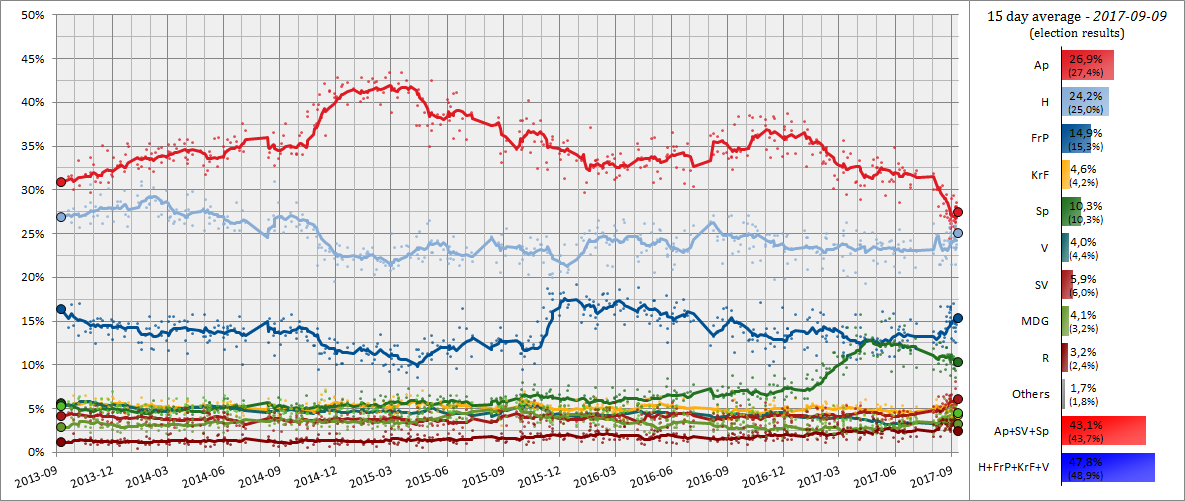 30 day moving average of poll results since the 2013 election, with each line corresponding to a political party.

 Longer term polling results based on monthly averages from pollofpolls.
 Zoom on the smaller parties.


Seat predictions
| Polling Period[25] | Government | Opposition | Government | Opposition | Government Lead | |||||||
|---|---|---|---|---|---|---|---|---|---|---|---|---|
| H | FrP | KrF | V | Ap | Sp | SV | MdG | Red | ||||
| September 2017 | 42 | 28 | 8 | 7 | 48 | 17 | 10 | 7 | 2 | 85 | 84 | +1 |
| August 2017 | 42 | 28 | 9 | 2 | 50 | 19 | 10 | 7 | 2 | 81 | 88 | -7 |
| July 2017 | 40 | 24 | 9 | 2 | 58 | 20 | 8 | 7 | 1 | 75 | 94 | -19 |
| June 2017 | 43 | 25 | 8 | 2 | 59 | 22 | 8 | 1 | 1 | 78 | 91 | -13 |
| May 2017 | 43 | 24 | 9 | 2 | 58 | 22 | 8 | 1 | 2 | 78 | 91 | -13 |
| April 2017 | 43 | 24 | 9 | 2 | 58 | 23 | 8 | 1 | 1 | 78 | 91 | -13 |
| March 2017 | 43 | 23 | 9 | 3 | 60 | 21 | 8 | 1 | 1 | 78 | 91 | -13 |
| February 2017 | 42 | 27 | 9 | 3 | 60 | 18 | 8 | 1 | 1 | 81 | 88 | -7 |
| January 2017 | 41 | 24 | 9 | 7 | 65 | 14 | 7 | 1 | 1 | 81 | 88 | -7 |
| December 2016 | 41 | 25 | 8 | 7 | 66 | 12 | 8 | 1 | 1 | 81 | 88 | -7 |
| November 2016 | 41 | 22 | 9 | 8 | 68 | 12 | 7 | 1 | 1 | 80 | 89 | -9 |
| October 2016 | 45 | 25 | 8 | 8 | 67 | 12 | 2 | 1 | 1 | 86 | 83 | +3 |
| September 2016 | 44 | 26 | 8 | 7 | 63 | 12 | 7 | 1 | 1 | 85 | 84 | +1 |
| August 2016 | 46 | 26 | 9 | 7 | 65 | 12 | 2 | 1 | 1 | 88 | 81 | +7 |
| July 2016 | 46 | 27 | 9 | 8 | 57 | 13 | 7 | 1 | 1 | 90 | 79 | +11 |
| June 2016 | 40 | 28 | 9 | 7 | 63 | 11 | 8 | 2 | 1 | 84 | 85 | -1 |
| May 2016 | 42 | 28 | 9 | 8 | 61 | 12 | 7 | 1 | 1 | 87 | 82 | +5 |
| April 2016 | 42 | 30 | 9 | 8 | 60 | 11 | 7 | 1 | 1 | 89 | 80 | +9 |
| March 2016 | 46 | 31 | 9 | 8 | 60 | 11 | 2 | 1 | 1 | 94 | 75 | +19 |
| February 2016 | 43 | 30 | 9 | 8 | 59 | 10 | 7 | 2 | 1 | 90 | 79 | +11 |
| January 2016 | 43 | 29 | 9 | 8 | 58 | 10 | 7 | 4 | 1 | 89 | 80 | +9 |
| December 2015 | 39 | 32 | 9 | 7 | 61 | 11 | 1 | 8 | 1 | 87 | 82 | +5 |
| November 2015 | 39 | 29 | 9 | 7 | 64 | 11 | 2 | 7 | 1 | 84 | 85 | -1 |
| October 2015 | 39 | 19 | 9 | 8 | 68 | 11 | 7 | 7 | 1 | 75 | 94 | -19 |
| September 2015 | 40 | 20 | 9 | 8 | 66 | 10 | 7 | 8 | 1 | 77 | 92 | -15 |
| August 2015 | 42 | 23 | 9 | 8 | 66 | 10 | 2 | 8 | 1 | 82 | 87 | -5 |
| July 2015 | 38 | 22 | 9 | 8 | 69 | 8 | 7 | 7 | 1 | 77 | 92 | -15 |
| June 2015 | 39 | 21 | 9 | 8 | 72 | 10 | 1 | 8 | 1 | 77 | 92 | -15 |
| May 2015 | 42 | 21 | 9 | 8 | 70 | 10 | 1 | 7 | 1 | 80 | 89 | -9 |
| April 2015 | 41 | 20 | 10 | 9 | 73 | 10 | 1 | 4 | 1 | 80 | 89 | -9 |
| March 2015 | 41 | 19 | 10 | 8 | 76 | 11 | 2 | 1 | 1 | 78 | 91 | -13 |
| February 2015 | 38 | 20 | 10 | 9 | 77 | 10 | 2 | 2 | 1 | 77 | 92 | -15 |
| January 2015 | 41 | 20 | 10 | 8 | 76 | 10 | 2 | 2 | 0 | 79 | 90 | -11 |
| December 2014 | 40 | 20 | 10 | 9 | 77 | 9 | 2 | 2 | 0 | 79 | 90 | -11 |
| November 2014 | 40 | 21 | 11 | 8 | 74 | 10 | 2 | 2 | 1 | 80 | 89 | -9 |
| October 2014 | 46 | 24 | 8 | 8 | 69 | 9 | 2 | 2 | 1 | 86 | 83 | +3 |
| September 2014 | 49 | 26 | 9 | 9 | 64 | 9 | 2 | 1 | 0 | 93 | 76 | +17 |
| August 2014 | 50 | 26 | 9 | 9 | 63 | 9 | 2 | 1 | 0 | 94 | 75 | +19 |
| July 2014 | 48 | 22 | 8 | 10 | 67 | 10 | 1 | 2 | 1 | 88 | 81 | +7 |
| June 2014 | 48 | 25 | 10 | 9 | 64 | 10 | 1 | 1 | 1 | 92 | 77 | +15 |
| May 2014 | 47 | 26 | 9 | 9 | 61 | 8 | 7 | 1 | 1 | 91 | 78 | +13 |
| April 2014 | 50 | 26 | 10 | 10 | 62 | 8 | 2 | 1 | 0 | 96 | 73 | +23 |
| March 2014 | 49 | 26 | 9 | 9 | 63 | 9 | 2 | 1 | 1 | 93 | 76 | +17 |
| February 2014 | 52 | 24 | 10 | 9 | 62 | 9 | 2 | 1 | 0 | 95 | 74 | +21 |
| January 2014 | 53 | 26 | 10 | 9 | 60 | 8 | 2 | 1 | 0 | 98 | 71 | +27 |
| December 2013 | 51 | 26 | 10 | 9 | 61 | 9 | 2 | 1 | 0 | 96 | 73 | +23 |
| November 2013 | 52 | 26 | 9 | 9 | 56 | 9 | 7 | 1 | 0 | 96 | 73 | +23 |
| October 2013 | 52 | 26 | 9 | 10 | 56 | 8 | 7 | 1 | 0 | 97 | 72 | +25 |
Results
 | |||||
|---|---|---|---|---|---|
| Party | Votes | % | Seats | +/– | |
| Labour Party | 800,947 | 27.37 | 49 | –6 | |
| Conservative Party | 732,895 | 25.04 | 45 | –3 | |
| Progress Party | 444,681 | 15.19 | 27 | –2 | |
| Centre Party | 302,017 | 10.32 | 19 | +9 | |
| Socialist Left Party | 176,222 | 6.02 | 11 | +4 | |
| Liberal Party | 127,910 | 4.37 | 8 | –1 | |
| Christian Democratic Party | 122,797 | 4.20 | 8 | –2 | |
| Green Party | 94,788 | 3.24 | 1 | 0 | |
| Red Party | 70,522 | 2.41 | 1 | +1 | |
| Pensioners' Party | 12,855 | 0.44 | 0 | 0 | |
| Health Party | 10,337 | 0.35 | 0 | New | |
| The Christians | 8,700 | 0.30 | 0 | 0 | |
| Capitalist Party | 5,599 | 0.19 | 0 | New | |
| Democrats in Norway | 3,830 | 0.13 | 0 | 0 | |
| Pirate Party | 3,356 | 0.11 | 0 | 0 | |
| The Alliance | 3,311 | 0.11 | 0 | New | |
| Coastal Party | 2,467 | 0.08 | 0 | 0 | |
| Nordmøre List | 2,135 | 0.07 | 0 | New | |
| Feminist Initiative | 696 | 0.02 | 0 | New | |
| Communist Party | 309 | 0.01 | 0 | 0 | |
| Norway Party | 151 | 0.01 | 0 | New | |
| Party of Values | 148 | 0.01 | 0 | New | |
| Society Party | 104 | 0.00 | 0 | 0 | |
| Northern Assembly | 59 | 0.00 | 0 | New | |
| Total | 2,926,836 | 100.00 | 169 | 0 | |
| Valid votes | 2,926,836 | 99.20 | |||
| Invalid/blank votes | 23,695 | 0.80 | |||
| Total votes | 2,950,531 | 100.00 | |||
| Registered voters/turnout | 3,765,245 | 78.36 | |||
| Source: valgresultat.no | |||||
Seat distribution
| Constituency | Total seats |
Seats won | ||||||||||||
|---|---|---|---|---|---|---|---|---|---|---|---|---|---|---|
| By party | By coalition | |||||||||||||
| A | H | FrP | Sp | SV | V | KrF | MdG | R | Red-Greens | Borgerlig | Others | |||
| Akershus | 17 | 5 | 6 | 3 | 1 | 1 | 1 | 7 | 10 | |||||
| Aust-Agder | 4 | 1 | 1 | 1 | 1 | 1 | 3 | |||||||
| Buskerud | 9 | 3 | 2 | 2 | 1 | 1 | 5 | 4 | ||||||
| Finnmark | 5 | 2 | 1 | 1 | 1 | 3 | 2 | |||||||
| Hedmark | 7 | 2 | 1 | 1 | 2 | 1 | 5 | 2 | ||||||
| Hordaland | 16 | 4 | 5 | 2 | 2 | 1 | 1 | 1 | 7 | 9 | ||||
| Møre og Romsdal | 9 | 2 | 3 | 2 | 1 | 1 | 3 | 6 | ||||||
| Nord-Trøndelag | 5 | 2 | 1 | 1 | 1 | 3 | 2 | |||||||
| Nordland | 9 | 2 | 2 | 2 | 2 | 1 | 5 | 4 | ||||||
| Oppland | 7 | 2 | 1 | 1 | 2 | 1 | 4 | 3 | ||||||
| Oslo | 19 | 5 | 6 | 2 | 2 | 2 | 1 | 1 | 7 | 10 | 2 | |||
| Østfold | 9 | 3 | 2 | 2 | 1 | 1 | 5 | 4 | ||||||
| Rogaland | 14 | 4 | 4 | 3 | 1 | 1 | 1 | 6 | 8 | |||||
| Sogn og Fjordane | 4 | 1 | 1 | 1 | 1 | 2 | 2 | |||||||
| Sør-Trøndelag | 10 | 4 | 2 | 1 | 1 | 1 | 1 | 6 | 4 | |||||
| Telemark | 6 | 2 | 1 | 1 | 1 | 1 | 3 | 3 | ||||||
| Troms | 6 | 2 | 1 | 1 | 1 | 1 | 4 | 2 | ||||||
| Vest-Agder | 6 | 1 | 2 | 1 | 2 | 1 | 5 | |||||||
| Vestfold | 7 | 2 | 3 | 1 | 1 | 2 | 4 | |||||||
| Total | 169 | 49 | 45 | 27 | 19 | 11 | 8 | 8 | 1 | 1 | 80 | 87 | 2 | |
| Source: Election Authority | ||||||||||||||
Voter demographics
| Cohort | Percentage of cohort voting for | |||||||||
|---|---|---|---|---|---|---|---|---|---|---|
| Ap | H | FrP | Sp | Sv | V | KrF | MDG | R | Others | |
| Total vote | 27.37% | 25.04% | 15.19% | 10.32% | 6.02% | 4.37% | 4.20% | 3.24% | 2.41% | |
| Gender | ||||||||||
| Females | 29.4% | 23.7% | 11.6% | 9.6% | 8.7% | 4.9% | 9.6% | 3.7% | 2.1% | |
| Males | 25.4% | 26.3% | 18.5% | 11.1% | 3.5% | 3.9% | 11.1% | 2.8% | 2.7% | |
| Age | ||||||||||
| 18–30 years old | 22% | 17.4% | 12.7% | 12.7% | 8.5% | 10.4% | 3.5% | 6.6% | 3.1% | |
| 30-59 years old | 28.4% | 27.8% | 13.3% | 9.5% | 6.2% | 3.7% | 3.6% | 3.5% | 2.6% | |
| 60 years old and older | 28.5% | 24.1% | 20.3% | 10.4% | 4.4% | 2.2% | 5.5% | 0.9% | 1.8% | |
| Work | ||||||||||
| low income | 26% | 21% | 16.5% | 12.9% | 6.2% | 4.3% | 4.3% | 4.1% | 2.1% | |
| Average income | 27.9% | 22.1% | 17.1% | 11% | 7.1% | 3.7% | 4.5% | 2.6% | 2.8% | |
| High income | 29% | 33.5% | 11.2% | 7.6% | 4.7% | 4.3% | 3.7% | 2.7% | 1.8% | |
| Education | ||||||||||
| Primary school | 28.7% | 22.3% | 21.7% | 13.1% | 2.9% | 3.2% | 3.2% | 1.6% | 1% | |
| High school | 24.6% | 25.1% | 19.4% | 11.9% | 5.7% | 3.4% | 4% | 2.6% | 1.6% | |
| University/college | 28.9% | 26.4% | 9.5% | 8.1% | 7.7% | 5.5% | 4.6% | 4.5% | 3.4% | |
| Source: Norwegian Institute for Social Research[26] | ||||||||||
Results by municipality
 Labour
 Conservative
 Progress
 Centre
 Socialist
 Liberal
 Christian
 Green
Green Red
Red


Aftermath
Prime Minister Solberg set out to form a governing coalition between the Conservative Party, Progress Party, Liberal Party, and the Christian Democrats. In late September 2017, the Christian Democrats left coalition talks due to the inclusion of the Progress Party.[27]
On 14 January 2018, a government was formed by the Conservative Party, the Progress Party and the Liberal Party.[28]
The Christian Democrats voted at a party conference to join Solberg's government on 2 November 2018 and on 16 January 2019, Solberg's Conservatives struck a deal with the Christian Democratic Party. This marked the first time since 1985 that Norway would be getting a majority government representing right-wing parties in the Storting.[29][30]
On 20 January 2020, the Progress Party decided to withdraw from the government due to a decision by Solberg to repatriate a woman linked to Islamic State and her children back to Norway. Solberg said that she would continue to head a minority government and the other parties in the coalition (Liberal Party, Christian Democrats) said they would also continue to serve in it.[31][32][33]