2020 California wildfires
Series of wildfires in California, US
From Wikipedia, the free encyclopedia
2020 was a record-setting year for wildfires in California. Over the course of the year, 8,648 fires burned 4,304,379 acres (1,741,920 ha),[1][2] more than four percent of the state's roughly 100 million acres of land, making 2020 the largest wildfire season recorded in California's modern history.[4][5] However, it is roughly equivalent to the pre-1800 levels which averaged around 4.4 million acres yearly and up to 12 million in peak years.[6] California's August Complex fire has been described as the first "gigafire", burning over 1 million acres across seven counties, an area larger than the state of Rhode Island. The fires destroyed over 10,000 structures[1] and cost over $12.079 billion (2020 USD) in damages, including over $10 billion in property damage and $2.079 billion in fire suppression costs.[3][2] The intensity of the fire season has been attributed to a combination of more than a century of poor forest management[7][8] and higher temperatures resulting from climate change.[9][10]

February 15, 2020 – January 5, 2021
| 2020 California wildfires | |
|---|---|
From top to bottom, and left to right; September 10 satellite image of the wildfires burning in California and Oregon; The Aurora Fire on June 26, 2020; The Bobcat Fire burning in the San Gabriel mountains near Monrovia; Smoke from the North Complex over the Bay Bridge at noon on September 9; An orange sky over Eureka on Sept 9; The CZU Lightning Complex fires along Butano Ridge on August 18; The Loyalton Fire near Calpine; The Hennessey and Spanish Fires burn towards Lake Berryessa on August 18, 2020 | |
| Date(s) | February 15, 2020 – January 5, 2021 |
| Statistics[1] | |
| Total fires | 8,648 |
| Total area | 4,304,379 acres (1,741,920 ha) |
| Impacts | |
| Deaths | 33[1] |
| Non-fatal injuries | 37[1] |
| Structures destroyed | 11,116 (Cal Fire)[1] 9,211 (NIFC)[2] |
| Damage | >$12.079 billion (2020 USD) (Third-costliest on record)[3][2] |
| Map | |
 A map of wildfires in California in 2020, using Cal Fire data | |
| Season | |
← 2019
2021 → | |


On August 18, 2020, Governor Gavin Newsom declared a state of emergency,[11] and on August 19, 2020, reported that the state was battling 367 known fires, many sparked by intense thunderstorms on August 16–17 caused by moisture from the remnants of Tropical Storm Fausto. Response and evacuations were complicated by a historic heatwave and the ongoing COVID-19 pandemic. On August 22, 2020, President Donald Trump issued a major disaster declaration (DR-4558), which provides Individual Assistance and/or Public Assistance.
In early September 2020, a combination of a record-breaking heat wave and strong katabatic winds (including the Jarbo, Diablo, and Santa Ana), caused explosive fire growth. The August Complex became California's largest recorded wildfire.[12] The Creek Fire expanded in the Big Creek drainage area, temporarily trapping hundreds of campers near the Mammoth Pool Reservoir. The North Complex explosively grew in size as the winds fanned it westward, threatening the city of Oroville, triggering mass evacuations, and causing 16 fatalities.[13]
Governor Newsom's request for a federal disaster declaration for six major wildfires was approved on October 17, 2020 after having been rejected the previous day by the Trump administration.[14][15]
Background
The timing of "fire season" in California is variable, depending on the amount of prior winter and spring precipitation, the frequency and severity of weather such as heat waves and wind events, and moisture content in vegetation. Northern California typically sees wildfire activity between late spring and early fall, peaking in the summer with hotter and drier conditions. Occasional cold frontal passages can bring wind and lightning. The timing of fire season in Southern California is similar, peaking between late spring and fall. The severity and duration of peak activity in either part of the state is modulated in part by weather events: downslope/offshore wind events can lead to critical fire weather, while onshore flow and Pacific weather systems can bring conditions that hamper wildfire growth.[16][17]
Early outlook
Early in the year, there was a concern for the 2020 fire season to potentially be prolonged and especially grave, due to the unusually dry months of January and February, one of the driest such periods of any calendar year on record.[18] On March 22, 2020, a state of emergency was declared by California Governor Gavin Newsom due to a mass die-off of trees throughout the state, potentially increasing the risk of wildfires.[19] However, throughout March and April, rain began to consistently fall in the state, which alleviated the drought conditions. Despite this, Northern California was still expected to have severe wildfire conditions due to the moderate or severe drought conditions in the area, whereas Central and Southern California were expected to have serious fire conditions later in the year due to the late wet season and precipitation.[20]
On June 18, 2020, climate scientist Daniel Swain predicted the 2020 Arizona wildfire season was a sign of what was to come in California, due to similar drought and weather conditions between Arizona and Northern California.[21]
Seasonal fire risk
| External videos | |
|---|---|
 "What are California megafires? Things to Know", 11.20.2019, Knowable Magazine "What are California megafires? Things to Know", 11.20.2019, Knowable Magazine |
The year 2020 was the largest wildfire year recorded in California history, according to the California Department of Forestry and Fire Protection.[2][4] From a historical perspective, the average annual acres burned prior to 1850 were probably significantly larger than years since reliable fire records began. Scott Stephens, a professor of fire science at UC Berkeley, estimated that prior to 1850, about 4,500,000 acres (1,800,000 ha) burned yearly, in fires that lasted for months. Activity peaked roughly every 30 years, with up to 11,800,000 acres (4,800,000 ha) burning during peak years.[7][8][22] The indigenous peoples of California historically set controlled burns and allowed natural fires to run their course.[7][6]
The peak of the wildfire season usually occurs between July and November when hot, dry winds are most frequent. The wildfire season typically does not end until the first significant rainstorm of autumn arrives, which is usually around October in Northern California, and early November in Southern California.[citation needed]
As wildfire becomes more frequent, the wildland–urban interface has increasingly become more dangerous when it comes to property damage and risk to life.[23]
Causes
Land development and forest management
Scientists believe that, prior to development, California fires regularly burned significantly more acreage than has been seen in recent history.[24] Wildfires have been aggressively suppressed in recent years, resulting in a buildup of fuel, increasing the risk of large uncontrollable fires. There is broad scientific consensus that there should be more controlled burning of forests in California in order to reduce fire risk.[24] A 2020 ProPublica investigation blames a combination of climate change and a history of insufficient controlled burning for the increase in "megafires."[8] A sharp increase in the population and development of fire-prone areas has also contributed to the increase in flammable tinder.[25]
Climate change

Climate change increases the temperature of wildfires in California, the risk for drought, and potentially also the frequency of such events.[26][9] David Romps, director of the Berkeley Atmospheric Sciences Center summarizes the situation as follows: "To cut to the chase: Were the heat wave and the lightning strikes and the dryness of the vegetation affected by global warming? Absolutely yes. Were they made significantly hotter, more numerous, and drier because of global warming? Yes, likely yes, and yes."[10]
Similarly, Friederike Otto, acting director of the University of Oxford Environmental Change Institute states, "There is absolutely no doubt that the extremely high temperatures are higher than they would have been without human-induced climate change. A huge body of attribution literature demonstrates now that climate change is an absolute game-changer when it comes to heat waves, and California won't be the exception."[27] Susan Clark, director of the Sustainability Initiative at the University at Buffalo argues, "This is climate change. This increased intensity and frequency of temperatures and heat waves are part of the projections for the future. [...] There is going to be more morbidity and mortality [from heat.] There are going to be more extremes."[27]
The National Interagency Fire Center's (NFIC) National Interagency Coordination (NICC) reported that monthly outlooks for the entire country will still drive wildfires across the country but especially California. The main drivers through fall and winter seasons will be La Nina, and drought conditions are going to continue through California, causing the wildfires to continue. The shift will start from Northern California to Southern California as precipitation will lessen the impact of wildfires across northern California.[citation needed][needs update]
Arson
In August 2020, a suspect was charged by the Monterey County Sheriff with arson relating to the Dolan Fire; however, this has not been officially determined as the cause of the fire.[28][29] In April 2021, another suspect, already arrested and charged for the murder of a woman, was charged with arson relating to the Markley Fire, one of the wildfires involving in the LNU Lightning Complex fires; according to authorities, the fire was set to cover up the aforementioned murder.[30] Arson has also been suspected as the cause of the Ranch 2 Fire in Los Angeles County.[citation needed]
Effects
A 2023 study found that these wildfires are affecting the California ecosystem and disrupting the habitats.[31][32] It found that in the 2020 and 2021 fire seasons 58% of the area affected by wildfires occurred in those two seasons since 2012.[31][32] These two fires destroyed 30% of the habitat of 50 species as well as 100 species that had 10% of their habitats burn. 5-14% of the species' habitats burned at a "high severity."[31][32]Over 19000 sq.kms of vegetation burned affecting the habitat of more than 508 vertebrate species.[33] A study based on patient data between July and December 2020 found an association between the exposure to wildfire smoke with increased odds of ED visits for mental health conditions.[34]
List of wildfires

The following is a list of fires that burned more than 1,000 acres (400 ha), or produced significant structural damage or casualties.
| Name | County | Acres | Start date | Containment date[a] | Notes | Ref |
|---|---|---|---|---|---|---|
| Interstate 5 | Kings | 2,060 | May 3 | May 7 | [36] | |
| Range | San Luis Obispo | 5,000 | May 27 | May 28 | [37] | |
| Scorpion | Santa Barbara | 1,395 | May 31 | June 1 | [38] | |
| Quail | Solano | 1,837 | June 6 | June 10 | 3 structures destroyed | [39][40] |
| Wood | San Diego | 11,000 | June 8 | June 12 | Burned on Camp Pendleton | [41] |
| India | San Diego | 1,100 | June 8 | June 14 | Burned on Camp Pendleton | [42] |
| Soda | San Luis Obispo | 1,672 | June 10 | June 11 | 2 structures destroyed | [43][44] |
| Grant | Sacramento | 5,042 | June 12 | June 17 | 1 structure damaged | [45] |
| Walker | Calaveras | 1,455 | June 16 | June 20 | 2 structures destroyed | [46] |
| Grade | Tulare | 1,050 | June 22 | June 26 | [47] | |
| Pass | Merced | 2,192 | June 28 | June 30 | [48] | |
| Bena | Kern | 2,900 | July 1 | July 3 | [49] | |
| Crews | Santa Clara | 5,513 | July 5 | July 13 | 1 structure destroyed; 1 damaged; 1 injury. Resulted in evacuations of rural Gilroy. | [50] |
| Soledad | Los Angeles | 1,525 | July 5 | July 15 | 1 injury, caused by fireworks | [51] |
| Mineral | Fresno | 29,667 | July 13 | July 26 | 7 structures destroyed | [52][53] |
| Coyote | San Benito | 1,508 | July 15 | July 18 | [54] | |
| Hog | Lassen | 9,564 | July 18 | August 8 | 2 structures destroyed | [55] |
| Gold | Lassen | 22,634 | July 20 | August 8 | 13 structures destroyed; 5 structures damaged; 2 firefighters injured in burnover | [56] |
| July Complex 2020 | Modoc, Siskiyou | 83,261 | July 22 | August 7 | 1 structure destroyed; 3 outbuildings destroyed | [57] |
| Blue Jay | Mariposa, Tuolumne | 6,922 | July 24 | November 20 | Lightning-sparked, 1 structure destroyed. | [58] |
| Red Salmon Complex | Humboldt, Siskiyou, Trinity | 144,698 | July 26 | November 17 | Originally started as both the Red and Salmon fire (both started by lightning strikes), but have since merged into one fire | [59][60] |
| Branch | San Luis Obispo | 3,022 | July 28 | August 1 | Started near CA 58 | [61] |
| Apple | Riverside | 33,424 | July 31 | November 18 | 4 structures destroyed; 8 outbuildings destroyed; 4 injuries | [62][63] |
| Pond | San Luis Obispo | 1,962 | August 1 | August 8 | 1 structure destroyed; 1 damaged; 13 outbuildings destroyed[64] | [65] |
| North | Lassen | 6,882 | August 2 | August 10 | 6,882 acres in total, of which approximately 4,105 acres burned in Washoe County, Nevada | [66] |
| Stagecoach | Kern | 7,760 | August 3 | August 16 | 23 structures destroyed; 4 damaged; 25 outbuildings destroyed; 2 damaged;[67] 1 firefighter fatality[68] | [69] |
| Wolf | Tuolumne | 2,057 | August 11 | November 19 | Lightning-sparked | [70] |
| Lake | Los Angeles | 31,089 | August 12 | September 28 | Lightning-sparked, 33 structures destroyed; 6 damaged; 21 outbuildings destroyed; 2 injuries | [71][72][73] |
| Ranch 2 | Los Angeles | 4,237 | August 13 | October 5 | Human-caused, suspected arson | [74] |
| Hills | Fresno | 2,121 | August 15 | August 24 | Lightning-sparked; 1 fatality | [75] |
| Loyalton | Lassen, Plumas, Sierra | 47,029 | August 15 | September 14 | Lightning-sparked, caused National Weather Service to issue first ever Fire Tornado Warning; 5 homes, 6 outbuildings destroyed | [76][77] |
| Beach | Mono | 3,780 | August 16 | August 28 | Lightning-sparked | [78] |
| River | Monterey | 48,088 | August 16 | September 4 | Lightning-sparked; 30 structures destroyed; 13 structures damaged; 4 injuries | [79] |
| Dome | San Bernardino | 43,273 | August 16 | September 14 | Lightning-sparked, burned in the Mojave National Preserve; 6 structures destroyed and 1.3+ million Joshua trees killed | [80] |
| CZU Lightning Complex | San Mateo, Santa Cruz | 86,509 | August 16 | September 22 | Several lightning-sparked fires burning close together across San Mateo and Santa Cruz Counties; 1,490 structures destroyed; 140 structures damaged; 1 injury; 1 fatality. | [81] |
| SCU Lightning Complex | Santa Clara, Alameda, Contra Costa, San Joaquin, Merced, Stanislaus | 396,624 | August 16 | October 1 | Deer Zone, Marsh, Canyon Zone and other surrounding fires combined into one multi-fire incident by CalFire; all believed to have been sparked by an intense and widespread lightning storm; 222 structures destroyed; 26 structures damaged; 6 injuries. It is the third-largest fire complex in California history. | [82][83] |
| August Complex | Glenn, Mendocino, Lake, Tehama, Trinity, Shasta | 1,032,648 | August 16 | November 12 | Information for the August Complex as a whole. Originally 38 separate fires, which later merged to become California's largest recorded wildfire. Main fires were the Doe and Elkhorn Fires, which merged on September 11. One firefighter fatality; 2 injuries; 935 structures destroyed; 5 structures damaged. | [84][85][86][12] |
| Rattlesnake | Tulare | 8,419 | August 16 | December 29 | Lightning sparked a slow-growing fire in inaccessible terrain. | [87] |
| LNU Lightning Complex | Colusa, Lake, Napa, Sonoma, Solano, Yolo | 363,220 | August 17 | October 2 | Multi-fire incident that includes the Hennessey Fire (305,651 acres), the Walbridge Fire (55,209 acres), and the Meyers Fire (2,360 acres) sparked by lightning; 1,491 structures destroyed; 232 structures damaged; 5 injuries; 6 fatalities.[88] It is the fifth-largest fire complex in California history. | [89][90] |
| Holser | Ventura | 3,000 | August 17 | September 6 | Unknown cause | [91] |
| Butte/Tehama/Glenn Lightning Complex (Butte Zone) | Butte | 19,609 | August 17 | October 17 | Lightning sparked 34 fires throughout Butte County; 14 structures destroyed; 1 structure damaged; 1 injury | [92][93] |
| North Complex | Plumas, Butte | 318,935 | August 17 | December 3 | Lightning sparked, includes the Claremont Fire and the Bear Fire; 2,342 structures destroyed; 113 structures damaged; 16 fatalities;[94] 13 injuries; It is the sixth-largest fire in California history and scorched more than 300,000 acres of land. | [95][96] |
| Jones | Nevada | 705 | August 17 | August 28 | Lightning sparked, 21 structures destroyed, 3 structures damaged, 7 injuries | [97] |
| Sheep | Plumas, Lassen | 29,570 | August 17 | September 9 | Lightning-sparked, 26 structures destroyed, 1 injury | [98][99] |
| Salt | Calaveras | 1,789 | August 18 | August 24 | Lightning-sparked | [100] |
| W-5 Cold Springs | Lassen, Modoc | 84,817 | August 18 | September 14 | Lightning-sparked. Fire spread eastward into Washoe County, Nevada. | [101] |
| Carmel | Monterey | 6,905 | August 18 | September 4 | Lightning-sparked, 73 structures destroyed; 7 structures damaged | [102] |
| Dolan | Monterey | 124,924 | August 18 | December 31 | Cause not officially determined; however, a suspect was charged with arson in connection to the fire; 19 structures destroyed. | [103][104][105] |
| Woodward | Marin | 4,929 | August 19 | October 2 | Lightning-sparked | [106] |
| SQF Complex | Tulare | 174,178 | August 19 | January 5 | Lightning-sparked, contains the Castle Fire and the Shotgun Fire; 228 structures destroyed; 12 structures damaged; 15 injuries | [107] |
| Moc | Tuolumne | 2,857 | August 20 | August 30 | Cause: Equipment | [108] |
| Moraine | Fresno, Tulare | 1,316 | August 21 | December 29 | Lightning-sparked | [109] |
| Slink | Alpine, Mono | 26,759 | August 29 | November 8 | Lightning-sparked | [110] |
| Creek | Fresno, Madera | 379,895 | September 4 | December 24 | 856 structures destroyed, 71 structures damaged; 15 injuries; At the time, it was the fourth-largest fire and the largest single (non-complex) fire in California history (surpassed by the Dixie Fire in 2021). | [111][112][113] |
| El Dorado | San Bernardino, Riverside | 22,744 | September 5 | November 16 | Sparked by a pyrotechnic device at a gender reveal party. 10 structures destroyed, 5 structures damaged; 1 firefighter fatality; 13 injuries.[114] Burned into the western perimeter of the Apple Fire on September 7. | [115][116][117] |
| Valley | San Diego | 16,390 | September 5 | September 24 | 61 structures destroyed, 11 structures damaged, 3 injuries | [118][119] |
| Bobcat | Los Angeles | 115,997 | September 6 | December 18 | Caused by tree touching power line, 171 structures destroyed. One of the largest fires in Los Angeles County's history | [120][121][122] |
| Oak | Mendocino | 1,100 | September 7 | September 14 | Unknown cause, 25 structures destroyed, 20 structures damaged | [123] |
| Slater / Devil | Siskiyou, Del Norte | 166,127 | September 7 | November 16 | Includes the Slater Fire (157,270 acres, 100% contained on November 12) and the Devil Fire (8,857 acres, 100% contained on November 16). 2 fatalities; 440 structures destroyed. Spread northward into Josephine County, Oregon. | [124][125] |
| Fork | El Dorado | 1,673 | September 8 | November 9 | Unknown cause | [126] |
| Bullfrog | Fresno | 1,185 | September 9 | November 9 | Cause under investigation | [127][128] |
| Willow | Yuba | 1,311 | September 9 | September 14 | 41 structures destroyed, 10 structures damaged | [129] |
| Fox | Siskiyou | 2,188 | September 14 | September 29 | Human-caused | [130][131] |
| Snow | Riverside | 6,254 | September 17 | October 6 | Unknown cause | [132][133][134] |
| Glass | Napa, Sonoma | 67,484 | September 27 | October 20 | Unknown cause; 1,555 structures destroyed; 280 structures damaged | [135] |
| Zogg | Shasta | 56,338 | September 27 | October 13 | 204 structures destroyed; 27 structures damaged; 4 fatalities, 1 injury; historic town of Ono destroyed | [136][137] |
| Silverado | Orange | 12,466 | October 26 | November 7 | Downed SCE power line; 2 hand crew firefighters critically injured; over 90,000 people evacuated; 5 structures destroyed, 9 structures damaged | [138][139] |
| Blue Ridge | Orange, San Bernardino, Riverside | 13,694 | October 26 | November 7 | Downed SCE power line; 1 structure destroyed, 10 structures damaged; at least 30,000 people evacuated | [140][141][142] |
| Laura 2 | Lassen | 2,800 | November 17 | November 24 | Unknown cause; 48 structures destroyed; 4 structures damaged | [143][144] |
| Mountain View | Mono, Alpine | 20,385 | November 17 | December 11 | Unknown cause; 81 structures destroyed; 1 fatality | [145][146][144] |
| Airport | Riverside | 1,087 | December 1 | December 12 | Unknown cause | [147] |
| Bond | Orange | 6,686 | December 2 | December 10 | Started by a house fire; 31 structures destroyed; 21 structures damaged; 2 firefighter injuries | [148][149][150][151][152] |
| Sanderson | Riverside | 1,933 | December 13 | December 14 | Unknown cause | [153] |
| Creek 5 | San Diego | 4,276 | December 23 | December 31 | Unknown cause; over 7,000 people evacuated from housing areas on Camp Pendleton | [154][155][156] |
Gallery of maps
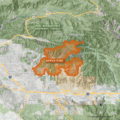
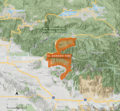
- Maps of significant wildfires in 2020 in California




See also

Notes
- Containment means that fire crews have established and secured control lines around the fire's perimeter. These lines are artificial barriers, like trenches or cleared vegetation, designed to stop the fire's spread, or natural barriers like rivers. Containment reflects progress in managing the fire but does not necessarily mean the fire is starved of fuel, under control, or put out.[35]
