24,25-Dihydroxycholecalciferol
Chemical compound
From Wikipedia, the free encyclopedia
24,25-Dihydroxycholecalciferol, also known as 24,25-dihydroxyvitamin D3, refers to a mixture of epimers (24R)-hydroxycalcidiol and (24S)-hydroxycalcidiol (abbreviated as 24(R),25-(OH)2D3 and 24(S),25-(OH)2D3)[1] closely related to 1,25-dihydroxyvitamin D3, the active form of vitamin D3. Like vitamin D3 itself and calcifediol (25-hydroxyvitamin D3), it is inactive as a hormone both in vitro[2] and in vivo.[3] It was first identified in 1972 in the laboratory of Hector DeLuca and Michael F. Holick.[4]

| |
| Names | |
|---|---|
| IUPAC name
(6R)-6-[(1R,3aS,4E,7aR)-4-[(2Z)-2-[(5S)-5-hydroxy-2-methylenecyclohexylidene]ethylidene]-7a-methyl-2,3,3a,5,6,7-hexahydro-1H-inden-1-yl]-2-methylheptane-2,3-diol | |
Other names
| |
| Identifiers | |
3D model (JSmol) |
|
| ChEMBL | |
| ChemSpider | |
| ECHA InfoCard | 100.049.754 |
PubChem CID |
|
| UNII | |
CompTox Dashboard (EPA) |
|
| |
| |
| Properties | |
| C27H44O3 | |
| Molar mass | 416.63 g/mol |
Except where otherwise noted, data are given for materials in their standard state (at 25 °C [77 °F], 100 kPa).
| |


Formation and significance
24(R),25-(OH)2D3 is formed from 25-hydroxyvitamin D3 by the action of CYP24A1 (25-hydroxyvitamin D3-24-hydroxylase).[5] CYP24A1 appears to be "a multicatalytic enzyme catalyzing most, if not all, of the reactions in the C-24/C-23 pathway of 25-OH-D3 metabolism."[6] 24(S),25-(OH)2D3 is derived from reduction of 25-OH-24-oxo-D3, a metabolite of 24(R),25-(OH)2D3.[5]
The proportion of serum 24,25-dihydroxyvitamin D3 that is the 24(R) isomer was found to be 96.8% in rats under standard conditions, decreasing to 89.5% several days after injection with a large dose of vitamin D3.[5]
It has been proposed that 24,25-dihydroxyvitamin D3 is a metabolite of 25-hydroxyvitamin D3 which is destined for excretion.[6]
It is not known whether the compound might also have some physiologically significant activity. Some evidence of a possible receptor has been obtained.[7]
Interactive pathway map
Click on genes, proteins and metabolites below to link to respective articles. [§ 1]
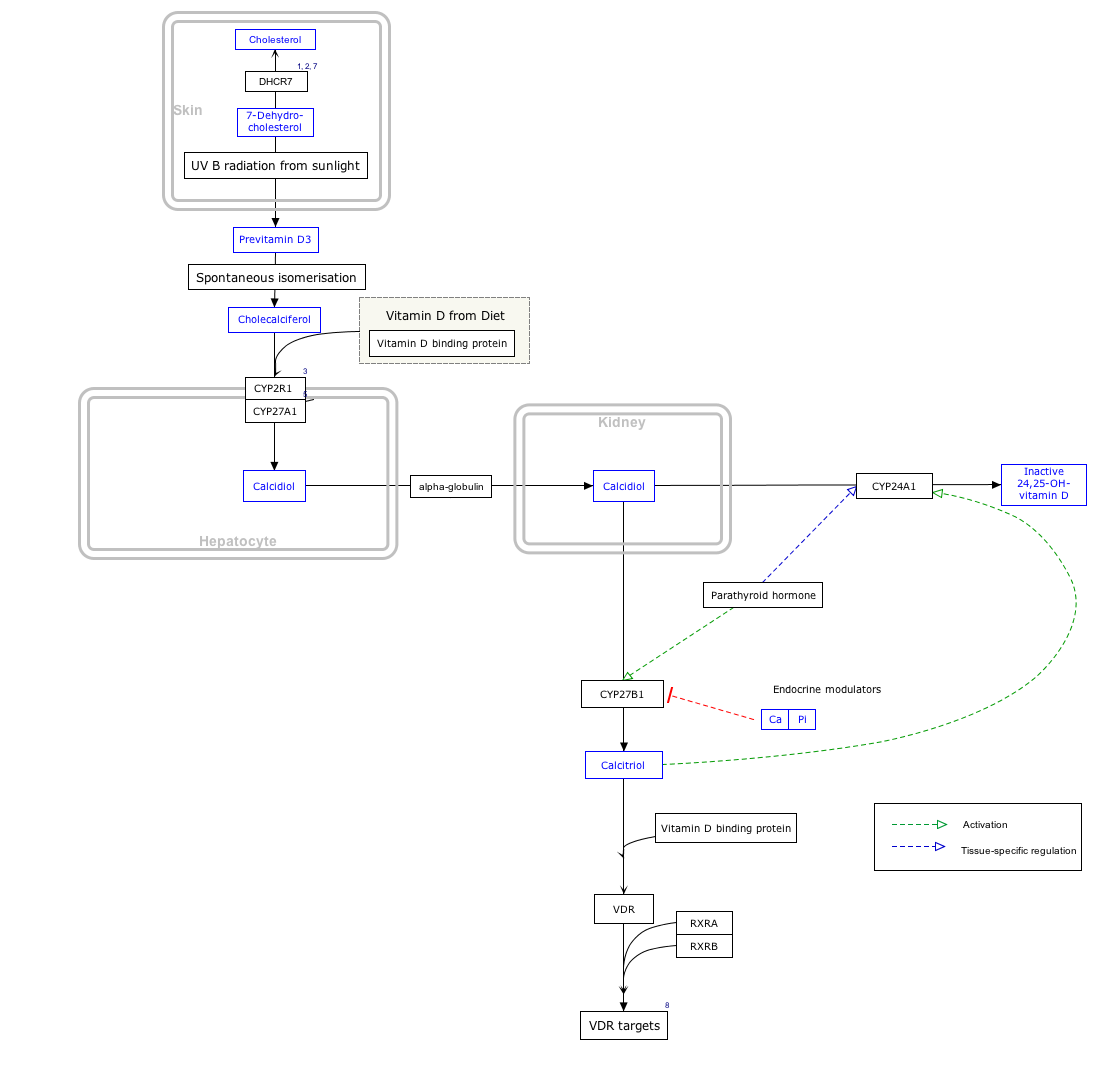
- The interactive pathway map can be edited at WikiPathways: "VitaminDSynthesis_WP1531".