271 series
Japanese electric multiple unit train type
From Wikipedia, the free encyclopedia
The 271 series (271系, 271-kei) is an electric multiple unit (EMU) train type operated by West Japan Railway Company (JR West) on Haruka limited express services to and from Kansai International Airport.[1]

| 271 series | |
|---|---|
Set HA654 at Kyoto Station in November 2019 | |
| In service | March 2020 - Present |
| Manufacturer | Kinki Sharyo |
| Family name | Haruka |
| Constructed | 2019–2020 |
| Entered service | 14 March 2020 |
| Number built | 18 cars (6 sets) |
| Number in service | 18 cars (6 sets) |
| Formation | 3 cars per trainset |
| Fleet numbers | HA651 – HA656 |
| Operator | JR West |
| Specifications | |
| Maximum speed | 130 km/h (81 mph) |
| Traction system | Variable frequency (SiC-MOSFET) |
| Electric system | 1,500 V DC overhead lines |
| Current collection | WPS28E single-arm pantograph |
| Safety systems | ATS-SW・P and Dead man's switch |
| Multiple working | 281 series |
| Track gauge | 1,067 mm (3 ft 6 in) |
Design
The trains inherit some of design elements of the 281 series currently used on Haruka services, such as its livery, the Haruka branding and the "square dot" logos.[1]
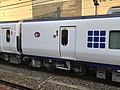 Haruka branding on a 271 series train

Formations
The trains are formed as three-car sets, and operate coupled with the existing 281 series sets to form as nine-car train services.[2] The 271 series trains are formed as follows.[3]
| Car | End car | Intermediate car | End car |
|---|---|---|---|
| Designation | KuMoHa 271 | MoHa 270 | KuMoHa 270 |
The KuMoHa 271 car is fitted with one WPS28E single-arm pantograph.
Interior
The interior features a 2+2 seating arrangement with rotating and reclining seats, AC power outlets on all seats, as well as dedicated luggage spaces. Multilingual passenger informations are provided on displays above the doors.[2]
 Interior
 Passenger information displays
 Luggage racks


History
On 21 June 2019 JR West announced the introduction of new 271 series trains on Haruka limited express services.[4] The order for 18 cars was worth 6 billion yen. The first train was unveiled at the Kinki Sharyo head office on 10 July 2019.[2] The trains entered revenue service on 14 March 2020,[5] but due to the outbreak of the COVID-19 pandemic and the subsequent drop of air travelers, JR West decided to postpone lengthening the Haruka trains to nine cars.[citation needed]
Currently, all Haruka trains are still formed in six car sets, with nine-car services intended to resume when air travel goes back to normal.[6] The sets re-entered service on 13 March 2021 with the introduction of that year's revised timetable when various Haruka sets resumed 9-car operation.[citation needed]
