45 Eugenia
Asteroid with two moons
From Wikipedia, the free encyclopedia
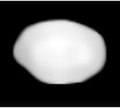
45 Eugenia is a large asteroid of the asteroid belt. It is famed as one of the first asteroids to be found to have a moon orbiting it. It was also the second triple asteroid to be discovered, after 87 Sylvia.

 | |
| Discovery[1] | |
|---|---|
| Discovered by | H. Goldschmidt |
| Discovery date | 27 June 1857 |
| Designations | |
| Pronunciation | /juːˈdʒiːniə/[2] |
Named after | Empress Eugénie |
| 1941 BN | |
| Main belt | |
| Adjectives | Eugenian |
| Orbital characteristics[3] | |
| Epoch 26 November 2005 (JD 2453701.5) | |
| Aphelion | 440.305 million km (2.943 AU) |
| Perihelion | 373.488 million km (2.497 AU) |
| 406.897 million km (2.720 AU) | |
| Eccentricity | 0.082 |
| 1,638.462 d (4.49 a) | |
| 45.254° | |
| Inclination | 6.610° |
| 147.939° | |
| 85.137° | |
| Known satellites | Petit-Prince S/2004 (45) 1 |
| Physical characteristics | |
| Dimensions | 232 × 193 × 161 km[4] 305 × 220 × 145 km[5][6] |
| 94±1 km[7] 107.3±2.1 km[5] | |
| Mass | (5.8±0.1)×1018 kg[7] (5.69±0.1)×1018 kg[4] (5.8±0.2)×1018 kg[8][9][a] |
Mean density | 1.66±0.07 g/cm3[7] 1.1±0.1 g/cm3[4] 1.1±0.3 g/cm3[9] |
Equatorial surface gravity | 0.017 m/s2[b] |
Equatorial escape velocity | 0.071 km/s[b] |
| 0.2375 d (5.699 h)[10] | |
| 117±10° | |
Pole ecliptic longitude | 124±10° |
Pole ecliptic latitude | −30±10°[6] |
| 0.065 (calculated)[7] 0.040±0.002[5] | |
| F[11] | |
| 7.46[5] | |
Discovery
Eugenia was discovered on 27 June 1857 by the Franco–German amateur astronomer Hermann Goldschmidt.[12] His instrument of discovery was a four-inch aperture telescope located in his sixth-floor apartment in the 6th arrondissement of Paris.[13] It was the 45th minor planet to be discovered. The preliminary orbital elements were computed by Wilhelm Forster in Berlin, based on three observations in July 1857.[14]
The asteroid was named by its discoverer after Empress Eugénie de Montijo, the wife of Napoleon III.[12] It was the first asteroid to be definitely named after a real person, rather than a figure from classical legend.[15]
Physical characteristics
Eugenia is a large asteroid, with a diameter of 214 km. It is an F-type asteroid, which means that it is very dark in colouring (darker than soot) with a carbonaceous composition. Like Mathilde, its density appears to be unusually low, indicating that it may be a loosely packed rubble pile, not a monolithic object. Eugenia appears to be almost anhydrous.[16] Lightcurve analysis indicates that Eugenia's pole most likely points towards ecliptic coordinates (β, λ) = (−30°, 124°) with a 10-degree uncertainty,[6] which gives it an axial tilt of 117°. Eugenia's rotation is then retrograde, rotating backward to its orbital plane.
Satellite system
Petit-Prince
In November 1998, astronomers at the Canada–France–Hawaii Telescope on Mauna Kea, Hawaii, discovered a small moon orbiting Eugenia. This was the first time an asteroid moon had been discovered by a ground-based telescope. The moon is much smaller than Eugenia, about 13 km in diameter, and takes five days to complete an orbit around it.
The discoverers chose the name "Petit-Prince" (formally "(45) Eugenia I Petit-Prince"). This name refers to Empress Eugénie's son, the Prince Imperial. However, the discoverers also intended an allusion to the children's novella The Little Prince by Antoine de Saint-Exupéry, which is about a young prince who lives on an asteroid.[17]

S/2004 (45) 1
A second, smaller (estimated diameter of 6 km) satellite that orbits closer to Eugenia than Petit-Prince has since been discovered and provisionally named S/2004 (45) 1.[18] It was discovered by analyses of three images acquired in February 2004 from the 8.2 m VLT "Yepun" at the European Southern Observatory (ESO) Cerro Paranal, in Chile.[19] The discovery was announced in IAUC 8817, on 7 March 2007 by Franck Marchis and his IMCCE collaborators.[18]
| Name | Semi-major axis | Diameter | Eccentricity | Inclination | Period |
|---|---|---|---|---|---|
| S/2004 (45) 1 | 610 km | 6 km | 0.11 ± 0.02 | 1.793d | |
| Petit-Prince | 1,164 km | 13 km | 0.002 | 8.0° | 4.716d |
Notes
- Uncertainty calculated from uncertainties in the orbit of Petit-Prince
- On the extremities of the long axis
See also
- Dactyl and Ida, another asteroid and asteroid moon system catalogued by astronomers
- 3122 Florence, another dual-moon asteroid confirmed only in September 2017
