ABACABA pattern
Mathematical fractal pattern
From Wikipedia, the free encyclopedia
The ABACABA pattern is a recursive fractal pattern that shows up in many places in the real world (such as in geometry, art, music, poetry, number systems, literature and higher dimensions).[1][2][3][4] Patterns often show a DABACABA type subset. AA, ABBA, and ABAABA type forms are also considered.[5]

Generating the pattern
In order to generate the next sequence, first take the previous pattern, add the next letter from the alphabet, and then repeat the previous pattern. The first few steps are listed here.[4]
| Step | Pattern | Letters |
|---|---|---|
| 1 | A | 21 − 1 = 1 |
| 2 | ABA | 3 |
| 3 | ABACABA | 7 |
| 4 | ABACABADABACABA | 15 |
| 5 | ABACABADABACABAEABACABADABACABA | 31 |
| 6 | ABACABADABACABAEABACABADABACABAFABACABADABACABAEABACABADABACABA | 63 |
ABACABA is a "quickly growing word", often described as chiastic or "symmetrically organized around a central axis" (see: Chiastic structure and Χ).[4] The number of members in each iteration is a(n) = 2n − 1, the Mersenne numbers ((sequence A000225 in the OEIS)). Replacing each letter with their respective numbers yields the ruler function.
Gallery


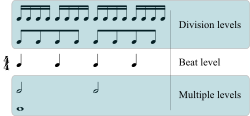 Metric levels:[1]EABACABADABACABA
 A staircase with each box double the size of the previous one:ABACABADABACABA[1]
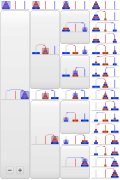

 Binary-reflected Gray code (BRGC):to G
 Rotary encoder:to I
 3-bit Gray code visualized as a traversal of vertices of a cube (0,1,3,2,6,7,5,4):[1]ABACABA
 Château de Chambord:ABACABA[6]


See also
Notes
- The strength, emphasis, or importance of the beginning of each duration the length of a single measure in 4
4 (eighth-notes) is, divisively (, , ), determined by each eighth-note's position in a DABACABA structure, while the eighth notes of two measures grouped, additively (), are determined by an EABACABADABACABA structure.[3]


