Acacia araneosa
From Wikipedia, the free encyclopedia
| Balcanoona Wattle | |
|---|---|
 | |
| In the ANBG | |
Scientific classification  | |
| Kingdom: | Plantae |
| Clade: | Tracheophytes |
| Clade: | Angiosperms |
| Clade: | Eudicots |
| Clade: | Rosids |
| Order: | Fabales |
| Family: | Fabaceae |
| Subfamily: | Caesalpinioideae |
| Clade: | Mimosoid clade |
| Genus: | Acacia |
| Species: | A. araneosa |
| Binomial name | |
| Acacia araneosa | |
 | |
| Synonyms[1] | |
|
Racosperma araneosum (Whibley) Pedley | |
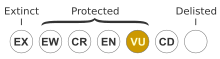

Acacia araneosa, commonly known as Balcanoona wattle or spidery wattle,[2] is a species of flowering plant in the family Fabaceae and is endemic to South Australia. It is a small, wispy tree with pendulous phyllodes that are circular in cross section, racemes of spherical heads of yellow flowers, and linear pods up to 145 mm (5.7 in) long.
Acacia araneosa is a small, erect, wispy tree that typically grows to a height of 3–8 m (9.8–26.2 ft) with a slender trunk 4–7 cm (1.6–2.8 in) in diameter. The bark is smooth and grey, reddish brown on branchlets. The phyllodes are pendulous, circular in cross section, mostly 180–350 mm (7.1–13.8 in) long and 1.0–1.8 mm (0.039–0.071 in) in diameter. The flowers are arranged in spherical heads in racemes 35–95 mm (1.4–3.7 in) long in leaf axils, on peduncles mostly 7–10 mm (0.28–0.39 in) long. The heads are compact, composed of 50 to 65 yellow flowers, with stamens 2.8–3.5 mm (0.11–0.14 in) long. Flowering has been observed from May to October, and the fruit is a crusty, linear pod 60–145 mm (2.4–5.7 in) long and 4–6 mm (0.16–0.24 in) wide, containing hard, black, oval seeds up to 5 mm (0.20 in) long and 3 mm (0.12 in) wide with an orange aril.[2][3][4]
Taxonomy
Acacia araneosa was first formally described by the botanist David Whibley in Contributions from the Herbarium Australiense, from specimens collected near Nudlamutana Well in the northern Flinders Ranges.[4][5] The specific epithet (araneosa) means 'cobwebby', referring to the appearance of the plant.[3]
Distribution and habitat
Balcanoona wattle has a limited distribution in association with Eucalyptus gillii and Triodia irritans in the Vulkathunha-Gammon Ranges National Park, from Balcanoona to Arkaroola, where it is found on rocky slopes, ridges and hills in open woodland, in skeletal soils.[2][4][6]