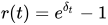
Accumulation function
From Wikipedia, the free encyclopedia
In actuarial mathematics, the accumulation function a(t) is a function of time t expressing the ratio of the value at time t (future value) and the initial investment (present value).[1][2] It is used in interest theory.
Thus a(0) = 1 and the value at time t is given by:

where the initial investment is

For various interest-accumulation protocols, the accumulation function is as follows (with i denoting the interest rate and d denoting the discount rate):
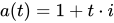
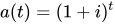
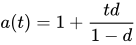

In the case of a positive rate of return, as in the case of interest, the accumulation function is an increasing function.