Acetabular labrum tear
From Wikipedia, the free encyclopedia
| Acetabular labrum tear | |
|---|---|
 | |
| A complex labral tear. An arthroscopic probe is seen at the junction of the labrum and acetabular rim. | |
| Specialty | Orthopedics |
| Causes | excessive force, hip dislocation, capsular hip hypermobility, hip dysplasia, hip degeneration |
| Risk factors | older age |
| Diagnostic method | physical examination, medical imaging |
| Treatment | surgery, physical therapy |
An acetabular labrum tear or hip labrum tear is a common injury of the acetabular labrum resulting from a number of causes including running, hip dislocation, and deterioration with ageing. Most are thought to result from a gradual tear due to repetitive microtrauma.
Acetabular labrum tears present with anterior hip or groin pain, and less commonly buttock pain. Frequently, there are also mechanical symptoms including clicking, locking, and giving way.[1] Due to the limitations of the physical examination, further diagnosis requires medical imaging.
Studies have shown that there are some differences in the tear area of the acetabular labrum in different regions, which may be related to the differences in people's living habits.[1]
Conservative treatment is usually recommended initially, including relative rest, the use of anti-inflammatory and pain medications.[1] Patients may also be considered for labral reconstruction surgery to help recover their athletic ability.[2] At present, there is not enough evidence to show that physical therapy is beneficial for the acetabular labrum.[3]
In addition, since the cause of the acetabular labrum tear has not been proven to be directly related to any specific action, this condition is difficult to prevent.[1]
It is estimated that 75% of acetabular labrum tears have an unknown cause. Tears of the labrum have been credited to a variety of causes such as excessive force, hip dislocation, capsular hip hypermobility, hip dysplasia, and hip degeneration.[2] A tight iliopsoas tendon has also been attributed to labrum tears by causing compression or traction injuries that eventually lead to a labrum tear.[4] Most labrum tears are thought to be from gradual tear due to repetitive microtrauma.[2] Incidents of labrum tears increase with age, suggesting that they may also be caused by deterioration through the aging process.[2] Labrum tears in athletes can occur from a single event or recurring trauma. Running can cause labrum tears due to the labrum being used more for weight bearing and taking excessive force while at the end-range motion of the leg: hyperabduction, hyperextension, hyperflexion, excessive external rotation.[5] Sporting activities are likely causes, specifically those that require frequent lateral rotation or pivoting on a loaded femur as in hockey or ballet.[2] Constant hip rotation places increased stress on the capsular tissue and damage to the iliofemoral ligament. This in turn causes hip rotational instability putting increased pressure on the labrum.[5] Traumatic injuries are most commonly seen in athletes who participate in contact or high-impact sports like football, soccer, or golf.[1] The prevalence rate for traumatic hip injuries that causes a tear of the labrum is very low. Less than 25% of all patients can relate a specific incident to their torn labrum; however, they are often a result of a dislocation or fracture.[6] Falling on one's side causes a blunt trauma to the greater trochanter of the femur. Since there is very little soft tissue to diminish the force between the impact and the greater trochanter, the entire blow is transferred to the surface of the hip joint.[7] And since bone density does not reach its peak until the age of 30, hip traumas could result in a fracture.[7] Tears of the hip labrum can be classified in a variety of ways, including morphology, etiology, location, or severity.[1]
Anatomical modifications of the femur and or hip socket cause a slow buildup of damage to the cartilage. Femur or acetabular dysplasia can lead to femoral acetabular impingement (FAI). Impingement occurs when the femoral head rubs abnormally or lacks a full range of motion in the acetabular socket.[8] There are three different forms of FAI. The first form is caused by a cam-deformity where extra bone is present on the femoral head, which leads to the head being non-spherical. The second deformity is referred to as a pincer deformity and it is due to an excess growth of the acetabular socket.[1] The third type of FAI is a combination of the first two deformities. When either abnormality is present, it changes the position of the femoral head in the hip socket. The increased stresses that the femur and or acetabulum experience may lead to a fracture of the acetabular rim or a detachment of the overstressed labrum.[1]

Diagnosis
An acetabular labrum tear is assessed by physical examination followed by medical imaging. An MR arthrogram is more reliable than magnetic resonance imaging. A full confirmation can be made using arthroscopy.[9][10][11]
Epidemiology
In the United States acetabular labrum tears usually occur in the anterior or anterior-superior area, possibly due to a sudden change from labrum to acetabular cartilage.[4] The most common labrum tears in Japan are in the posterior region, likely due to the customary practice of sitting on the floor. Posterior labrum tears in the Western world usually occur when a force drives the femoral head posteriorly which transfers shear and compressive forces to the posterior labrum.[1]
Rehabilitation
There is little evidence for the benefit of physical therapy for the acetabular labrum.[3] Some studies though report that physical therapy could be of benefit in restoring "sports-ready" capabilities.[2] Following surgery, such as labral reconstruction which has shown promising results in helping people by using an iliotibial band graft.[12] Patients will use crutches for up to six weeks and physical exercise such as running, curtailed for at six months.[13]
There are usually four phases in the rehabilitation process: "Phase I: initial exercises (weeks 1–4), Phase II: intermediate exercises (weeks 5–7), Phase III: advanced exercises (weeks 8–12), and Phase IV: return to sports (weeks 12+)".[3] Therapy programs need to be personalised.[14]
In phase I the first objective is to minimize pain and inflammation. A symmetrical gait pattern is essential so as not to create an imbalance in the muscles of the hip. Aquatic therapy enables more gravity-free movement.
In phase II more flexibility in the soft tissue is promoted, with an emphasis on strength training basics. [citation needed]
In phase III the focus is to begin building functional strength, using single leg exercises to build the muscle and challenge the strength of the hip.[citation needed]
Phase IV is the final stage where further exercise is prescribed until returning to sports.[3] Complex movements like squatting, kicking, and running, will be promoted until symmetrical pain free movements are achieved.[2]
 Single leg bridge
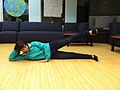 Side leg raise
 Single leg balance


