Achimenes
From Wikipedia, the free encyclopedia
| Achimenes | |
|---|---|
 | |
Scientific classification  | |
| Kingdom: | Plantae |
| Clade: | Tracheophytes |
| Clade: | Angiosperms |
| Clade: | Eudicots |
| Clade: | Asterids |
| Order: | Lamiales |
| Family: | Gesneriaceae |
| Genus: | Achimenes P.Browne (1756) |
| Species[1] | |
|
24; see text | |
| Synonyms[1] | |
| |
Achimenes /æˈkɪmɪniːz/[2] is a genus of about 25 species of tropical and subtropical rhizomatous perennial herbs in the flowering plant family Gesneriaceae. They have a multitude of common names such as magic flowers, widow's tears, Cupid's bower, or hot water plant.
According to some authorities, the plant's name may come from the Greek word cheimanos meaning "tender" or "sensitive to cold".[3]
Range and taxonomy
The genus is native to Mexico and Central America, with one species (A. erecta) occurring naturally in the West Indies. The largest number of species is found in Mexico. Several species and hybrids are widely cultivated and naturalized outside their native range. A complete list of the species, with their synonyms and geographic distributions, can be found in the Smithsonian Institution's World Checklist of Gesneriaceae.
Two species previously included in Achimenes are now classified in the segregation genus Eucodonia and several phylogenetic studies have supported this separation.
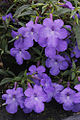 Achimenes cettoana in cultivation
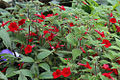 Achimenes erecta in cultivation
 Achimenes longiflora in cultivation
 Achimenes misera in cultivation
 Achimenes patens 'Major' in cultivation
 Achimenes pedunculata in cultivation
 Achimenes skinneri in cultivation


Species
24 species are accepted.[1]
- Achimenes admirabilis Wiehler
- Achimenes antirrhina (DC.) C.V.Morton
- Achimenes brevifolia C.V.Morton
- Achimenes candida Lindl.
- Achimenes cettoana H.E.Moore
- Achimenes dulcis C.V.Morton
- Achimenes erecta (Lam.) H.P.Fuchs
- Achimenes fimbriata Rose ex C.V.Morton
- Achimenes flava C.V.Morton
- Achimenes glabrata (Zucc.) Fitzg.
- Achimenes grandiflora (Schiede) DC.
- Achimenes heterophylla (Mart.) DC.
- Achimenes hintoniana Ram.-Roa & L.E.Skog
- Achimenes ixtapaensis Beutelsp. & J.Mart.-Mel.
- Achimenes longiflora DC.
- Achimenes mexicana (Seem.) Benth. & Hook.f. ex Fritsch
- Achimenes misera Lindl.
- Achimenes nayaritensis L.E.Skog
- Achimenes obscura C.V.Morton
- Achimenes occidentalis C.V.Morton
- Achimenes patens Benth.
- Achimenes pedunculata Benth.
- Achimenes skinneri Gordon ex Lindl.
- Achimenes woodii C.V.Morton
