In combustion processes, the reaction rate  is dependent on temperature
  in the following form (Arrhenius law),
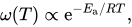
where  is the activation energy, and
  is the universal gas constant. In general, the condition
  is satisfied, where
  is the burnt gas temperature. This condition forms the basis for activation energy asymptotics. Denoting
  for unburnt gas temperature, one can define the Zel'dovich number and heat release parameter as follows

In addition, if we define a non-dimensional temperature
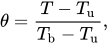
such that  approaching zero in the unburnt region and approaching unity in the burnt gas region (in other words,
  ), then the ratio of reaction rate at any temperature to reaction rate at burnt gas temperature is given by[9][10]
![{\displaystyle {\frac {\omega (T)}{\omega (T_{\rm {b}})}}\propto {\frac {\mathrm {e} ^{-E_{\rm {a}}/RT}}{\mathrm {e} ^{-E_{\rm {a}}/RT_{\rm {b}}}}}=\exp \left[-\beta (1-\theta ){\frac {1+q}{1+q\theta }}\right].}](https://wikimedia.org/api/rest_v1/media/math/render/svg/9b42e1efcc69176afdca98a8378925fea32130ca)
Now in the limit of  (large activation energy) with
  , the reaction rate is exponentially small i.e.,
  and negligible everywhere, but non-negligible when
  . In other words, the reaction rate is negligible everywhere, except in a small region very close to burnt gas temperature, where
  . Thus, in solving the conservation equations, one identifies two different regimes, at leading order,
- Outer convective-diffusive zone
- Inner reactive-diffusive layer
where in the convective-diffusive zone, reaction term will be neglected and in the thin reactive-diffusive layer, convective terms can be neglected and the solutions in these two regions are stitched together by matching slopes using method of matched asymptotic expansions. The above-mentioned two regime are true only at leading order since the next order corrections may involve all the three transport mechanisms.