Acylindrically hyperbolic group
From Wikipedia, the free encyclopedia
In the mathematical subject of geometric group theory, an acylindrically hyperbolic group is a group admitting a non-elementary 'acylindrical' isometric action on some geodesic hyperbolic metric space.[1] This notion generalizes the notions of a hyperbolic group and of a relatively hyperbolic group and includes a significantly wider class of examples, such as mapping class groups and Out(Fn).
Acylindrical action
Let G be a group with an isometric action on some geodesic hyperbolic metric space X. This action is called acylindrical[1] if for every there exist such that for every with one has





If the above property holds for a specific , the action of G on X is called R-acylindrical. The notion of acylindricity provides a suitable substitute for being a proper action in the more general context where non-proper actions are allowed.
An acylindrical isometric action of a group G on a geodesic hyperbolic metric space X is non-elementary if G admits two independent hyperbolic isometries of X, that is, two loxodromic elements such that their fixed point sets and are disjoint.

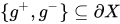

It is known (Theorem 1.1 in [1]) that an acylindrical action of a group G on a geodesic hyperbolic metric space X is non-elementary if and only if this action has unbounded orbits in X and the group G is not a finite extension of a cyclic group generated by loxodromic isometry of X.
Acylindrically hyperbolic group
A group G is called acylindrically hyperbolic if G admits a non-elementary acylindrical isometric action on some geodesic hyperbolic metric space X.
Equivalent characterizations
It is known (Theorem 1.2 in [1]) that for a group G the following conditions are equivalent:
- The group G is acylindrically hyperbolic.
- There exists a (possibly infinite) generating set S for G, such that the Cayley graph is hyperbolic, and the natural translation action of G on is a non-elementary acylindrical action.
- The group G is not virtually cyclic, and there exists an isometric action of G on a geodesic hyperbolic metric space X such that at least one element of G acts on X with the WPD ('Weakly Properly Discontinuous') property.
- The group G contains a proper infinite 'hyperbolically embedded' subgroup.[2]

History
Properties
- Every acylindrically hyperbolic group G is SQ-universal, that is, every countable group embeds as a subgroup in some quotient group of G.
- The class of acylindrically hyperbolic groups is closed under taking infinite normal subgroups, and, more generally, under taking 's-normal' subgroups.[1] Here a subgroup is called s-normal in if for every one has .
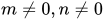
- If G is an acylindrically hyperbolic group and or with then the bounded cohomology is infinite-dimensional.[3][4][1]
- Every acylindrically hyperbolic group G admits a unique maximal normal finite subgroup denoted K(G).[2]
- If G is an acylindrically hyperbolic group with K(G)={1} then G has infinite conjugacy classes of nontrivial elements, G is not inner amenable, and the reduced C*-algebra of G is simple with unique trace.[2]
- There is a version of small cancellation theory over acylindrically hyperbolic groups, allowing one to produce many quotients of such groups with prescribed properties.[5]
- Every finitely generated acylindrically hyperbolic group has cut points in all of its asymptotic cones.[6]
- For a finitely generated acylindrically hyperbolic group G, the probability that the simple random walk on G of length n produces a 'generalized loxodromic element' in G converges to 1 exponentially fast as . [7]
- Every finitely generated acylindrically hyperbolic group G has exponential conjugacy growth, meaning that the number of distinct conjugacy classes of elements of G coming from the ball of radius n in the Cayley graph of G grows exponentially in n. [8]