Aes grave
From Wikipedia, the free encyclopedia
Aes grave ("heavy bronze") is a term in numismatics indicating bronze cast coins used in central Italy during the 3rd century BC, whose value was generally indicated by signs: I for the as, S for semis and pellets for unciae. Standard weights for the as were 272, 327, or 341 grams, depending upon the issuing authority.[1]
The main Roman cast coins had these marks and images:
| Image | value | mark |
|---|---|---|
| Ianus | As | I |
| Iupiter | Semis | S |
| Minerva | Triens | four pellets |
| Hercules | Quadrans | three pellets |
| Mercury | Sextans | two pellets |
| Bellona or Roma | Uncia | one pellet |
Main series were from Rome, Ariminum (Rimini), Iguvium (Gubbio), Tuder (Todi), Ausculum (Ascoli Satriano), Firmum (Fermo), Hatria - Hadria (Atri), Luceria (Lucera), and Latin central Italy. Other series have unknown provenance.
Gallery
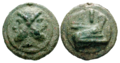 As (c. 235 BC)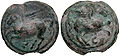
 Triens (c. 241–235 BC)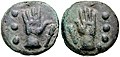
 Sextans (c. 289–245 BC)
 Quincunx (coin) (after 220 BC)
 Uncia (coin) (c. 275–270 BC)


