Anthropogenic CO2 that is released into the atmosphere is partitioned into three components: approximately 45% remains in the atmosphere (referred to as the airborne fraction), while about 24% and 31% are absorbed by the oceans (ocean sink) and terrestrial biosphere (land sink), respectively.[4] If the airborne fraction increases, this indicates that a smaller amount of the CO2 released by humans is being absorbed by land and ocean sinks, due to factors such as warming oceans or thawing permafrost. As a result, a greater proportion of anthropogenic emissions remains in the atmosphere, thereby accelerating the rate of climate change. This has implications for future projections of atmospheric CO2 levels, which must be adjusted to account for this trend.[5] The question of whether the airborne fraction is rising, remaining steady at approximately 45%, or declining remains a matter of debate. Resolving this question is critical for comprehending the global carbon cycle and has relevance for policymakers and the general public.
The quantity “airborne fraction” is termed by Charles David Keeling in 1973, and studies conducted in the 1970s and 1980s defined airborne fraction from cumulative carbon inventory changes as,[5]
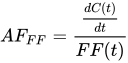
Or,
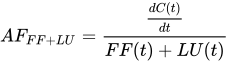
In which C is atmospheric carbon dioxide, t is time, FF is fossil-fuel emissions and LU is the emission to the atmosphere due to land use change.
At present, studies examining the trends in airborne fraction are producing contradictory outcomes, with emissions linked to land use and land cover change representing the most significant source of uncertainty. Some studies show that there is no statistical evidence of an increasing airborne fraction and calculated airborne fraction as,[6]
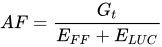
Where Gt is growth of atmospheric CO2 concentration, EFF is the fossil-fuel emissions flux, ELUC is the land use change emissions flux.
Another argument was presented that the airborne fraction of CO2 released by human activities, particularly through fossil-fuel emissions, cement production, and land-use changes, is on the rise.[7] Since 1959, the average CO2 airborne fraction has been 0.43, but it has shown an increase of approximately 0.2% per year over that period.[3]
The trend analyses of airborne fraction may be affected by external natural occurrences, such as the El Niño-Southern Oscillation (ENSO), volcanic eruptions, and other similar events.[8] It is possible that the methodologies used in these studies to analyze the trend of airborne fraction are not robust, and therefore, the conclusions drawn from them are not warranted.

