Akchakhan-Kala
Archaeological site in Uzbekistan
From Wikipedia, the free encyclopedia
Akchakhan-Kala, or Akcha-khan Kala, also named after the locality Kazakly-Yatkan/ Kazakl'i-Yatkan, in modern Karakalpakstan, Uzbekistan, was an ancient fortress in Chorasmia built in the 4th/ 3rd century BCE and occupied until it was despoiled in the 2nd century CE.[2][3] It is part of the "Fifty fortresses oasis" in modern-day Uzbekistan.[4] The abandonment of Akchakhan-Kala was apparently followed by the establishment of the new capital of Toprak-Kala, 14 km to the northeast.[5]

A mural from Akchakhan-Kala | |
  Akchakhan-Kala Shown within West and Central Asia  Akchakhan-Kala Akchakhan-Kala (Uzbekistan) | |
| Alternative name | Akchakhan-Kala |
|---|---|
| Location | Karakalpakstan, Uzbekistan |
| Coordinates | 41°49′41.17″N 60°43′8.67″E[1] |
| Type | Settlement |
| History | |
| Periods | Parthian, Sasanian |
| Site notes | |
| Condition | Ruined |
Excavations


Paintings
Many decorations have been found, belonging to the period from the 1st century BCE to the 2nd century CE: a large quantity of frescoes, unbaked-clay modelled sculptures including fragments of a Ketos in Hellenistic style, and a Zoroastrian fire altar with paintings of colossal Avestan gods.[5] Parthian artistic influences have also been described.[6]
 Akchakhan-Kala mural
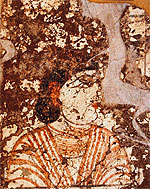 Akchakhan-Kala mural
 Akchakhan-Kala mural
 Location of the Akchakhan-Kala fortress in the Chorasmian oasis, in relation to other main fortresses

.jpg)


