Alexander Thoirs House
From Wikipedia, the free encyclopedia
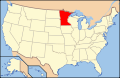
Wabasha, Minnesota
Alexander Thoirs House | |
 The Alexander Thoirs House from the northeast | |
   | |
| Location | 329 West 2nd Street, Wabasha, Minnesota |
|---|---|
| Coordinates | 44°23′2″N 92°2′9″W / 44.38389°N 92.03583°W |
| Area | Less than one acre |
| Built | 1868–1870 |
| Architectural style | Greek Revival |
| MPS | Red Brick Houses in Wabasha, Minnesota, Associated with Merchant-Tradesmen MPS |
| NRHP reference No. | 89000372[1] |
| Designated | May 15, 1989 |
The Alexander Thoirs House is the oldest surviving brick house in Wabasha, Minnesota, United States, and the earliest example of the brick merchant houses that characterized the city's 19th-century streetscape. It was built in two phases in 1868 and 1870 for a successful local shoemaker. The house was listed on the National Register of Historic Places in 1989 for having local significance in the theme of architecture.[2] It was nominated for its status in the city's early housing stock, its fine Greek Revival architecture, and its embodiment of the success of Wabasha's early merchant class, which helped establish the city's own commercial importance.[3]
The Alexander Thoirs House is a wood frame building with a brick veneer. The main section is a two-story rectangle, with a 1+1⁄2-story wing centered on one side, giving the house a T-shaped footprint. The foundation is cement-plastered limestone. A porch spans the front of the main wing and wraps around to attach to the side wing. The house sits prominently on a corner lot facing northeast.[3]
The house is unornamented aside from the distinctive gable returns of Greek Revival architecture. Other elements of the style include the low gables, sidehall plan, and general proportions. The brick veneer and arched windows, however, are quite atypical of Greek Revival.[3]