Algorithmic cooling
From Wikipedia, the free encyclopedia
Algorithmic cooling is an algorithmic method for transferring heat (or entropy) from some qubits to others[1] or outside the system and into the environment, which results in a cooling effect. This method uses regular quantum operations on ensembles of qubits, and it can be shown that it can succeed beyond Shannon's bound on data compression.[2] The phenomenon is a result of the connection between thermodynamics and information theory.
The cooling itself is done in an algorithmic manner using ordinary quantum operations. The input is a set of qubits, and the output is a subset of qubits cooled to a desired threshold determined by the user. This cooling effect may have usages in initializing cold (highly pure) qubits for quantum computation and in increasing polarization of certain spins in nuclear magnetic resonance. Therefore, it can be used in the initializing process taking place before a regular quantum computation.
Quantum computers need qubits (quantum bits) on which they operate. Generally, in order to make the computation more reliable, the qubits must be as pure as possible, minimizing possible fluctuations. Since the purity of a qubit is related to von Neumann entropy and to temperature, making the qubits as pure as possible is equivalent to making them as cold as possible (or having as little entropy as possible). One method of cooling qubits is extracting entropy from them, thus purifying them. This can be done in two general ways: reversibly (namely, using unitary operations) or irreversibly (for example, using a heat bath). Algorithmic cooling is the name of a family of algorithms that are given a set of qubits and purify (cool) a subset of them to a desirable level.
This can also be viewed in a probabilistic manner. Since qubits are two-level systems, they can be regarded as coins, unfair ones in general. Purifying a qubit means (in this context) making the coin as unfair as possible: increasing the difference between the probabilities for tossing different results as much as possible. Moreover, the entropy previously mentioned can be viewed using the prism of information theory, which assigns entropy to any random variable. The purification can, therefore, be considered as using probabilistic operations (such as classical logical gates and conditional probability) for minimizing the entropy of the coins, making them more unfair.
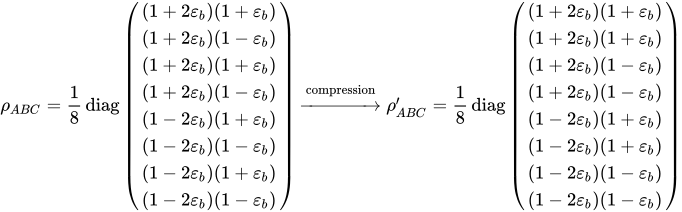
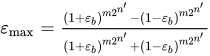
The case in which the algorithmic method is reversible, such that the total entropy of the system is not changed, was first named "molecular scale heat engine",[3] and is also named "reversible algorithmic cooling". This process cools some qubits while heating the others. It is limited by a variant of Shannon's bound on data compression and it can asymptotically reach quite close to the bound.
A more general method, "irreversible algorithmic cooling", makes use of irreversible transfer of heat outside of the system and into the environment (and therefore may bypass the Shannon bound). Such an environment can be a heat bath, and the family of algorithms which use it is named "heat-bath algorithmic cooling".[4] In this algorithmic process entropy is transferred reversibly to specific qubits (named reset spins) that are coupled with the environment much more strongly than others. After a sequence of reversible steps that let the entropy of these reset qubits increase they become hotter than the environment. Then the strong coupling results in a heat transfer (irreversibly) from these reset spins to the environment. The entire process may be repeated and may be applied recursively to reach low temperatures for some qubits.
Background
Thermodynamics
Algorithmic cooling can be discussed using classical and quantum thermodynamics points of view.
Cooling
The classical interpretation of "cooling" is transferring heat from one object to the other. However, the same process can be viewed as entropy transfer. For example, if two gas containers that are both in thermal equilibrium with two different temperatures are put in contact, entropy will be transferred from the "hotter" object (with higher entropy) to the "colder" one. This approach can be used when discussing the cooling of an object whose temperature is not always intuitively defined, e.g. a single particle. Therefore, the process of cooling spins can be thought of as a process of transferring entropy between spins, or outside of the system.
Heat reservoir
The concept of heat reservoir is discussed extensively in classical thermodynamics (for instance in Carnot cycle). For the purposes of algorithmic cooling, it is sufficient to consider heat reservoirs, or "heat baths", as large objects whose temperature remains unchanged even when in contact with other ("normal" sized) objects. Intuitively, this can be pictured as a bath filled with room-temperature water that practically retains its temperature even when a small piece of hot metal is put in it.
Using the entropy form of thinking from the previous subsection, an object which is considered hot (whose entropy is large) can transfer heat (and entropy) to a colder heat bath, thus lowering its own entropy. This process results in cooling.
Unlike entropy transfer between two "regular" objects which preserves the entropy of the system, entropy transfer to a heat bath is normally regarded as non-preserving. This is because the bath is normally not considered as a part of the relevant system, due to its size. Therefore, when transferring entropy to a heat bath, one can essentially lower the entropy of their system, or equivalently, cool it. Continuing this approach, the goal of algorithmic cooling is to reduce as much as possible the entropy of the system of qubits, thus cooling it.
Quantum mechanics
General introduction
Algorithmic cooling applies to quantum systems. Therefore, it is important to be familiar with both the core principles and the relevant notations.
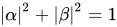
A qubit (or quantum bit) is a unit of information that can be in a superposition of two states, denoted as and . The general superposition can be written as where and . If one measures the state of the qubit in the orthonormal basis composed of and , one gets the result with probability and the result with probability .





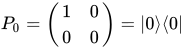
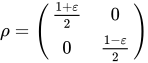
The above description is known as a quantum pure state. A general mixed quantum state can be prepared as a probability distribution over pure states, and is represented by a density matrix of the general form , where each is a pure state (see ket-bra notations) and each is the probability of in the distribution. The quantum states that play a major role in algorithmic cooling are mixed states in the diagonal form for . Essentially, this means that the state is the pure state with probability and is pure with probability . In the ket-bra notations, the density matrix is . For the state is called pure, and for the state is called completely mixed (represented by the normalized identity matrix). The completely mixed state represents a uniform probability distribution over the states and .



![{\displaystyle \varepsilon \in [-1,1]}](https://wikimedia.org/api/rest_v1/media/math/render/svg/e51ee3c3d21519c8eff0d5ddaee0734b7fedbb7d)





Polarization or bias of a state
The state above is called -polarized, or -biased, since it deviates by in the diagonal entries from the completely mixed state.


Another approach for the definition of bias or polarization is using Bloch sphere (or generally Bloch ball). Restricted to a diagonal density matrix, a state can be on the straight line connecting the antipodal points representing the states and ("north and south poles" of the sphere). In this approach, the parameter () is exactly the distance (up to a sign) of the state from the center of the ball, which represents the completely mixed state. For the state is exactly on the poles and for the state is exactly in the center. A bias can be negative (for example ), and in this case the state is in the middle between the center and the south pole.

In the Pauli matrices representation form, an -biased quantum state is[4]

Entropy
Since quantum systems are involved, the entropy used here is von Neumann entropy. For a single qubit represented by the (diagonal) density matrix above, its entropy is (where the logarithm is to base ). This expression coincides with the entropy of an unfair coin with "bias" , meaning probability for tossing heads. A coin with bias is deterministic with zero entropy, and a coin with bias is fair with maximal entropy (.



The relation between the coins approach and von Neumann entropy is an example of the relation between entropy in thermodynamics and in information theory.
Intuition
An intuition for this family of algorithms can come from various fields and mindsets, which are not necessarily quantum. This is due to the fact that these algorithms do not explicitly use quantum phenomena in their operations or analysis, and mainly rely on information theory. Therefore, the problem can be inspected from a classical (physical, computational, etc.) point of view.
Physics
The physical intuition for this family of algorithms comes from classical thermodynamics.[3]
Reversible case
The basic scenario is an array of qubits with equal initial biases. This means that the array contains small thermodynamic systems, each with the same entropy. The goal is to transfer entropy from some qubits to others, eventually resulting in a sub-array of "cold" qubits and another sub-array of "hot" qubits (the sub-arrays being distinguished by their qubits' entropies, as in the background section). The entropy transfers are restricted to be reversible, which means that the total entropy is conserved. Therefore, reversible algorithmic cooling can be seen as an act of redistributing the entropy of all the qubits to obtain a set of colder ones while the others are hotter.
To see the analogy from classical thermodynamics, two qubits can be considered as a gas container with two compartments, separated by a movable and heat-insulating partition. If external work is applied in order to move the partition in a reversible manner, the gas in one compartment is compressed, resulting in higher temperature (and entropy), while the gas in the other is expanding, similarly resulting in lower temperature (and entropy). Since it is reversible, the opposite action can be done, returning the container and the gases to the initial state. The entropy transfer here is analogous to the entropy transfer in algorithmic cooling, in the sense that by applying external work entropy can be transferred reversibly between qubits.
Irreversible case
The basic scenario remains the same, however an additional object is present – a heat bath. This means that entropy can be transferred from the qubits to an external reservoir and some operations can be irreversible, which can be used for cooling some qubits without heating the others. In particular, hot qubits (hotter than the bath) that were on the receiving side of reversible entropy transfer can be cooled by letting them interact with the heat bath. The classical analogy for this situation is the Carnot refrigerator, specifically the stage in which the engine is in contact with the cold reservoir and heat (and entropy) flows from the engine to the reservoir.
Information theory
The intuition for this family of algorithms can come from an extension of Von-Neumann's solution for the problem of obtaining fair results from a biased coin.[5] In this approach to algorithmic cooling, the bias of the qubits is merely a probability bias, or the "unfairness" of a coin.
Applications
Two typical applications that require a large number of pure qubits are quantum error correction (QEC)[4] and ensemble computing.[2] In realizations of quantum computing (implementing and applying the algorithms on actual qubits), algorithmic cooling was involved in realizations in optical lattices.[6] In addition, algorithmic cooling can be applied to in vivo magnetic resonance spectroscopy.[7]
Quantum error correction
Quantum error correction is a quantum algorithm for protection from errors. The algorithm operates on the relevant qubits (which operate within the computation) and needs a supply of new pure qubits for each round. This requirement can be weakened[4][8] to purity above a certain threshold instead of requiring fully pure qubits. For this, algorithmic cooling can be used to produce qubits with the desired purity for quantum error correction.
Ensemble computing
Ensemble computing is a computational model that uses a macroscopic number of identical computers. Each computer contains a certain number of qubits, and the computational operations are performed simultaneously on all the computers. The output of the computation can be obtained by measuring the state of the entire ensemble, which would be the average output of each computer in it.[9] Since the number of computers is macroscopic, the output signal is easier to detect and measure than the output signal of each single computer.
This model is widely used in NMR quantum computing: each computer is represented by a single (identical) molecule, and the qubits of each computer are the nuclear spins of its atoms. The obtained (averaged) output is a detectable magnetic signal.
NMR spectroscopy
Nuclear magnetic resonance spectroscopy (sometimes called MRS - magnetic resonance spectroscopy) is a non-invasive technique related to MRI (magnetic resonance imaging) for analyzing metabolic changes in vivo (from Latin: "within the living organism"), which can potentially be used for diagnosing brain tumors, Parkinson's disease, depression, etc. It uses some magnetic properties of the relevant metabolites to measure their concentrations in the body, which are correlated with certain diseases. For example, the difference between the concentrations of the metabolites glutamate and glutamine can be linked to some stages of neurodegenerative diseases, such as Alzheimer's disease.[10]
Some uses of MRS focus on the carbon atoms of the metabolites (see carbon-13 nuclear magnetic resonance). One major reason for this is the presence of carbon in a large portion of all tested metabolites. Another reason is the ability to mark certain metabolites by the 13C isotope, which is more easy to measure than the usually used hydrogen atoms mainly because of its magnetic properties (such as its gyromagnetic ratio).
In MRS, the nuclear spins of the atoms of the metabolites are required to be with a certain degree of polarization, so the spectroscopy can succeed. Algorithmic cooling can be applied[7] in vivo, increasing the resolution and precision of the MRS. Realizations (not in vivo) of algorithmic cooling on metabolites with 13C isotope have been shown to increase the polarization of 13C in amino acids[11] and other metabolites.[12][13]
MRS can be used to obtain biochemical information about certain body tissues in a non-invasive manner. This means that the operation must be carried out at room temperature. Some methods of increasing polarization of spins (such as hyperpolarization, and in particular dynamic nuclear polarization) are not able to operate under this condition since they require a cold environment (a typical value is 1K, about -272 degrees Celsius). On the other hand, algorithmic cooling can be operated in room temperature and be used in MRS in vivo,[7] while methods that required lower temperature can be used in biopsy, outside of the living body.


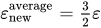















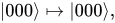
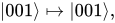
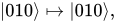
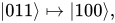
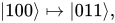
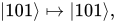
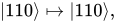
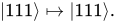

![{\displaystyle {\frac {1+\varepsilon _{\text{new}}^{\text{average}}}{2}}=\operatorname {tr} [(P_{0}\otimes I\otimes I)(U\rho _{A,B,C}U^{\dagger })]={\frac {1+{\frac {3\varepsilon }{2}}-{\frac {\varepsilon ^{3}}{2}}}{2}},}](https://wikimedia.org/api/rest_v1/media/math/render/svg/dd9c8038ba9a757a1995b3be403a77be79f1c390)