Ali Barid Shah I
Sultan of Bidar from 1542 to 1580
From Wikipedia, the free encyclopedia
Ali Barid Shah I was the third ruler of the Barid Shahi dynasty at Bidar. He succeeded his father in 1540, and ruled until his death in 1580. He was considered a man of letters, and invited scholars and craftsmen from all over the Indian subcontinent to his capital.[1] He is also known to have played a key logistical role in the Battle of Talikota.[2]

| Ali Barid Shah I | |
|---|---|
 Ali Barid Shah I of Bidar Sultanate | |
| 3rd Sultan of Bidar | |
| Reign | 1542–1580 |
| Predecessor | Amir Barid I |
| Successor | Ibrahim Barid Shah |
| Died | 1580 |
| Burial | |
| Father | Amir Barid I |
| Religion | Islam |
Reign
He was the third ruler of the Barid Shahi dynasty, but the first to assume royal titles.[3]
During his reign, Bidar was attacked by Murtaza Nizam Shah, who intended to annex it as a jagir for his general Sahib Khan. The Nizam Shahi army was also reinforced by troops from the Golconda Sultanate. Ali Barid sought assistance from Ali Adil Shah I of Bijapur, who sent a thousand horsemen towards the cause. The Nizam Shahi army later returned to their capital in order to quell a rebellion.[2]
Ali Barid was also in attendance at the Battle of Talikota, where the Deccan Sultanates united against the Vijayanagara Empire. He played a key logistical role in the battle.
He ordered the construction of his own tomb, which was completed in 1576.[4] Another building commissioned by him was the Rangin Mahal within the Bidar Fort.[2] Ali Barid died in 1579.[a]
Gallery
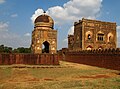 Tomb of Ali Barid Shah of Bidar Sultanate.
 Frescoed calligraphy at wall of Tomb of Ali Barid Shah.
 Tomb of Ali Barid Shah of Bidar Sultanate.


