Allanche
From Wikipedia, the free encyclopedia
Allanche | |
|---|---|
 View from Chavanon | |
 Coat of arms | |
 Location of Allanche | |
  Allanche  Allanche | |
| Coordinates: 45°13′48″N 2°56′07″E / 45.23°N 2.9353°E | |
| Country | France |
| Region | Auvergne-Rhône-Alpes |
| Department | Cantal |
| Arrondissement | Saint-Flour |
| Canton | Murat |
| Intercommunality | Hautes Terres Communauté |
| Government | |
| • Mayor (2020–2026) | Philippe Rosseel[1] |
Area 1 | 49.89 km2 (19.26 sq mi) |
| Population (2023)[2] | 773 |
| • Density | 15.5/km2 (40.1/sq mi) |
| Time zone | UTC+01:00 (CET) |
| • Summer (DST) | UTC+02:00 (CEST) |
| INSEE/Postal code | 15001 /15160 |
| Elevation | 784–1,295 m (2,572–4,249 ft) (avg. 968 m or 3,176 ft) |
| 1 French Land Register data, which excludes lakes, ponds, glaciers > 1 km2 (0.386 sq mi or 247 acres) and river estuaries. | |
Allanche (French pronunciation: [alɑ̃ʃ]; Occitan: Alancha) is a commune in the Cantal department in the Auvergne region of south-central France.
Heraldry
Allanche is located some 70 km south of Clermont-Ferrand and 20 km east by southeast of Massiac. It can be accessed by the D679 from Marcenat in the northwest to the village then south to Sainte-Anastasie. The D39 comes from Pradiers in the north through the village then south to Chalinargues. The D9 road branches off the D3 to the west of the commune and passes through the village continuing to the northeast. Apart from the village there are a number of hamlets. These are:
- Chastre
- Chavanon
- Coudour
- Feydit
- Le Bac Bas
- Le Bac Haut
- Les Cites
- Maillargues
- Roche Haut
- Romaniargues
The commune is largely farmland with patches of forest and the edge of a large forest in the east.[3]
The Allanche river flows from the northwest through the village and continues southeast to feed the Alagnon river. Many tributaries feed the Allanche in the commune including the Ruisseau de Laneyrat, the Ruisseau de Coudoun, the Ruisseau de Chavanon, the Ruisseau de Vernois, and other unnamed streams.[3]
|
Blazon: Or, two keys saltirewise in sable.
|
Administration
List of Successive Mayors[4]
| From | To | Name |
|---|---|---|
| 1792 | 1800 | Antoine Gabriel Benoid |
| 1800 | 1802 | Jean Pierre Feydin |
| 1802 | 1805 | Guillaume Peuvergne |
| 1805 | 1813 | Jean Pierre Feydin |
| 1813 | 1830 | Antoine Gabriel Benoid |
| 1830 | 1838 | Jean Benoit Bertrand |
| 1838 | 1855 | Jean Pierre Catinaud |
| 1855 | 1874 | Louis Bonnet |
| 1874 | 1880 | Gabriel Charles Bonnet |
| 1880 | 1890 | Jules Magot |
| 1890 | 1896 | Auguste Dellac |
| 1896 | 1903 | Henri Bonnet |
| 1903 | 1904 | Jean Romain Faucillon |
| 1904 | 1919 | Justin Veisset |
| 1919 | 1929 | Léon Parlier |
| 1929 | 1932 | Albert Chastel |
| 1932 | 1935 | Roger Albeine |
| 1935 | 1941 | Jules Eugène Farradeche |
- Mayors from 1941
| From | To | Name | Party |
|---|---|---|---|
| 1941 | 1944 | Léon Parlier | |
| 1944 | 1948 | Jules Eugène Farradeche | |
| 1948 | 1971 | Maurice Peschaud | |
| 1971 | 1995 | Pierre Jarry | |
| 1995 | 2001 | Christian Léoty | RPR |
| 2001 | 2008 | André Papon | |
| 2008 | 2016 | Christian Léoty | LR |
| 2016 | 2026 | Philippe Rosseel |
Population
Culture and heritage
Civil heritage
- The former Château de Mercoeur (15th century)
 is registered as an historical monument.[7]
 - At Allanche station from May to September there is the Vélorail Cézallier for tourists.
- In the south-west of the commune are the Pinatelle Allanche mountains.

Religious heritage
The commune has two religious buildings and structures that are registered as historical monuments:
- The Church of Saint-Julien-de-Chanet (12th century).[8] The church contains several items that are registered as historical objects:
- The Church of Saint John the Baptist (12th century).[14] The church contains several items that are registered as historical objects:

- Other religious sites of interest
- The Presbytery contains a Reliquary (15th century)
 that is registered as an historical object.[21]
 - The Church of Chanet contains a Processional Cross (15th century) which is registered as an historical object.[22]
Church of Saint John the Baptist Picture Gallery
 The church
 Entrance and Tower
 The entrance
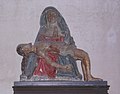 The pieta in the church


Notable people linked to the commune
- Charles Ganilh (1758–1836), economist, was born in Allanche.


