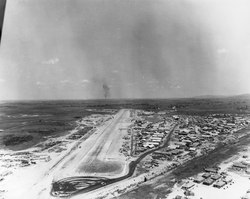
An Hòa Combat Base (also known as Đức Dục) is a former U.S. Marine Corps and Army of the Republic of Vietnam (ARVN) base west of Hội An in Quảng Nam Province, Vietnam.
The base was located approximately 28km west of Hội An and 4km west northwest of the Mỹ Sơn temple complex, near to the Tỉnh Yên River (Thu Bồn River) and the An Hòa industrial complex.[1]
Marines waiting to board HMM-164 helicopters at An Hòa in 1968
In August 1966 the Marines completed the construction of the MSR (main supply route) between Da Nang and An Hòa, naming it the "Liberty Road".[2]:209 It was decided that a bridge would be built to shorten the route. From April to September 1967 Seabees of Mobile Construction Battalion 4 built a 2,040 feet (620m) "Liberty bridge" (Tự Do bridge, now the Giao Thủy bridge) over the Thu Bồn river.[3]
The airfield was capable of handling C-7, C-123 and C-130 aircraft.[1]
On the night of 21 November 1968, a PAVN/VC battalion attacked the base. Supported by fire from 82mm and 60mm mortars, 57mm recoilless rifles and B-44 rockets, PAVN and VC troops advanced against the base's eastern perimeter. When the attack began at 22:00, Marine tank and artillery crews on the perimeter began direct fire against the advancing PAVN/VC, using Beehive anti-personnel rounds. Amphibian tractors arrived and added the weight of their machine guns to the battle. Combined Action Platoon (CAP) 2-9-1, positioned in the hamlet of Mau Chanh (2), about a kilometer east of the base, lay in the path of the attack. The CAP Marines and their South Vietnamese Popular Force (PF) counterparts took the PAVN/VC flanks and rear under fire, calling for air and artillery support. At 23:30, the PAVN/VC troops fell on CAP 2-9-1. AC-47 gunships held back the PAVN/VC while a platoon of Marines mounted in amphibian tractors, with tanks and helicopter gunships escorting, attacked east from An Hoa to reinforce the hamlet and bring an ammunition resupply. The battle raged for five hours, during which the Marines threw back four attack waves. At 03:30 the shooting died down. Despite the heavy fighting, friendly casualties numbered only three Marines and a PF with minor wounds. Marine sources listed 21 dead PAVN/VC in the area.[4]
Marine PFC Dan Bullock, the youngest American serviceman killed in action in the Vietnam War died at An Hòa on 7 June 1969.
The base is abandoned and has reverted to jungle. Remains of the runway can still be seen.
References
12Kelley, Michael (2002). Where we were in Vietnam. Hellgate Press. p.10. ISBN978-1555716257.
12345Shulimson, Jack (1982). U.S. Marines in Vietnam: An Expanding War 1966. History and Museums Division, Headquarters, U.S. Marine Corps. ISBN978-1494285159. This article incorporates text from this source, which is in the public domain.
↑Cosmas, Graham (1988). U.S. Marines in Vietnam: Vietnamization and Redeployment 1970–1971. History and Museums Division, Headquarters, U.S. Marine Corps. p.102. ISBN978-1482384123. This article incorporates text from this source, which is in the public domain.