Anchylorhynchus
From Wikipedia, the free encyclopedia
| Anchylorhynchus | |
|---|---|
 | |
| A. aegrotus (female) | |
Scientific classification  | |
| Kingdom: | Animalia |
| Phylum: | Arthropoda |
| Class: | Insecta |
| Order: | Coleoptera |
| Suborder: | Polyphaga |
| Infraorder: | Cucujiformia |
| Family: | Curculionidae |
| Tribe: | Derelomini |
| Genus: | Anchylorhynchus Schönherr, 1836 |
| Type species | |
| Anchylorhynchus variabilis Gyllenhal, 1836 | |
Anchylorhynchus is a genus of weevils belonging the family Curculionidae and subfamily Curculioninae. It currently includes 25 described species distributed from Panama to Argentina.[1][2] Members of the genus are pollinators of palms in the genera Syagrus, Oenocarpus and Butia, with adults living in inflorescences and larvae feeding on developing fruits. The first instar larvae of Anchylorhynchus have an unusual morphology, being specialized on killing other larvae infesting the palm fruits.
Anchylorhynchus can be readily distinguished from other Derelomini by a number of features.[3][4] The body is round, convex, and densely covered by scales varying from yellow to black. The rostrum is flattened dorso-verntrally at the apex, and exhibits 2-7 longitudinal grooves from the base of the rostrum to the insertion of antennae. The antennal funicle (segments excluding the first and the club) has only six segments, as opposed to seven segments in other genera. The antennae are inserted at the apex of the rostrum in both sexes, while it is inserted closer to the base in most other Curculionidae (at least in females).
Species of Anchylorhynchus are sexually dimorphic, with males usually being larger than females. In some species, males also have longer tarsi, and/or denser and longer hairs in the ventrites, metasternum and tarsi. In all described species, females have a retraction in ventrites III-IV of the abdomen. The shape and degree of retraction varies between species, but these segments are always flat in males.
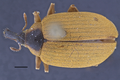 A. vanini, female, dorsal
 A. vanini, female, ventral
 Color polymorphism in A. eriospathae


Larval morphology and behavior
Larvae of Anchylorhynchus go through 4 stages (instars) before molting into a pupa. The most distinctive stage is the first instar. First-instar larvae of Anchylorhynchus are unique in Curculionidae due to their falcate mandibles (usually found in insects that feed on other insects). Additionally, they are flattened dorso-ventrally, living between sepals and petals of female palm flowers. After hatching, larvae migrate to the base of the female flower, drilling a hole into the developing fruit. After entering the fruit, larvae molt and start consuming plant tissues, causing abortion of developing fruits. First- and second instar larvae attack and consume other larvae upon encountering them. Later instars avoid other larvae and are not aggressive. Starting on the second instar, larvae acquire the grub-like, cylindrical and C-shaped body characteristic of other Curculionidae. The mandible also changes its shape, becoming triangular and broad, adapted to crush plant tissues.[5]
 First-instar larva
 Fourth-instar larva


