Andrena bicolor
From Wikipedia, the free encyclopedia
| Andrena bicolor | |
|---|---|
_bicolor_(female)_-_Flickr_-_S._Rae.jpg) | |
| Female | |
_bicolor_(male)_-_Flickr_-_S._Rae.jpg) | |
| Male | |
Scientific classification  | |
| Domain: | Eukaryota |
| Kingdom: | Animalia |
| Phylum: | Arthropoda |
| Class: | Insecta |
| Order: | Hymenoptera |
| Family: | Andrenidae |
| Genus: | Andrena |
| Species: | A. bicolor |
| Binomial name | |
| Andrena bicolor Fabricius, 1775 | |
| Synonyms[2] | |
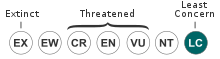
Andrena bicolor, or Gwynne's mining bee, is a common and widespread Western Palearctic mining bee which is found over most of Europe as well as North Africa and the Middle East and which reaches eastwards into Siberia.
Andrena bicolor is a small to medium-sized mining bee, with the males being slightly smaller than the females. The females have a coat of reddish-brown hairs on the dorsal surface of the thorax, a wholly black-haired face and indistinct bands of yellowish hairs on the margins of the first to third tergites. The spring brood can show an extensive black hair covering on the femur and the sides of the thorax, this is not as marked in the autumn brood. It has dark tibia on the hind legs[3] but these have obvious orange hairs which have been said to resemble a pair of orange leg warmers.[4] The spring brood males have black hairs on the head and side of the thorax and lack the bright colours of the females, while summer brood males often show brown hairs on the face and have no black hairs on the side of the thorax.[3]