Angelic Salutation (Stoss)
From Wikipedia, the free encyclopedia

_03.JPG)
Angelic Salutation (German: Engelsgruß) is an assemblage of life-sized limewood sculptures celebrating the Annunciation by the late-Gothic German artist Veit Stoss. It was commissioned in 1517 by Anton II Tucher and completed the following year. Tucher was a high ranking official in Nuremberg in southern Germany, and donated the work to the medieval church of St. Lorenz (or St. Lawrence) in Nuremberg, where it still freely suspended on a metal chain in the center of the choir, facing the high altar.[1]
The sculptures are dominated by the life-sized figures of Virgin Mary and Archangel Gabriel, from whom the work takes its name.[2] They are suspended within a circular frame resembling a wreath of roses, that represent the rosary of the Annunciation. Angelic Salutation' is widely regarded as Stoss' masterpiece.[3] Mary and Gabriel are surrounded by a series of small angels, many of whom are ringing bells or playing musical instrument.[4] The statues are suspended within the encircling frame of a wreath of roses embedded with eight medallions illustrating scenes from both the Life of the Virgin and Life of Christ.[4]
Stoss created a large gilded crown to hang over the frame, but this is now lost. Tucher commissioned craftsman Jakob Pulmann to design and install an iron candelabra holding a miniature statue of Mary in order to illuminate Stoss's work.[4]
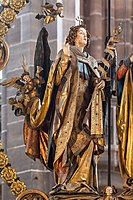 Gabriel
 Mary
Mary


