Anisota virginiensis
Species of moth
From Wikipedia, the free encyclopedia
Anisota virginiensis, the pink-striped oakworm moth, is a species of silk moth of the family Saturniidae.

| Anisota virginiensis | |
|---|---|
| |
| Southern pink-striped oakworm moth, female (left) and male | |
Scientific classification  | |
| Kingdom: | Animalia |
| Phylum: | Arthropoda |
| Clade: | Pancrustacea |
| Class: | Insecta |
| Order: | Lepidoptera |
| Family: | Saturniidae |
| Genus: | Anisota |
| Species: | A. virginiensis |
| Binomial name | |
| Anisota virginiensis (Drury, 1773) | |
| Synonyms | |


Description
Habitat
Biology
Females release a pheromone which attracts males that swarm around her like bees. Mating occurs during the morning.[4] It is a rapid process. The male and female stay together for the rest of the day and then the female finds a place to lay eggs, usually under oak leaves.[4] Such mating swarms have been observed at carrion, where host plants may be higher quality due to the influx of nutrients associated with decomposition.[6]
The caterpillars are gray or greenish with dull brownish yellow or rosy stripes. There are scales on each segment and two long spines on the mesothorax.[3] The caterpillars pupate for a short time.[4] They feed on the foliage of oak trees, maples, birches, and hazels. The caterpillar overwinters in the soil as a pupa. Caterpillars that are newly hatched or are in the middle of growing feed in groups while those that are mature or nearly so feed separately.[7] The caterpillar is about an eighth of an inch long. The head is large in proportion to the body. The inside of the mouth is yellow. The legs are semi-translucent.[8]
Ecology
Life cycle gallery
 Mating
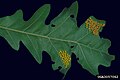 Eggs
Eggs Larvae feeding on Quercus texana
 Larva
Larva Pupa
Pupa


