Aporometra paedophora
From Wikipedia, the free encyclopedia
| Aporometra paedophora | |
|---|---|
_01.jpg) | |
| Aporometra paedophora | |
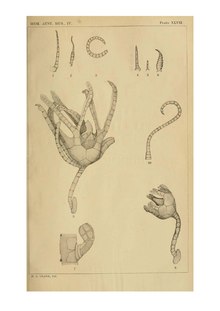 | |
| Aporometra paedophora Figs 4-10, Plate XLVII (HL Clark, 1909) | |
Scientific classification  | |
| Domain: | Eukaryota |
| Kingdom: | Animalia |
| Phylum: | Echinodermata |
| Class: | Crinoidea |
| Order: | Comatulida |
| Family: | Aporometridae |
| Genus: | Aporometra |
| Species: | A. paedophora |
| Binomial name | |
| Aporometra paedophora | |
| Synonyms[1] | |
| |
Aporometra paedophora is a marine invertebrate, a species of crinoid or feather star in the family Aporometridae. It was first found at a depth of 22 fathoms (40 m) off the Manning River on the New South Wales coast.[2] Other specimens were found off the coast of Bunbury, Western Australia at depths between 9 and 15 m (but these have since been identified as Aporometra wilsoni).[3] Based on morphological evidence of four (somewhat degraded) specimens of A. paedophora (all paratypes), Helgen & Rouse believe that this may not be a separate species from Aporometra wilsoni.[3]
Plate XLVII shows three types of pinnules: first, second and distal pinnules (Figs 4–6), and pentacrinoid larvae (Figs 7–9) from youngest to oldest. Fig 10 shows a cirrus.[2] In the earliest free-swimming stage, the arms are about 7 mm long and have about nine pinnules on each side.[2] This is a small species of crinoid with arms up to 3 cm (1.2 in) long. All Clark's large specimens carried pentacrinoid larvae attached to their pinnules.[2]
Distribution
This crinoid is endemic to temperate Australian waters,[3] and apparently found only off the Manning River, in New South Wales.[3]
