Architecture of Delhi
From Wikipedia, the free encyclopedia
The architecture of Delhi dates back more than a thousand years. As the capital of several empires of India, including the Rajput kingdom, Delhi Sultanate, Mughal Empire, and British Raj, the city of Delhi has been a centre for art and architecture.


The few surviving structures from before the Delhi Sultanate period include Agrasen ki Baoli, Surajkund reservoir, Lal Kot and Qila Rai Pithora. There were several temples built during this period, remnants of which are still present in Qutb complex. These were built by the Tomaras and Chahamans (Chauhans) Rajput dynasties.[1][2][3][4]
Delhi Sultanate
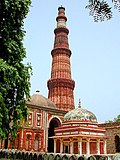 The Qutub Minar is the world's tallest brick minaret at 72.5 metres, built by Qutb-ud-din Aibak of the Slave dynasty in 1192 CE.[5]
 Alauddin Khilji's madrasa and Tomb in the Qutb complex.
 Tomb of Ghiyasuddin Tughluq within the Tughlaqabad Fort.
 Jahaz Mahal is built during the Lodi dynasty period (1452–1526) as a pleasure resort.
 Shish Gumbad in Lodhi garden, New Delhi


The Delhi Sultanate ruled the city between 1206 and 1526. Their rule saw the development of early Indo-Islamic architecture, the most prominent being the Qutb Minar complex, a group of monuments surrounding the Qutb Minar. This period also saw building of many forts and cities like Siri Fort, Tughlaqabad and Feroz Shah Kotla. Many tombs were built around this period which are still present in many locations like Qutb Minar complex, Hauz Khas Complex and Lodi Gardens.
Mughal Empire
 The Red Fort was commissioned by Mughal Emperor Shah Jahan in the 17th century, it was the main residence of the Mughal emperors for nearly 200 years.[6]

 The Jama Masjid is one of the largest mosques in India.


Mughal Architecture emerged as a form of Indo-Islamic architecture during the rule of the Mughal Empire. Mughal architecture is characterized by large bulbous onion domes, the use of white marble and red sandstone, delicate ornamentation work, and large buildings surrounded by gardens on all four sides.
The Humayun's Tomb is the first notable example of Mughal architecture in Delhi. Except for a few architectures like Humayun's Tomb and Purana Qila, most of the architectural work of this period was done in Shah Jahan's time or later. This period also saw building of 18th century Astronomical Observatory called Jantar Mantar.
Another important achievement of this period was building of Mughal gardens. Its design was inspired by Persian Char Bagh Gardens. Some gardens built during Mughal period are garden built in front of Humayun's Tomb, Roshanara Bagh, Qudsia Bagh and Garden built in Safdarjang's tomb complex.


.jpg)


