Argentine painting
From Wikipedia, the free encyclopedia
.jpg)
Argentina has a rich history of different types of art, which has changed throughout the centuries to become what it is today.
An Argentine painting refers to all the pictorial production done in the country of Argentina throughout the centuries.
Cueva de las Manos (Cave of the Hands), in Patagonia, Argentina, is an example of one such work. It has been declared a World Heritage Site by the UNESCO.[1] Other important prehistoric artwork is located in the north of Córdoba. A collection of more than 35,000 pictographs (one of the densest collections of such images in the world) is found in the hills of Colorado, Veladero, Intihuasi and Unmount.
More recently, the pre-Hispanic cultures that inhabited the present territory of Argentina left a number of pictorial records. In the Andean northeast, the Ceramic Period cultures, from the Condorhuasi culture (400 BCE–700 CE) to the La Aguada (650–950 CE) and Santa María (1200–1470 CE), show a comprehensive development in the painting of ceramics and stone.

 Feline Warrior (650-950 D.C.)
La Aguada Culture


Colonial painting
During the Spanish colonial era, painting developed primarily as a religious art in churches, designed to Christianize indigenous peoples. Colonial-era religious painting was often done by forced indigenous artists and African slaves under the power of the religious orders.
Colonial painting is also seen in the books and manuscripts made by colonists, priests, scientists, and visitors. Notable among these are the drawings and watercolors of the German Jesuit Florian Paucke (1719–1789).
In what is now northwest Argentina, especially in Jujuy, the Cuzco School developed in the churches, with its images of ángeles arcabuceros (angels armed with Spanish colonial muskets) and triangular virgins (a syncretism of the cult of the Virgin Mary and the Pachamama).
 Taking honey down (1749–1767)
Florián Paucke Military Angel (18th Century)
Mateo Pisarro


Nineteenth century
In the first years of the 19th century, many foreign artists visited and resided in Argentina, leaving their works. Among them were English mariner Emeric Essex Vidal (1791–1861), a watercolorist who left important graphic evidence of Argentine history; French engineer Carlos E. Pellegrini (1800–1875), who was devoted to painting out of necessity and who would be the father of president Carlos Pellegrini; the mariner Adolfo D'Hastrel (1805–1875), who published his drawings and watercolors in the book Colección de vistas y costumbres del Río de la Plata (1875); and lithographer César Hipólito Bacle (1790–1838).
In the 1830s, Carlos Morel (1813–1894), considered the first strictly Argentine painter, came to prominence. Soon after followed Prilidiano Pueyrredón (1823–1870) and Cándido López (1840–1902), who painted the life of gauchos and the wars of premodern Argentina.
In the middle of the 19th century the first Argentine artistic institutions began to be organized. These included La Sociedad Estímulo de Bellas Artes and El Museo Nacional de Bellas Artes, whose first director was the painter Eduardo Schiaffino. The great wave of European immigration (1870–1930) established a strong relationship to European painting, mainly through Italian painters or children of Italians. Eduardo Sívori (1847–1918) introduced naturalism with works such as El despertar de la criada, followed by painters like Reinaldo Giudici (1853–1927) and Ernesto de la Cárcova (1866–1927), Ángel Della Valle (1852–1903) developed a painting movement depicting the customs of the countryside, with works like La vuelta del malón.
 Battle of the Cavalry in the Time of Rosas (1830)
Carlos Morel Disembarkation of Allied Troops (ca. 1860)
Cándido López Field Foreman and Laborer (1864)
Prilidiano Pueyrredón The Soup of the Poor (1884)
Reinaldo Giudici The Awakening of the Maid (1887)
Eduardo Sívori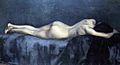 The repose (1889)
Eduardo Schiaffino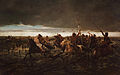 The Return of the Malón (1892)
Ángel Della Valle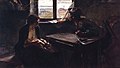


.jpg)


.jpg)

_-_Google_Art_Project.jpg)


(1).JPG)

_-_Mural_Quinquela_Martín.JPG)
