Arithmetic zeta function
From Wikipedia, the free encyclopedia
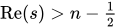
In mathematics, the arithmetic zeta function is a zeta function associated with a scheme of finite type over integers. The arithmetic zeta function generalizes the Riemann zeta function and Dedekind zeta function to higher dimensions. The arithmetic zeta function is one of the most fundamental objects of number theory.
The arithmetic zeta function ζX (s) is defined by an Euler product analogous to the Riemann zeta function:
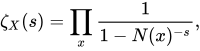
where the product is taken over all closed points x of the scheme X. Equivalently, the product is over all points whose residue field is finite. The cardinality of this field is denoted N(x).
Examples and properties
Varieties over a finite field
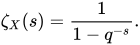
If X is the spectrum of a finite field with q elements, then
For a variety X over a finite field, it is known by Grothendieck's trace formula that

where is a rational function (i.e., a quotient of polynomials).

Given two varieties X and Y over a finite field, the zeta function of is given by


where denotes the multiplication in the ring of Witt vectors of the integers.[1]


Ring of integers
If X is the spectrum of the ring of integers, then ζX (s) is the Riemann zeta function. More generally, if X is the spectrum of the ring of integers of an algebraic number field, then ζX (s) is the Dedekind zeta function.
Zeta functions of disjoint unions
The zeta function of affine and projective spaces over a scheme X are given by
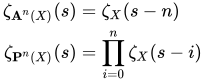
The latter equation can be deduced from the former using that, for any X that is the disjoint union of a closed and open subscheme U and V, respectively,

Even more generally, a similar formula holds for infinite disjoint unions. In particular, this shows that the zeta function of X is the product of the ones of the reduction of X modulo the primes p:
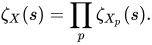
Such an expression ranging over each prime number is sometimes called Euler product and each factor is called Euler factor. In many cases of interest, the generic fiber XQ is smooth. Then, only finitely many Xp are singular (bad reduction). For almost all primes, namely when X has good reduction, the Euler factor is known to agree with the corresponding factor of the Hasse–Weil zeta function of XQ. Therefore, these two functions are closely related.